Select one or more regions of interest
by clicking on the filter elements
Drag the filter elements horizontally,
and select one or multiple
thematic areas of interest.
1500 Pilot Demo Farms are Engaged to Implement Climate Smart Farming Practices and Share their Experiences in the Climate Farm Demo Network
Europe
All zones
Benefits of the practice
2. Increased visibility of these practices towards farmers
3. A solid demonstration network available to advisors and farmers beyond the project end
An EU-wide network of 1460 pilot demonstrations farms have been set up to accelerate the adoption of Climate Smart Farming (CSF) practices. The network covers 26 EU countries and 4 pedo-climatic areas in Nordic, oceanic, continental and mediterranean clusters. A diversity of agricultural sectors is represented, ranging from animal husbandry and mixed farming systems to specialised arable and horticulture crops, including organic farms. The aim of the Climate Farm Demo network is to:
⦁ increase implementation of climate adaptation and mitigation measures on European farm
⦁ organise 4,500 on-farm demo events reaching 150,000 farmers
⦁ engage 250,000 actors in peer-to-peer learning activities
The farmers will be supported in their endeavours by a Climate Farm Advisors. At the start of the project each Pilot Demo Farm was audited for its climate impact. Based on the audit results, the Climate Farm Advisors and farmers developed a climate adaptation and mitigation plan, which set the course for implementing climate smart farming practices during the project lifetime. Each year, the farm’s progress will be evaluated, and the plans will be updated. In a period of 6 years, each farm will organise 3 demonstration events to showcase their experiences with the implementation of climate smart farming practices with a broader audience of farmers and other stakeholders.
The farms in the network can be consulted on a map on the project’s webpage. Farms can be filtered on country, farm type, production system and the thematic areas they are taking measure in. The map is an interesting tool be used by any organisation or person interested in visiting farms engaged in the implementation of climate smart farming practices in their own country or abroad. In this way, the network aims to connect to wider audience outside the consortium.
An EU-wide network of 1460 pilot demonstrations farms have been set up to accelerate the adoption of Climate Smart Farming (CSF) practices. The network covers 26 EU countries and 4 pedo-climatic areas in Nordic, oceanic, continental and mediterranean clusters. A diversity of agricultural sectors is represented, ranging from animal husbandry and mixed farming systems (65% of the farms in the network) to specialised arable (18%) and horticulture crops (17%), including organic farms (28%). The aim of the Climate Farm Demo network is to:
• increase implementation of climate adaptation and mitigation measures on European farm
• organise 4,500 on-farm demo events reaching 150,000 farmers
• engage 250,000 actors in peer-to-peer learning activities
The number of farms per country, differs according to the total carbon emissions produced by agricultural activities in each country. Countries with high emissions (Germany, France, UK, Poland, Spain, and Italy) have recruited approximately 130 farms. Countries with middle high emissions(Belgium, Greece, Ireland, The Netherlands, Romania) recruited approximately 60 farmers. The countries with low emissions recruited 25farms. The network consists of both commercial pilot demo farms and experimental farms. Out of this group of pilot demonstration farms, a lighthouse farm network will be developed (see Practice Abstract #4).
The farmers will be supported in their endeavours by a Climate Farm Advisors. At the start of the project each Pilot Demo Farm as audited for its climate impact. Based on the audit results, the Climate Farm Advisors and farmers developed a climate adaptation and mitigation plan, which sets the course for implementing climate smart farming practices in the coming year. The farms show interest in a wide variety of thematic areas, ranging from energy management, over forage production to agroforestry and landscape management. Each year, the farm’s progress towards climates mart farming will be evaluated and the plans will be updated. In a period of 6 years, each farm will organise 3 demonstration events to showcase their experiences with the implementation of climate smart farming practices with a broader audience of farmers and other stakeholders.
The farms in the network can be consulted on a map on the project’s webpage. Farms can be filtered on country, farm type, production system and the thematic areas they are taking measure in. The map is an interesting tool be used by any organisation or person interested in visiting farms engaged in the implementation of climate smart farming practices in their own country or abroad. In this way, the network aims to connect to wider audience outside the consortium.
GEEP - An Environmental Assessment Tool for Pig Farming in France
France
Temperate Climate
Benefits of the practice
- Environmental assessment of pig farming
- Good environmental practices
- Decision-making tool
Production system(s)
Thematic Area(s)
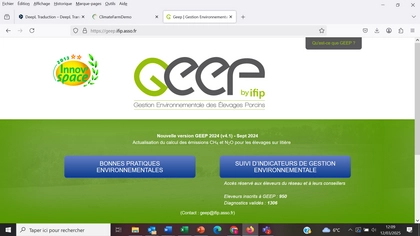
Since 2014, IFIP (the French technical institute for the pig industry) has been providing French pig farmers with the GEEP calculation tool to assess the environmental performance of their workshops. GEEP is also a network of over 900 pig farmers and around 130 advisors. The environmental balance sheet is based on nine quantitative indicators covering the consumption of natural resources (water and energy), emissions (nitrogen and phosphorus), gaseous emissions (ammonia and greenhouse gases), and waste production. These indicators are calculated using the environmental flows from the farm divided by the kilograms of pigs produced on the farm (e.g., kg of NH₃ per kg of pigs produced).
For greenhouse gas emissions, the scope considers the entire pig production cycle using an LCA (life cycle assessment) approach, with the indicator expressed per kg of live weight. This type of indicator enables farmers to compare their performance with other farms in the same sector and collective benchmarks. GEEP is connected to the national technical-economic database managed by IFIP, which saves time when entering individual data and ensures the robustness of the information.
This tool is sensitive to several levers for reducing greenhouse gas emissions. Farmers can enter the formulation of the feed they use, selecting the raw feedstuffs and their origin to calculate the feed’s carbon footprint as accurately as possible. It incorporates several best practices in the effluent management chain, including the frequency of effluent evacuation from buildings, different storage methods, and methanization. The results also consider the technical performance of each physiological stage. GEEP is a comprehensive tool designed to support farmers in their efforts toward continuous improvement.
Depuis 2014, l’IFIP (institut technique de la filière porcine) met à disposition des éleveurs de porcs français, l’outil de calcul GEEP, pour évaluer les performances environnementales de leur atelier. GEEP c’est aussi un réseau qui regroupe plus de 900 éleveurs porcins et environ 130 conseillers. Le bilan environnemental s’appuie sur 9 indicateurs quantitatifs portant sur les consommations de ressources naturelles (eau et énergie), les rejets (azote et phosphore), les émissions gazeuses (ammoniac et gaz à effet de serre) et la production de déchets. Ces indicateurs sont calculés avec les flux environnementaux de l’élevage divisés par les kilogrammes de porc générés sur l’élevage (ex : kg de NH3/ kg de porc produit).
Pour les émissions de gaz à effets de serre, le périmètre prend en compte l’ensemble du cycle de production de porc dans une approche par ACV (analyse de cycle de vie), l’indicateur est alors exprimé par kg de poids vif. Ce type d’indicateur permet aux éleveurs de se comparer à d’autres élevages de même orientation et de se positionner par rapport à des références collectives. GEEP est connecté à la base nationale de données technico-économiques gérée par l’IFIP, ce qui représente un gain de temps pour la saisie des données individuelles et un gage de robustesse de l’information. Cet outil est sensible à de nombreux leviers de réduction d’émissions de GES. L’éleveur peut renseigner la formulation de l’aliment consommé en choisissant les matières premières et leur origine, pour calculer au plus juste l’empreinte carbone de celui-ci. Il intègre de nombreuses bonnes pratiques sur la chaine de gestion des effluents : fréquence d’évacuation des effluents au bâtiment, différentes modalités de stockage, méthanisation… Les résultats prennent également en compte les performances techniques de chaque stade physiologique. GEEP est un outil complet pour accompagner l’éleveur dans une démarche d’amélioration continue.
In France, decarbonization is becoming increasingly important in pork production due to the environmental labeling of consumer products and the Low Carbon Label launched by the French Ministry for Ecological Transition. The Low Carbon Label offers the prospect of remuneration for pig farmers’ efforts to reduce their greenhouse gas emissions, provided they follow a sector-specific method validated for pig farming by the Ministry.
Supporting Pig Farms in Achieving National Low-Carbon Objectives
France’s national low-carbon strategy (SNBC) sets a target of reducing greenhouse gas emissions from agriculture by 46%.
Simulations show that an average farrow-to-finish farm with 250 sows could reduce its greenhouse gas emissions by 2% to 25% over the pig’s life cycle, depending on the mitigation measures implemented. This reduction would amount to several dozen to several hundred tonnes of CO₂ avoided per year.
To reward these efforts, a Low Carbon Label method has been developed specifically for pig farms. It is largely based on the GEEP evaluation method, with a more detailed assessment of greenhouse gas emissions in two key areas:
• Feed formulation: Whether purchased or produced on the farm, this method allows for the substitution of imported raw materials linked to deforestation and the processing of co-products.
• Effluent methanization: A more detailed assessment is conducted, considering different models such as psychrophilic methanization, co-generation, injection, and autonomous or collective units.
GEEP’s sensitivity to various climate change mitigation levers makes it a valuable tool for supporting the decarbonization of pig farms. As a result, GEEP has been selected for two European projects—Climate Farm Demo and Climate Smart Advisors—which, over six years, aim to assist pilot farms in developing climate change mitigation and adaptation plans. These efforts will serve as demonstrations for large-scale implementation in the field.
GEEP: A Constantly Evolving Tool to Meet User Needs
GEEP’s reference databases and calculation rules for gaseous emissions are continuously updated to incorporate the latest developments. It also adapts to user needs. Since 2023, it has allowed farmers to enter the detailed formulation of the feed used, ensuring alignment with actual on-farm practices and enabling precise calculations of the carbon impact of purchased feed.
To disseminate information and understand user expectations, several meetings are organized annually with the network of advisors.
How Can Methane Emissions from Ruminants be Reduced?
Europe
All Zones
Benefits of the practice
- Enteric methane
- Methane emission reduction
- Feed additives
Production system(s)
Thematic Area(s)
Methane (CH₄) comes from the digestion of feed in the rumen, where specialized microbes (methanogens) convert certain components of the diet into methane, which is then eructated into the air. Eructated methane is one of the main sources of greenhouse gases in agriculture.
There are several scientifically documented and effective ways to reduce the methane emitted by ruminants:
⦁ Feed: Changing the ruminant diet can influence CH₄ production. For example, introducing feed supplements such as fats or tannins or using more digestible feed can reduce methane emissions.
⦁ Genetic selection: There are individual variations in methane production among animals, making it possible to select those that emit less methane. In the long term, this could help reduce herd-wide emissions.
⦁ Feed additives: These prevent CH₄ production in the rumen. While highly effective, they require regular distribution in the feed, which can be challenging for grazing livestock.
⦁ New technologies: Research is underway on vaccines targeting methane-producing microbes and devices that capture methane directly from the animals’ noses. These approaches are still experimental but could provide complementary solutions in the future.
Reducing CH₄ emissions must not compromise the profitability of livestock farming or its role in global food production. The feasibility of solutions varies depending on farming systems, economic conditions, and available infrastructure. To have a real large-scale impact, multiple solutions must be combined while ensuring they remain accessible and practical for farmers.
In conclusion, reducing methane emissions requires better feed management, genetic selection, the use of feed additives, and technological innovation. This must be supported by policies that promote sustainable practices while preserving the economic sustainability of farms.
Le méthane des ruminants provient de la digestion des aliments dans le rumen, où des microbes spécialisés (les méthanogènes) transforment certains composants de la ration en méthane, qui est ensuite rejeté dans l’air par éructation. Le méthane éructé constitue une des principales sources de gaz à effet de serre en agriculture. Il est donc essentiel de trouver des solutions pour limiter ces émissions sans compromettre la production et le bien-être des animaux.
Les stratégies existantes pour réduire les émissions de méthane
Plusieurs leviers d’action sont scientifiquement documentés et efficaces pour réduire le méthane émis par les ruminants :
L’alimentation : modifier la ration peut influencer la production de méthane. Par exemple, introduire certains additifs comme les matières grasses ou les tannins, ou privilégier des aliments plus digestibles peut permettre de réduire les émissions.
La sélection génétique : il existe des variations individuelles dans la production de méthane des animaux qui permettent de sélectionner des animaux qui émettent moins. Cela pourrait, à long terme, permettre de réduire les émissions à l’échelle du troupeau.
Les compléments alimentaires anti-méthane : certains compléments bloquent directement la production de méthane dans le rumen. Ces solutions sont très efficaces mais nécessitent une distribution régulière dans l’alimentation, ce qui peut être compliqué dans les élevages au pâturage.
Les nouvelles technologies : des travaux sont en cours sur des vaccins ciblant les microbes producteurs de méthane ou des dispositifs captant le méthane directement à la sortie du nez des animaux. Ces approches sont encore expérimentales mais pourraient offrir des solutions complémentaires dans le futur.
Quels défis pour l’avenir ?
La réduction des émissions de méthane ne doit pas compromettre la rentabilité des élevages ni leur rôle dans la production alimentaire mondiale. La faisabilité des solutions varie selon les systèmes d’élevage, les conditions économiques et les infrastructures disponibles. Pour avoir un impact réel à grande échelle, il faudra combiner plusieurs stratégies et s’assurer qu’elles restent accessibles aux éleveurs et pratique dans leur utilisation.
En conclusion, la lutte contre les émissions de méthane passe par une meilleure gestion de l’alimentation, la sélection génétique, l’utilisation de compléments alimentaires et l’innovation technologique. Ces efforts doivent s’accompagner de politiques de soutien pour encourager les pratiques durables tout en maintenant la durabilité, y compris économique, des exploitations agricoles.
Roques et al. published a comprehensive paper in 2024 in the Annual Review of Animal Biosciences titled: “Recent Advances in Enteric Methane Mitigation and the Long Road to Sustainable Ruminant Production.”
Main Strategies and Their Mechanisms for Reducing Methane Emissions in Ruminants
• (a) Herd Level: Methane emissions are reduced by breeding low emitting animals, either through direct selection or genomic selection based on methane-related genetic traits.
• (b) Dietary Strategies: Methane is reduced by increasing digestibility, accelerating passage rates, or bypassing the rumen to limit nutrient availability for microbes.
• (c) Rumen-Level Strategies: Mitigation occurs by inhibiting hydrogen-producing microbes, shifting the methanogenesis substrate, or directly inhibiting methanogens.
• (d) Targeted Strategies: These approaches reduce methane emissions by inhibiting key enzymes in the methanogenesis pathway or directly affecting methanogens’ viability.
[Abbreviations: CNSL – cashew nutshell liquid; 3-NOP – 3-nitrooxypropanol]
The individual variation in enteric methane emissions observed among animals under identical feeding and management conditions suggests the potential for breeding low-emission cattle and sheep. To achieve this, animals with genetic potential for lower methane emissions must be identified and selected. The heritability of methane production(0 = no impact, 1 = extreme impact) ranges from 0.13 to 0.29 in sheep and 0.11 to 0.45 in dairy cattle.
Dietary Strategies and Methane Mitigation
Dietary strategies modulate methanogenesis in two ways:
1. By influencing the production of substrates used by methanogens
2. By directly affecting methanogens themselves
The key dietary factors affecting the rumen ecosystem include:
• Feed digestibility (positively correlated with methane emissions)
• Fermentation products
• Rumen pH
Replacing carbohydrates with lipids in ruminant diets effectively reduces absolute methane emissions. However, dietary and management strategies at the herd level provide an average mitigation effect of 18%, while the global reduction remains much lower (<10%) due to adoption rates and economic challenges.
Most strategies reduce the emission intensity of ruminant-based products, but overall emissions would decrease only if ruminant numbers were reduced. In contrast, strategies that specifically target methanogens and the methanogenic pathway have been shown to effectively reduce emissions, often with limited negative effects on the rumen microbial ecosystem. These strategies include feed additives, some of which are now commercially available in certain countries.
Advisors Supporting Farmers in Climate Action
Europe
All Zones
Benefits of the practice
- Farmer Engagement: Higher adoption of mitigation and adaptation practices.
- Advisor-Farmer Connection: Strengthened relationships and trust.
- Advisor Benefits: Increased job satisfaction and professional fulfillment.
Production system(s)
Thematic Area(s)
The Climate Farm Demo Top Tips for advisors supporting farmers in the uptake of climate mitigation and adaptation measures are listed below:
Get to know the farmers you are trying to influence. A range of factors, such as age, access to finance and attitude towards risk, impact the willingness of farmers to change their farming practices. Don’t forget the personal touch – make the connection with the farmer, and their family. And most importantly, listen to the farmer’s arguments, fears and wishes.
Highlight the positives including good practices and the progress made by the farmer, without being afraid of calling out the areas for improvement.
Keep it simple. Farmers need to know that the recommended solutions are backed up by science, that the new approaches work to reduce GHG emissions…but don’t necessarily need to know all the scientific details.
Frame your messages carefully, highlighting the benefits to the farmer (profitability, productivity, work-life balance) of adopting climate mitigation or adaptation measures. Farmers tend to implement climate-beneficial measures due to other farm-related benefits.
Always prepare before meeting with the farmer. Use available benchmarking tools/ GHG assessment tools to understand the farm’s current GHG emissions profile. Review other available farm performance data also.
Provide ongoing support through (short) visits, phone consultations, membership of a WhatsApp group, emails, invitations to events etc.
Facilitate farmer-to-farmer learning. Farmer groups help farmers to identify solutions and solve problems, while allowing farmers to support one another. Consider forming a group of “like minded” farmers to discuss more sustainable farming practices or include the topic in existing group discussions.
Prepare for a long-time horizon: it may be a number of years before there are measurable environmental and economic outcomes. Also, tackle the adoption of one or two mitigation practices at a time…avoid identifying a list of actions to be taken.
Familiarise yourself with currently available rewards and incentives, available from the Government/ EU or from the marketplace. Be able to highlight what is required of the farmer to avail themselves of these.
Consider what else you can do to create an enabling environment that facilitates the farmer taking climate action.
How can an advisor best support a farmer as they implement climate mitigation and adaptation measures? A useful first step would be to increase the farmer’s awareness of the need for climate action, followed by the completion of a GHG audit, to establish the baseline farm GHG emissions. Once the audit is completed, the advisor and farmer can then identify areas for action and agree an action plan. Following this, it will be up to the farmer to implement the chosen actions, and for the advisor to continue to support the farmer in their transition. It is likely that advisors will work with farmers at different stages of the innovation-decision process and that the advisor’s role will change depending on where the farmer is during the process. Advisors will make an impact through a combination of advisory activities, focusing on relevant and user friendly content, which stimulates farmer learning and motivates their decision to apply new knowledge.
The Climate Farm Demo Top Tips for advisors supporting farmers in the uptake of climate mitigation and adaptation measures are listed below:
1. Get to know the farmers you are trying to influence. A range off actors, such as age, access to finance and attitude towards risk, impact the willingness of farmers to change their farming practices. Don’t forget the personal touch – make the connection with the farmer, and their family. And most importantly, listen to the farmer’s arguments, fears and wishes.
2. Highlight the positives including good practices and the progress made by the farmer, without being afraid of calling out the areas for improvement.
3. Keep it simple. Farmers need to know that the recommended solutions are backed up by science, that the new approaches work to reduce GHG emissions…but don’t necessarily need to know all the scientific details.
4. Frame your messages carefully, highlighting the benefits to the farmer (profitability, productivity, work-life balance) of adopting climate mitigation or adaptation measures. Farmers tend to implement climate-beneficial measures due to other farm-related benefits.
5. Always prepare before meeting with the farmer. Use available benchmarking tools/ GHG assessment tools to understand the farm’s current GHG emissions profile. Review other available farm performance data also.
6. Provide ongoing support through (short) visits, phone consultations, membership of a WhatsApp group, emails, invitations to events etc.
7. Facilitate farmer-to-farmer learning. Farmer groups help farmers to identify solutions and solve problems, while allowing farmers to support one another. Consider forming a group of “like minded” farmers to discuss more sustainable farming practices or include the topic in existing group discussions.
8. Prepare for a long-time horizon: it may be a number of years before there are measurable environmental and economic outcomes. Also, tackle the adoption of one or two mitigation practices at a time and avoid identifying a list of actions to be taken.
9. Familiarise yourself with currently available rewards and incentives, available from Government/ EU or from the marketplace. Be able to highlight what is required of the farmer to avail of these.
10. Consider what else you can do to create an enabling environment that facilitates the farmer taking climate action.
The Role of Soils for Climate Mitigation and Adaptation
Europe
All Zones
Benefits of the practice
- Improved soil fertility and long-term productivity
- Enhanced climate resilience and carbon sequestration
- Reduced GHG emissions through sustainable soil management
Production system(s)
Thematic Area(s)
Why Soils Matter
Arable soils are the foundation of farming across the EU, crucial for fertility, productivity, profitability, and long-term sustainability. Soils are now central to climate debates due to their role in reducing greenhouse gas (GHG) emissions and supporting resilient agriculture. Scientists are developing methods to quantify soil organic carbon (SOC) for climate mitigation, while policymakers explore carbon credit schemes. Farmers are increasingly interested in carbon farming as a potential income source.
Effects of Climate Change on Soils
Climate change poses challenges to soil health, including:
Increased erosion and nutrient leaching from heavy rainfall and extreme weather
Frequent waterlogging or droughts, impacting plant productivity
Greater pest pressure and altered microbial activity due to temperature changes
Faster decomposition of soil organic matter under warmer conditions
Negative impacts on soil structure and stability
Investing in soil health is essential to preserve ecosystems and maintain productivity.
How to Build Healthy and Fertile Soils
Building healthy soil takes time. Long-term studies, like Switzerland’s DOK trial, show that biodynamic and organic practices can sequester more SOC than conventional systems. Farmers can apply two strategies to stabilize or increase carbon in soils: (a) increase carbon inputs (e.g., cover crops, compost) and/or (b) reduce carbon losses (e.g., reduced tillage, rewetting peatlands).
Soil and Climate Goals
While SOC is often seen as a solution to the climate crisis, challenges remain—measuring, verifying, ensuring additionality, permanence, and addressing leakage and sequestration potential. SOC is not a simple fix, but carbon farming can increase farmer engagement and foster sustainable practices.
Balancing climate goals with other sustainability aspects supports the long-term health and fertility of soils.
Why Soils Matter
The foundation of most farms across the EU is their arable soils, along with their fertility and health. These factors regulate not only soil functions but also productivity, financial returns, and the long-term sustainability of production. In fact, 95% of the world’s food is either directly or indirectly produced on soils (1).
In recent years, arable soils have become an increasingly important focus in the climate debate. Their role in reducing greenhouse gas (GHG) emissions and supporting resilient agriculture across the EU is a topic of significant discussion. Scientists are working to develop methods that can accurately quantify soil organic carbon (SOC) to assess its potential as a climate mitigation solution. Policymakers are striving to integrate these findings into carbon credit schemes, while farmers are becoming increasingly interested in carbon farming as a potential source of income.
Effects of Climate Change on Soil Health, Fertility, and Carbon
The unavoidable effects of climate change will present new and additional challenges for farmers related to their soils:
• Erosion and nutrient leaching are likely to increase due to more intense and frequent rainfall, winds, and extreme weather events.
• Waterlogging or changing soil moisture caused by flooding or droughts will become more frequent, posing challenges to plant productivity.
• Increased pest and disease pressures due to changing temperature patterns.
• Higher rates of soil organic matter decomposition driven by warmer temperatures.
• Negative impacts on soil structure and stability (2).
Therefore, investing now in healthy and fertile soils is essential for farmers to preserve the ecosystem functions of arable soils and maintain crop productivity in the long term.
What Can Be Done to Build Healthy and Fertile Soils
Building healthy, fertile, and resilient soils takes time (3). Long-term experiments, such as the DOK trial in Switzerland, show that it takes many years to see the effects of certain management practices on SOC. These studies have demonstrated that biodynamic and organic farming practices may have greater potential to sequester SOC compared to conventional systems. Organic fertilizers, such as compost, farmyard manure, and cover crop systems, have been proven beneficial in stabilizing or increasing SOC(4). In general, farmers can focus on two approaches:
• Increasing carbon inputs (e.g., through cover crops, compost,organic manure, etc.)
• Reducing carbon losses (e.g., through reduced tillage, rewetting of peatlands, and similar practices) (5).
By adopting these methods, farmers can contribute to building and maintaining healthy, fertile soils over the long term.
Soils and Climate Goals
Currently, there are high expectations that SOC will provide a solution to the climate problem. However, scientific evidence indicates that relying on SOC as a definitive solution for achieving a climate-neutral Europe presents significant challenges. These include issues related to the measurement, verification, and reporting of SOC. Concerns arise from differences in soil carbon sequestration potential, additionality, permanence, and leakage effects (6).
As a result, expectations for soils as an easy fix for climate challenges need to be tempered. Nonetheless, carbon farming can serve as a starting point for advisory efforts and for farmers to engage with the topic of climate change. It can encourage constructive dialogue about potential adaptations to management practices that align with climate mitigation, adaptation, and broader sustainability goals.
It is crucial to emphasize: holistic solutions are needed ones that balance climate goals with other sustainability objectives, ensuring long-term soil fertility and the health of arable soils
The Key Role of the National Coordinator in a Project such as CFD: Scope and Limits of His/Her Tasks
Europe
European scale
Benefits of the practice
- European CSA project
- Intermediate management
The Climate Farm Demo (CFD) project promotes Climate Smart Farming Practices across 26 countries, involving 1,500 farmers and 250+ advisors. To ensure effective implementation, the project relies on National Coordinators (NCs), who serve as the crucial link between the European management team and national agricultural networks.
The NC’s main responsibilities include:
Facilitating smooth communication between the European team and national stakeholders.
Reporting challenges and progress from their country to the project management team.
Ensuring all project documents are accessible in the local language.
Managing the national network by organizing knowledge exchange events and maintaining advisor and farmer engagement.
Supporting and monitoring national partners in carrying out their expected tasks.
Expanding the project’s reach by engaging policymakers, researchers, and farmers through effective communication.
Contributing to policy development by working with national and regional authorities.
NCs may have expertise in specific agricultural fields, but they are not required to be specialists in all aspects of climate adaptation and mitigation. However, their role has certain limitations:
They do not have decision-making authority over national partners.
They cannot provide specialized training outside their expertise.
If solely acting as NCs, they are not directly responsible for audits, adaptation plans, or demonstration events.
Overall, NCs play a vital role in ensuring the project’s success by bridging communication gaps, supporting local stakeholders, and broadening the impact of climate-smart farming initiatives.
Climate Farm Demo (CFD) is a project that focuses on the deployment of Climate Smart Farming Practices by those working in the field, in this case farmers engaged in various production systems, accompanied by advisors.
The CFD project is deploying its scheme in 26 countries and with 1,500 farmers, accompanied by more than 250 advisors. To bring such a programme to life, it is essential to rely on an intermediary operational management link, the ‘National Coordinator’ (NC). The NC is essential, because he is familiar with the operating methods (the ‘codes’) of his country’s agricultural ecosystem and, of course, carries out his tasks in the local language!
The NCs are the ‘’ pivotal ‘’ links between the project’s management at global (European) level and the networks deployed in each of the countries(26 countries in the case of CFD). Their main roles are to:
• Ensure a fluid exchange between the team managing the project at European level and the deployment of national actions on the field(and make sure that all the documents made available within the project are accessible in a language that everyone in their country understands),
• Act as a link between the partners in its country (mainly advisory bodies and farmers) while managing the national network by organizing skill-building and knowledge exchange events and ensuring continued engagement among advisors and farmers,
• Contribute (under the responsibility of the project’s general management) to monitoring and supporting the tasks expected of the partners in his/her country throughout the project,
• Broaden the impact of the Climate Farm Demo project within his country by engaging a broader audience, including the farming and scientific communities, through suitable communication channels. Build relationships with national and regional policymakers and contribute to shaping the strategic plan for Policy Initiatives and Policies (PIPs),
• Report on initiatives and difficulties encountered by advisors and farmers in his/her country to the project management.
The NC may of course combine several roles and be an advisor, or a scientific specialist in a particular field or sector, or even be involved in running a Living Lab. However, they are not required to be scientific specialists in all areas of climate change adaptation or mitigation.
The main limitations of his mission are as follows:
• They have no decision-making responsibility in relation to the partners in their country involved in the project.
• They are unable to provide training to their country’s advisors or farmers in specialized subjects, except in their own areas of expertise.
• In case they perform only the role of the NC, they are not directly involved in delivering project outputs such as audits, adaptation and mitigation plans, or demonstration events.
From CFD’s experience, it is essential to connect the National Coordinators together in order to create a dynamic peer’s network. We experienced an efficient pattern through a quarterly online meeting when NCs share highlights, needs and issues of their national networks, while coordination team can communicate information relevant for all national networks.
One of the keys to success is to create an operational intermediate management function through a ‘Network Management Unit’, which is extremely important and valuable in making the project run smoothly.
In CFD, during the first two years we created small groups of 5 to 7 NCs to create favourable conditions for the NCs to get to know each other. From the third year, once the working links had been developed, we moved to groups of 8 to 10 NCs to widen the circle of exchanges, which has proved to be quite effective and relevant.
In addition, the NCs systematically have a dedicated face-to-face session at the annual meetings organised in one of the partner countries.
How to Structure an Effective European Project with a Wide Range of Agricultural Actors in Several Countries
Europe
All Zones
Benefits of the practice
- European project running efficiently
- National ecosystems are connected, locally and with the European level
- Advisors are trained with the best practices across Europe to support farmers in their climate transition.
Production system(s)
Thematic Area(s)
If you’re leading a project that involves diverse actors (i.e. farmers, advisors, cooperatives, researchers, and agro-industries) across multiple countries, like the European “Climate Farm Demo” (CFD), structuring your project effectively is key to success. Here are some insights from over two years of CFD experience:
⦁ Clear Role Definition
In large-scale projects such as CFD which involves over 80 partners, 1,500 farmers, 250 advisors, and National Coordinators across 26 countries, defining roles is crucial. Clearly identify the levels of responsibility and differentiate between those who carry out tasks (field actors) and decision-makers who provide resources. The goal is to keep the organization simple, flexible, and efficient, with dedicated channels to address each actor type.
2. Linking European and National/Local Levels
To ensure the network functions well across countries, the following steps are key:
⦁ Leverage Existing Networks: Build on national or regional demo-farm networks, advisory groups, or cooperatives. If none exist, help partners create one.
⦁ National Coordinators: Appoint someone to lead local efforts, connect with national stakeholders and act as an interface with the European level (see dedicated Practice Abstract).
⦁ Common Operating Framework: Create a flexible, cohesive framework for national networks to follow.
⦁ Regular Engagement: Organize recurring missions like annual national meetings to keep stakeholders engaged.
⦁ Quarterly Coordination: Connect all National Coordinators regularly through a dedicated management group and online meetings to share updates, challenges, and solutions.
⦁ Involving Advisors and Experts: Advisors are crucial for guiding farmers through climate-smart practices. Ensure that National Coordinators facilitate these networks, connect with advisors’ managers for support, and involve experts to train advisors on new practices and facilitation skills.
Are you a project leader and want to set up a network gathering many different actors, such as farmers, advisors, researchers, cooperatives, suppliers and agro-industries in over 25 countries, as is the case for the European “Climate Farm Demo” (CFD) project?
After more than 2 years up and running, here are some initial observations based on CFD’s experience on how to run a project that works. Our first and most important outcome is to structure the project organisation with defined roles and link the European level with the national and local levels.
Identify roles
In a very large-scale project such as CFD, over 80 partners are involved in the management and activities, while there are 1,500 farmers, over 250 advisors, and 30 work packages and task leaders, 20 thematic and sectors specialists and 26 National Coordinators (i.e. 1 per country involved in demonstration events in the field).
One of the critical points in the running of such a project is to clearly identify the levels of responsibility and decision-making and to differentiate between those who carry out tasks (field actors) and decision-makers who provide resources. Each actor must understand their role in the global framework, while the organization remains simple and flexible.
The challenge is to develop channels through which these actors can be addressed effectively. In CFD, we organise bi-annual meetings (1 face-to face and 1 online) and targeted webinars for decision-makers, while structuring a specific operating model for field actors (see below).
Articulate the European level with each national network
It is vital that the network is connected at national and local levels: how to do so?
1. Ideally, establish the national network by building on existing national or local demo-farm networks derived from previous projects, cooperative, agroindustry or advisor groups: this ensures the network is already operational. If no such network exists, the project must support the national partners for its creation. This requires attention and organisational flexibility, as well as the support of operational intermediaries (see next point);
2. Appoint National Coordinators: its role is to create links with the partners involved in its own country, lead local actors towards a common goal and act as an interface with the European level (please see dedicated Practice Abstract ”The key role of the National Coordinator in a project such as CFD: scope and limits of his tasks”);
3. Define a common operating framework for these national networks that is sufficiently solid and coherent, while remaining flexible and ‘comfortable’;
4. Provide resources in the country language – or translate them if necessary: tools, trainings and documentation will be most useful to advisors and farmers if available in their own language;
5. Define recurring missions and key actions for national networks, such as committing them to organising a national meeting each year;
6. Connect the National Coordinators together through a quarterly online meeting: they will share their highlights, needs and issues, while you can communicate information relevant for all national networks. One of the keys to success is to create an operational intermediate management function through a ‘Network Management Unit’, which is extremely important and valuable in making the project run smoothly;
7. Connect with the network of advisors in each country, building on current networks whenever possible. Indeed, advisors are crucial to support farmers in the journey towards climate smart transition;
8. Appoint the National Coordinator as Climate Farm Advisors’ network facilitator, responsible for creating the dynamics and synergies needed to disseminate climate smart farming practices as widely as possible;
9. Engage with the advisors’ direct managers to ensure they will provide the means for the advisors to act in the field;
10. Involve thematic experts to train the advisors on new climate smart practices but also on facilitating skills (see dedicated Practice Abstract mentioned above).
The Use of LED Lighting in Dairy Housing to Increase Performance and Lower Costs and Carbon Footprint
UK
Temperate Climate
Benefits of the practice
- Improved Milk Production
- Lower Electricity Costs
- Improved Animal Welfare
Production system(s)
Thematic Area(s)
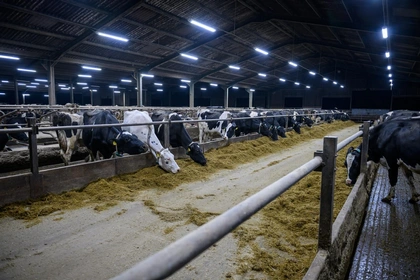
Providing better lighting in dairy setups can increase yields by 10%. Milking cows exposed to light levels over 150 lux for 16 hours a day can increase yields by 8–13%, as increased daylight reduces the cows’ melatonin levels. This, in turn, enables more of their naturally occurring milk-producing hormones to be secreted. However, it is also important to provide 8 hours of darkness to optimise the cows’ circadian rhythm, which improves health and reproductive performance.
Farmers must take care when measuring light. It is important to take measurements at cow level, ideally with sensors that automatically activate the lighting systems. A common mistake is placing lights only above the feed passage and not distributing them evenly throughout the cubicle building. A cow typically spends only 3–4 hours per day at the feed barrier but rests in a cubicle for 12–16+ hours per day. If lighting is inadequate in the cubicles, where the cow spends most of her time, she will not be exposed to the required photoperiod.
Red night lights may be used to facilitate cow movement and observation during darkness. The intensity of red light has minimal or no effect on the cows’ perception of darkness and thus does not significantly impact melatonin secretion. There should be no brighter lights in any part of the barn, and cows need 2–4 weeks on average to adjust.
LED lights with blue-enriched white light (400–500 nm) are an ideal light source and help reduce energy costs. These can also be incorporated into units that provide red night lights. Optimising the light spectrum and photoperiod helps regulate the cows’ circadian rhythm by mimicking summer daylight conditions, which stimulates feed intake and milk production. Red night lights also improve fertility and general well-being, while providing a better environment for farm workers and aiding in heat detection.
At the recent Climate Farm Demo project meeting in Slovenia, the herd management thematic visit highlighted the importance of having suitable lighting in cow sheds, especially when dairy cows are housed for extended periods.
In the UK, and elsewhere, it is common for transparent roofing panels to be used to allow light into cow sheds during the day. However, the transparency of these panels deteriorates as dirt accumulates and the materials degrade, so it is common to encounter sheds with substandard light levels.
Providing better lighting in dairy setups can increase yields by up to 10%. Milking cows exposed to light levels over 150 lux for 16 hours a day can see yields increase by 8–13%, as the extended daylight reduces melatonin levels in cows, which in turn enables more of their naturally occurring milk producing hormones—IGF-1 and prolactin—to be secreted. However, it is also important to provide 8 hours of darkness to optimise the cows’ circadian rhythm. This promotes better sleep patterns and reduces stress, thus improving health and reproductive performance.
Farmers must take care when measuring light. Measurements should ideally be taken with sensors at cow level that automatically activate the lighting system. A common mistake is placing lights only above the feed passage and not evenly throughout the cubicle building. Cows typically spend just 3–4 hours per day at the feed barrier, while resting in cubicles for 12–16+ hours daily. If lighting is inadequate in the cubicles, cows will not receive the required photo period.
Red night lights can be used to facilitate cow movement and observation during darkness. The intensity of red light has minimal or no effect on cows’ perception of darkness and thus does not significantly affect melatonin secretion. There should be no brighter lights in any part of the barn. Cows need, on average, 2–4 weeks to adjust to new lighting.
There has been much research in humans on the role that light—and blue light in particular—plays in Seasonal Affective Disorder (SAD). Symptoms of SAD include fatigue, sleep disturbances, and changes in appetite. Cows are no different.
In dairy housing, LED lights are commonly used due to their lower energy consumption and longer lifespan compared to other light sources. The light spectrum of LEDs can vary significantly depending on the type used.
LED lights with blue-enriched white light (400–500 nm) are ideal and help reduce energy costs. These can be integrated into units that also provide red night lights. Optimising the light spectrum and photoperiod helps regulate cows’ circadian rhythms by mimicking summer daylight
conditions, which increases levels of IGF-1 and prolactin, stimulates feed intake, and boosts milk production. Red night lights also support fertility, general well-being, better working environments for farm staff, and heat detection.
The impact on carbon footprint—measured per litre of milk—can be significant. Increased milk production, improved feed efficiency, and reduced energy costs per litre are estimated to deliver a 4% reduction in CO₂e per litre.
This impact could be even greater in farms with very poor housing conditions, as the estimate does not account for expected improvements infertility, cow health, or reduced replacement rates.
Ideal LED lighting: more yield, better welfare, more profit, lower costs, and a reduced carbon footprint.
Effective Communication for Demo Events - Boosting Reach, Engagement, and Impact
Europe
All Zones
Benefits of the practice
- Targeted outreach and higher attendance
- Wider visibility and knowledge transfer
- Stronger networks and lasting impact
Announcing and promoting your farm demonstration events is key to ensuring strong participation, meaningful exchange, and lasting impact. Whether you are a farmer or advisor, good communication helps bring the right people to your event, builds interest, and ensures your experiences reach others who can benefit from them. Sharing your event before and after also supports the wider goals of the Climate Farm Demo project by spreading knowledge on climate-smart farming practices.
Announcing your demo event
A clear and timely announcement helps participants plan and signals that their presence is valued. Tailor your message and use tools that match your audience:
- Direct messages (email, SMS, phone calls) to specific farmers or advisors.
- Local channels farmers trust—WhatsApp groups, bulletin boards, newsletters, Facebook groups.
- Networks and institutions (advisors, farming groups, local authorities).
Include the date, time, location, topic, and key benefits of attending. Explain what will be demonstrated or learned in a practical way.
Promoting your demo
Promotion builds curiosity and widens your audience:
- Share posts via social media channels (Facebook, Instagram, LinkedIn).
- Tag partners and Climate Farm Demo to extend reach.
- Use engaging visuals-photos of your farm or previous events.
- Highlight the benefit: e.g. “See how cover crops reduce fertiliser needs.”
After the event
Follow up with a thank-you message and a summary post:
- Share main outcomes and good photos.
- Mention who attended and what was learned.
- Tag key participants or supporters.
Benefits of good communication:
- Stronger turnout and engagement
- Wider knowledge sharing
- More impact from your effort
- Better visibility for your farm or organisation
By planning your event communication before and after, you help ensure it makes a difference for both your local community and farmers across Europe.
Promoting and announcing your farm demonstration events is essential for ensuring a successful turnout, meaningful exchange, and long-term impact. Whether you are a farmer or advisor, good communication helps bring the right people to your event, creates interest in the topic, and allows others to benefit from your experience. Sharing your event before and after also supports the wider goals of your project by spreading knowledge on climate-smart farming practices.
Announcing your demo event
The first step is a clear and timely announcement. This helps potential participants plan and signals that their presence is welcome and valued.
Depending on your audience, you can use different tools:
• Direct invitations: Personal emails, text messages, or calls work well—especially when tailored to the interests of specific farmers or advisors.
• Farmer-used communication channels: Post in local WhatsApp or Facebook groups, cooperatives’ newsletters, or bulletin boards at local supply stores.
• Advisor networks and local institutions: Inform advisory services, local government or extension services so they can help share the news.
Your announcement should include the date, time, location, topic, and key benefits of attending. Keep it clear and practically explain what participants can expect to see or learn.
Promoting your event
Promotion adds visibility and builds curiosity beyond your direct contacts.
Consider:
• Posting on your farm or advisory organisation’s social media (Facebook, Twitter/X, Instagram, LinkedIn).
• Tagging project (e.g., Climate Farm Demo), local institutions or cooperatives to extend reach.
• Using engaging visuals: Share photos from past events or a picture of the host farm to attract attention.
• Mentioning why the event matters—for example, “See how cover crops help reduce fertiliser costs.”
After the event
Your work doesn’t end when the event does. Sharing a thank-you message shows appreciation and builds relationships for future events. A short follow-up post with key takeaways and a few good photos helps spread the knowledge further and increases impact:
• Post highlights from the demo day on social media. (good photos or videos are highly recommended)
• Mention who attended, what was discussed, and what was learned.
• Use quotes or feedback from participants if available.
• Tag participants, partners, and any supporting organisations.
Key benefits for farmers and advisors:
• Stronger participation and engagement
• Wider sharing of knowledge and practical solutions
• Stronger local networks and visibility for your work
• Greater impact from your demo effort
By announcing, promoting, and following up on your event, you help ensure your demo farm’s experience contributes to the wider adoption of climate-smart farming practices—both locally and across Europe.
Reducing Ammonia Emissions by Optimizing the Feed Rations of Dairy Cows
Luxembourg
Continental Europe
Benefits of the practice
- Ammonia emissions
- Optimization of protein content in ration
- Protein autonomy
Production system(s)
Thematic Area(s)
The practice of optimizing crude protein intake in dairy cows (See Figure 3, Measure 16 in CFD AMM library) is a key lever for reducing both ammonia and GHG emissions.
As part of the AUTOPROT project (www.autoprot.eu), it was established that a considerable proportion of the protein produced and fed on the farm is not utilised by the dairy herd. This unutilised protein is of great importance because it increases the risk of ammonia losses. The AUTOPROT project also showed that farms with a high degree of self-sufficiency in protein (protein self-sufficiency) have a lower proportion of unutilised protein. It can be shown mathematically that the unutilised protein corresponds to the luxury consumption of protein by the dairy cattle.
It is known from the literature that high crude protein levels in cattle rations generally lead to increased excretion of nitrogen in the form of urine. It is the urine that is responsible for the escape of ammonia, as urea, the main component of urine, is very quickly converted into ammonia. If the crude protein in the rations is well adapted to the animals’ requirements, the animals excrete more nitrogen via faeces, which contributes significantly less to ammonia emissions.
Thanks to a study by Sajeev et al. (2017), it also became known that the potential for reducing ammonia losses in cattle by reducing by 1% the crude protein surplus in the ratio is 17% of the total output.
A key point is the definition of a target value for ration optimisation. According to experts, crude protein levels in the rations of dairy cows can be reduced to a level of 15% in dry matter without any loss in milk yield. In the opinion of the experts, a crude protein content of 14% in the ration is sufficient for young cattle. Based on these considerations, the CONVIS farms in the AUTOPROT project were able to achieve potential savings in NH3 emissions of around 10 kg of nitrogen per ha through ration optimisation. Of these savings, 90% came from ration optimisation for dairy cows alone.
Die Optimierung der Rohproteinaufnahme bei Milchkühen (siehe Abbildung 3, Maßnahme 16 in der CFD-AMM-Bibliothek) ist ein wichtiger Hebel zur Verringerung der Ammoniak- und Treibhausgasemissionen.
Im Rahmen des Projektes AUTOPROT (www.autoprot.eu) wurde festgestellt, dass ein beträchtlicher Teil des Proteins, das im Betrieb erzeugt und verfüttert wird, von der Milchviehherde nicht verwertet wird. Dieses nicht verwertete Eiweiß ist von großer Bedeutung, denn es erhöht die Gefahr von Ammoniakverlusten. Im Projekt AUTOPROT wurde ferner gezeigt, dass Betriebe mit einem hohen Selbstversorgungsgrad an Eiweiß (Eiweißautarkie) einen niedrigeren Anteil an nicht-verwerteten Eiweiß aufweisen. Man kann rechnerisch darstellen, dass das nicht verwertete Eiweiß dem Luxuskonsum an Eiweiß durch das Milchvieh entspricht.
Aus der Literatur ist bekannt, dass hohe Rohproteingehalte in der Ration von Rindern im Allgemeinen zu einer erhöhten Ausscheidung des Stickstoffs unter Form von Harn führen. Dabei ist gerade der Harn dafür verantwortlich, dass Ammoniak entweicht, da der Harnstoff als Hauptbestandteil des Harns sehr schnell in Ammoniak umgewandelt wird. Wenn das Rohprotein in den Rationen gut am Bedarf der Tiere angepasst ist, scheiden die Tiere den Stickstoff vermehrt über Kot aus, der deutlich weniger zu den Ammoniakemissionen beträgt.
Dank einer Studie von Sajeev et al. (2017) wurde weiter bekannt, dass im Rindviehbereich das Reduzierungspotential der Ammoniakverluste durch Verringerung um 1% des Rohproteinüberschusses in der Ration bei 17% des Gesamtausstoßes liegt.
Ein wesentlicher Punkt ist die Definition einer Zielgröße für die Rationsoptimierung. Nach Ansicht von Experten lassen sich Rohprotein-Gehalte in der Ration von Milchkühen bis auf ein Niveau von 15% in der Trockensubstanz ohne Einbußen in der Milchleistung absenken. Für das Jungvieh ist nach Ansicht der Experten ein Rohproteingehalt in der Ration von 14% ausreichend. Aus diesen Überlegungen konnte für die CONVIS-Betriebe ein Einsparungspotential an NH3-emissionen über die Rationsoptimierung von rund 10 kg Stickstoff pro ha. Von diesen Einsparungen stammen 90% allein aus der Rationsoptimierung der Milchkühe.
As part of the AUTOPROT project, it was established that a considerable proportion of the protein produced and fed on the farm is not valorized by the dairy herd. This not valorized protein is of great importance because it increases the risk of ammonia losses. The AUTOPROT project also showed that farms with a high degree of self-sufficiency in protein (protein self-sufficiency) have a lower proportion of non-valorized protein. Protein self-sufficiency can be expressed as a function of the feed supply or the protein requirement of the dairy herd.
The not valorized protein is closely linked to the crude protein surplus in the ration or to the luxury consumption of dairy cattle. It can be shown mathematically that the higher the amount of protein consumed by dairy cattle more than their requirements, the greater the difference between the protein consumed and the protein valorized by the animals as milk and meat. This also increases the amount of nitrogen excreted and thus the potential for ammonia emissions.
It is known from the literature that high crude protein levels in cattle rations generally lead to increased excretion of nitrogen in the form of urine. It is the urine that is responsible for the escape of ammonia, as urea, the main component of urine, is very quickly converted into ammonia. If the crude protein in the rations is well adapted to the animals’ requirements, the animals excrete more nitrogen via faeces, which contributes significantly less to ammonia emissions.
As part of the project, an average crude protein content of 16.7% in the dry matter of dairy cows was determined for the CONVIS farms. For young cattle, the average crude protein content was 14.5% in dry matter.
Thanks to a study by Sajeev et al. (2017), it also became known that the potential for reducing ammonia losses in cattle by reducing the crude protein content in the ration by 1% is 17% of the total output.
A key point is the definition of a target value for ration optimization.
According to experts, crude protein levels in the rations of dairy cows can be reduced to a level of 15% in dry matter without any loss in milk yield. In the opinion of the experts, a crude protein content of 14% in the ration is sufficient for young cattle. Based on these considerations, the CONVIS farms in the AUTOPROT project were able to achieve potential savings in NH3 emissions of around 10 kg of nitrogen per ha through ration optimization. Of these savings, 90% came from ration optimization for dairy cows alone.
Main conclusions
• As part of the AUTOPROT project, the relationship between excess crude protein in the ration of dairy cattle and ammonia losses was analysed.
• The CONVIS farms analysed showed a crude protein content of 16.7% in the ration of the dairy cows.
• From the crude protein content, the ammonia savings are derived by assuming that reducing the crude protein content by 1% results in a17% reduction in emissions.
• By optimizing the rations of dairy cows (lowering the crude protein content to 15%) and young cattle, there is potential to reduce NH3 losses by up to 25%. In the case of the CONVIS farms, this amounts to around 10 kg NH3_N/ha.
• In general, a high protein autonomy (high protein self-sufficiency) is an essential prerequisite for achieving low ammonia emissions.