



Contact/s:
Laure Triste
laure.triste@ilvo.vlaanderen.be
Reinforcing Your Key Message During Demonstration Events with the use of Props

Europe
All Zones
- Effective demonstration events
- Use of props
- Higher retention rates
Summary for Practicioners on the Main Finding(s)/Innovative solution(s)
When organizing a demonstration event, you want your key message to come across clearly and stick with the participants. A powerful tool to reinforce your key message is the use of props. The word “prop” is borrowed from the theater and movie industry, where it refers to a “movable article or object used on the set of a movie or play.” Furthermore, it is also defined as “a support to keep something from shaking or falling.” Building on these definitions, in demonstration events, we refer to a “prop” as “an object that supports or emphasizes the key message during a demonstration.”
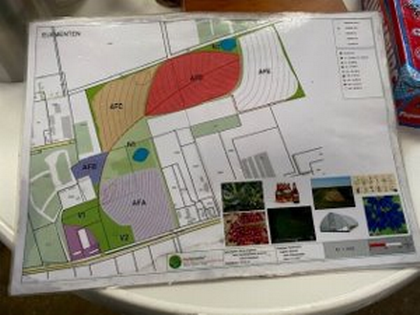
Props can take many forms, such as information boards, soil samples, feed samples, a harvester, or even a cow. The main idea is that they are simple and enhance understanding of the key message at a glance. For example, when you want to stress the importance of making quality silage to reduce feed costs, a bale of silage can be presented alongside a meal. Or, when explaining different plots on a farm, participants can be provided with a simple map of the plots and their characteristics.
By using a prop, the learning retention rate of participants can be doubled to 20%, compared to a simple lecture, which has a retention rate of 10%. But, if you want to significantly increase the retention rate to 75%, you can introduce a prop that participants can actively engage with. For example, if you want to discuss the difference between multiple varieties of forage, you can present different samples that participants can feel, smell, taste, etc., along with a description of their characteristics. Or, when discussing the quality of a clover field, a clover scorecard can be handed out to the participants to help them judge the clover content in a grass/clover sward.