



Contact/s:
Richard Lloyd
richardl@i4agri.org
The Use of LED Lighting in Dairy Housing to Increase Performance and Lower Costs and Carbon Footprint

UK
Temperate Climate
- Improved Milk Production
- Lower Electricity Costs
- Improved Animal Welfare
Thematic Areas
Production System/s
Summary for Practicioners on the Main Finding(s)/Innovative solution(s)
Providing better lighting in dairy setups can increase yields by 10%. Milking cows exposed to light levels over 150 lux for 16 hours a day can increase yields by 8–13%, as increased daylight reduces the cows’ melatonin levels. This, in turn, enables more of their naturally occurring milk-producing hormones to be secreted. However, it is also important to provide 8 hours of darkness to optimise the cows’ circadian rhythm, which improves health and reproductive performance.
Farmers must take care when measuring light. It is important to take measurements at cow level, ideally with sensors that automatically activate the lighting systems. A common mistake is placing lights only above the feed passage and not distributing them evenly throughout the cubicle building. A cow typically spends only 3–4 hours per day at the feed barrier but rests in a cubicle for 12–16+ hours per day. If lighting is inadequate in the cubicles, where the cow spends most of her time, she will not be exposed to the required photoperiod.
Red night lights may be used to facilitate cow movement and observation during darkness. The intensity of red light has minimal or no effect on the cows’ perception of darkness and thus does not significantly impact melatonin secretion. There should be no brighter lights in any part of the barn, and cows need 2–4 weeks on average to adjust.
LED lights with blue-enriched white light (400–500 nm) are an ideal light source and help reduce energy costs. These can also be incorporated into units that provide red night lights. Optimising the light spectrum and photoperiod helps regulate the cows’ circadian rhythm by mimicking summer daylight conditions, which stimulates feed intake and milk production. Red night lights also improve fertility and general well-being, while providing a better environment for farm workers and aiding in heat detection.
Additional Information
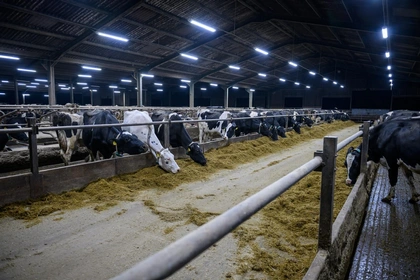
At the recent Climate Farm Demo project meeting in Slovenia, the herd management thematic visit highlighted the importance of having suitable lighting in cow sheds, especially when dairy cows are housed for extended periods.
In the UK, and elsewhere, it is common for transparent roofing panels to be used to allow light into cow sheds during the day. However, the transparency of these panels deteriorates as dirt accumulates and the materials degrade, so it is common to encounter sheds with substandard light levels.
Providing better lighting in dairy setups can increase yields by up to 10%. Milking cows exposed to light levels over 150 lux for 16 hours a day can see yields increase by 8–13%, as the extended daylight reduces melatonin levels in cows, which in turn enables more of their naturally occurring milk producing hormones—IGF-1 and prolactin—to be secreted. However, it is also important to provide 8 hours of darkness to optimise the cows’ circadian rhythm. This promotes better sleep patterns and reduces stress, thus improving health and reproductive performance.
Farmers must take care when measuring light. Measurements should ideally be taken with sensors at cow level that automatically activate the lighting system. A common mistake is placing lights only above the feed passage and not evenly throughout the cubicle building. Cows typically spend just 3–4 hours per day at the feed barrier, while resting in cubicles for 12–16+ hours daily. If lighting is inadequate in the cubicles, cows will not receive the required photo period.
Red night lights can be used to facilitate cow movement and observation during darkness. The intensity of red light has minimal or no effect on cows’ perception of darkness and thus does not significantly affect melatonin secretion. There should be no brighter lights in any part of the barn. Cows need, on average, 2–4 weeks to adjust to new lighting.
There has been much research in humans on the role that light—and blue light in particular—plays in Seasonal Affective Disorder (SAD). Symptoms of SAD include fatigue, sleep disturbances, and changes in appetite. Cows are no different.
In dairy housing, LED lights are commonly used due to their lower energy consumption and longer lifespan compared to other light sources. The light spectrum of LEDs can vary significantly depending on the type used.
LED lights with blue-enriched white light (400–500 nm) are ideal and help reduce energy costs. These can be integrated into units that also provide red night lights. Optimising the light spectrum and photoperiod helps regulate cows’ circadian rhythms by mimicking summer daylight
conditions, which increases levels of IGF-1 and prolactin, stimulates feed intake, and boosts milk production. Red night lights also support fertility, general well-being, better working environments for farm staff, and heat detection.
The impact on carbon footprint—measured per litre of milk—can be significant. Increased milk production, improved feed efficiency, and reduced energy costs per litre are estimated to deliver a 4% reduction in CO₂e per litre.
This impact could be even greater in farms with very poor housing conditions, as the estimate does not account for expected improvements infertility, cow health, or reduced replacement rates.
Ideal LED lighting: more yield, better welfare, more profit, lower costs, and a reduced carbon footprint.