



Contact/s:
Maria Mendonça
mmendonca@consulai.com
Establishing a Rotational Grazing Calendar in Mixed Farming Systems in Portugal
Mediterranean zone
- Improving soil health
- Promoting grassland regeneration
- Establishing a holistic farm management
Thematic Areas
Production System/s
Summary for Practicioners on the Main Finding(s)/Innovative solution(s)
The impact of climate change on the Montado system is severe, causing soil degradation, water scarcity, high temperatures, extreme weather events, and pest and disease proliferation. These factors affect tree health and productivity, and animal welfare. To ensure the system’s resilience and sustainability, it is essential to balance forest density and livestock stocking rates, influencing grazing strategies.
Optimized grazing management is crucial, especially in systems with high stocking rates or multiple livestock types. Overgrazing can lead to soil compaction, reduced tree health, and compromised vegetation regeneration. Well-managed pastures, however, reduce the need for supplementary feed, lowering farm costs. Defining grazing areas, rest periods, and animal numbers per plot helps to adapt the Montado system to climate change and improves pasture management.
Implementing a rotational grazing calendar varies depending on farm characteristics and livestock type but is key to system resilience. This strategy can be expanded to other mixed and extensive livestock systems, strengthening sustainability.
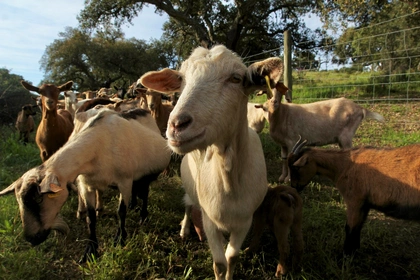
At Monte da Silveira, a 700-hectare farm in Castelo Branco, Portugal, livestock includes pigs, sheep, and goats, alongside crops and pastures. Grazing is rotational: each plot subdivided into small plots where a high number of animals graze for a short period (hours or days) and then rest for a long period (months or years). The number of animals and grazing time is controlled to avoid overgrazing, erosion and soil degradation, promoting soil regeneration. The system follows a specific grazing sequence: local-breed black pigs feed on acorns first, followed by sheep grazing on herbaceous species, and finally goats controlling shrubs. This model adds value to acorn-fed pigs, reduces wildfire risk, and prevents overgrazing.
Summary for Practicioners in Native Language
O sistema do Montado enfrenta impactos significativos das alterações climáticas, como degradação do solo, escassez de água, temperaturas elevadas, fenómenos extremos e proliferação de pragas e doenças, afetando a produtividade e sanidade das árvores e o bem-estar animal. Para aumentar a resiliência e sustentabilidade, é essencial equilibrar densidade florestal, efetivo animal e gestão das pastagens. A estratégia de pastoreio é crucial, especialmente em sistemas com um efetivo animal elevado ou diversificado.
A adoção de um calendário rotativo ajuda a minimizar a compactação do solo e otimizar a regeneração das pastagens, sendo possível adaptar a estratégia consoante a dimensão da exploração e tipo de gado. Esta estratégia pode ser aplicada a outros sistemas mistos e extensivos, promovendo a resiliência dos mesmos.
No Monte da Silveira, uma exploração com 700 hectares em Castelo Branco, o pastoreio é rotacional: cada parcela é subdivida em pequenas parcelas onde um número elevado de animais pasta por um curto período de tempo (horas ou dias), ficando a regenerar durante um longo período de tempo (meses ou anos). O número de animais por área e o tempo de pastoreio são controlados para evitar o sobre-pastoreio, erosão e degradação do solo, promovendo a regeneração dos solos.
O calendário segue uma ordem específica: os porcos entram primeiro para consumir bolotas, seguidos das ovelhas que se alimentam das espécies herbáceas, e das cabras, que controlam as espécies arbustivas. Além do sobre-pastoreio ser evitado, este método valoriza a carne de porco preto alentejano, alimentado com bolota, e reduz o risco de incêndios devido ao controlo da vegetação arbustiva.
Additional Information
The impact of climate change on the Montado system is severe. Soil degradation, water scarcity, high temperatures, extreme weather events and pest and disease proliferation are some of the identified effects on climate change in the system that affect tree health and productivity and animal welfare. The system needs to be adapted to increase its resilience and economic viability and sustainability. One of the farmers’ priorities regarding this system is how to balance the three components: forest density versus livestock stock rate, leading to different grazing strategies indifferent farms.
The grazing strategy is crucial, particularly in systems with higher stocking rates or with more than one type of livestock. If not well managed, overgrazed grassland can lead to soil degradation and compaction, decrease in tree health and productivity, reduced restoration in the following years, among other impacts. Additionally, the more available grassland for the livestock to feed on, less additional forage or feed is needed, which translates into fewer costs for the farm.
This measure contributes to the adaptation of the Montado system to climate change, as it aims to decrease soil compaction and improve grassland management, by defining various factors such as grazed area, grazing time and non-grazing time and number of animals per plot.
Depending on the farm dimension and on the type of livestock, the calendar will have different timeline and structure, however it is a key aspect to promote the system’s resilience.
While the establishment of a rotational grazing calendar is dependable of existing animals, this strategy can be scaled up to other mixed systems or extensive livestock production systems, allowing an improved system
resilience.
In Monte da Silveira, a 700-hectare farm in Castelo Branco in Portugal, has a diverse range of livestock from pigs, sheep and goats and various crops and pastures. each plot subdivided into small plots where a high number of animals graze for a short period (hours or days), and then rest for a long period (months or years). The number of animals and grazing time is controlled to avoid overgrazing, erosion and soil degradation, promoting soil regeneration.
The key difference is the establishment of a rotational grazing calendar according to the existing animals. The first animals to graze the plots are local-breed black pigs to feed on the acorn, followed by sheep that feed on the herbaceous species, and finally goats that control the shrubs. The benefit of these grazing systems is that acorn-fed pigs have higher value, wildfires occurrence is reduced due to shrubs control and excessive grazing is avoided.