


Contact/s:
Annie Soulier
annie.soulier@ifip.asso.fr
GEEP - An Environmental Assessment Tool for Pig Farming in France

France
Temperate Climate
- Environmental assessment of pig farming
- Good environmental practices
- Decision-making tool
Thematic Areas
Production System/s
Summary for Practicioners on the Main Finding(s)/Innovative solution(s)
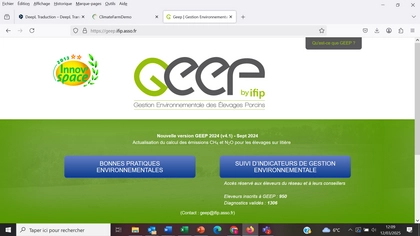
Since 2014, IFIP (the French technical institute for the pig industry) has been providing French pig farmers with the GEEP calculation tool to assess the environmental performance of their workshops. GEEP is also a network of over 900 pig farmers and around 130 advisors. The environmental balance sheet is based on nine quantitative indicators covering the consumption of natural resources (water and energy), emissions (nitrogen and phosphorus), gaseous emissions (ammonia and greenhouse gases), and waste production. These indicators are calculated using the environmental flows from the farm divided by the kilograms of pigs produced on the farm (e.g., kg of NH₃ per kg of pigs produced).
For greenhouse gas emissions, the scope considers the entire pig production cycle using an LCA (life cycle assessment) approach, with the indicator expressed per kg of live weight. This type of indicator enables farmers to compare their performance with other farms in the same sector and collective benchmarks. GEEP is connected to the national technical-economic database managed by IFIP, which saves time when entering individual data and ensures the robustness of the information.
This tool is sensitive to several levers for reducing greenhouse gas emissions. Farmers can enter the formulation of the feed they use, selecting the raw feedstuffs and their origin to calculate the feed’s carbon footprint as accurately as possible. It incorporates several best practices in the effluent management chain, including the frequency of effluent evacuation from buildings, different storage methods, and methanization. The results also consider the technical performance of each physiological stage. GEEP is a comprehensive tool designed to support farmers in their efforts toward continuous improvement.
Summary for Practicioners in Native Language
Depuis 2014, l’IFIP (institut technique de la filière porcine) met à disposition des éleveurs de porcs français, l’outil de calcul GEEP, pour évaluer les performances environnementales de leur atelier. GEEP c’est aussi un réseau qui regroupe plus de 900 éleveurs porcins et environ 130 conseillers. Le bilan environnemental s’appuie sur 9 indicateurs quantitatifs portant sur les consommations de ressources naturelles (eau et énergie), les rejets (azote et phosphore), les émissions gazeuses (ammoniac et gaz à effet de serre) et la production de déchets. Ces indicateurs sont calculés avec les flux environnementaux de l’élevage divisés par les kilogrammes de porc générés sur l’élevage (ex : kg de NH3/ kg de porc produit).
Pour les émissions de gaz à effets de serre, le périmètre prend en compte l’ensemble du cycle de production de porc dans une approche par ACV (analyse de cycle de vie), l’indicateur est alors exprimé par kg de poids vif. Ce type d’indicateur permet aux éleveurs de se comparer à d’autres élevages de même orientation et de se positionner par rapport à des références collectives. GEEP est connecté à la base nationale de données technico-économiques gérée par l’IFIP, ce qui représente un gain de temps pour la saisie des données individuelles et un gage de robustesse de l’information. Cet outil est sensible à de nombreux leviers de réduction d’émissions de GES. L’éleveur peut renseigner la formulation de l’aliment consommé en choisissant les matières premières et leur origine, pour calculer au plus juste l’empreinte carbone de celui-ci. Il intègre de nombreuses bonnes pratiques sur la chaine de gestion des effluents : fréquence d’évacuation des effluents au bâtiment, différentes modalités de stockage, méthanisation… Les résultats prennent également en compte les performances techniques de chaque stade physiologique. GEEP est un outil complet pour accompagner l’éleveur dans une démarche d’amélioration continue.
Additional Information
In France, decarbonization is becoming increasingly important in pork production due to the environmental labeling of consumer products and the Low Carbon Label launched by the French Ministry for Ecological Transition. The Low Carbon Label offers the prospect of remuneration for pig farmers’ efforts to reduce their greenhouse gas emissions, provided they follow a sector-specific method validated for pig farming by the Ministry.
Supporting Pig Farms in Achieving National Low-Carbon Objectives
France’s national low-carbon strategy (SNBC) sets a target of reducing greenhouse gas emissions from agriculture by 46%.
Simulations show that an average farrow-to-finish farm with 250 sows could reduce its greenhouse gas emissions by 2% to 25% over the pig’s life cycle, depending on the mitigation measures implemented. This reduction would amount to several dozen to several hundred tonnes of CO₂ avoided per year.
To reward these efforts, a Low Carbon Label method has been developed specifically for pig farms. It is largely based on the GEEP evaluation method, with a more detailed assessment of greenhouse gas emissions in two key areas:
• Feed formulation: Whether purchased or produced on the farm, this method allows for the substitution of imported raw materials linked to deforestation and the processing of co-products.
• Effluent methanization: A more detailed assessment is conducted, considering different models such as psychrophilic methanization, co-generation, injection, and autonomous or collective units.
GEEP’s sensitivity to various climate change mitigation levers makes it a valuable tool for supporting the decarbonization of pig farms. As a result, GEEP has been selected for two European projects—Climate Farm Demo and Climate Smart Advisors—which, over six years, aim to assist pilot farms in developing climate change mitigation and adaptation plans. These efforts will serve as demonstrations for large-scale implementation in the field.
GEEP: A Constantly Evolving Tool to Meet User Needs
GEEP’s reference databases and calculation rules for gaseous emissions are continuously updated to incorporate the latest developments. It also adapts to user needs. Since 2023, it has allowed farmers to enter the detailed formulation of the feed used, ensuring alignment with actual on-farm practices and enabling precise calculations of the carbon impact of purchased feed.
To disseminate information and understand user expectations, several meetings are organized annually with the network of advisors.