



Contact/s:
Melissa Näf-Doffey
melissa.naef@agridea.ch
How Soil Cover and Reduced Tillage Enhance the Stability and Resilience of Agriculture to Extreme Weather Events

Switzerland
Temperate Climatic
- Maintaining soil health
- Increase resilience
- Emission mitigation
Thematic Areas
Summary for Practicioners on the Main Finding(s)/Innovative solution(s)
The Climate Farm Demo event in Bavois, Switzerland, in October 2024 focused on educating and training agricultural professionals about the essential role of cover crops as well as methods like direct seeding, in addressing the challenges posed by climate change.
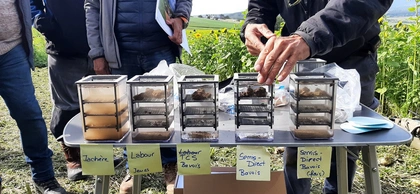
Research presented at the event showed that soil covered by plants can absorb rainwater more effectively, reduce erosion, and heat up less in summer. In contrast, uncovered soils are vulnerable to water and nutrient losses, as well as soil erosion. An aggregate stability test conducted on-site illustrated how soil stability is affected by management practices and how plant cover can improve soil stability.
Individuals from agricultural practice and advisory can leverage these insights by integrating strategies for implementing cover crops and reduced tillage into their farming practices. These methods improve soil quality and fertility, contributing to long-term yield stability and increases.
At the end of the event, Hanspeter Liniger (University of Bern) shared findings from the “Hot earth is not cool” project, highlighting how uncovered soils are highly vulnerable to erosion, runoff, and heat stress. He explained that covered soils absorb and store rainwater better, protecting against erosion and drought. Rain simulator studies show that up to 50% of heavy rainfall runs off uncovered soils, causing major losses of water, soil, and nutrients. In contrast, soils under permanent pasture or cover crops with no-till practices showed minimal runoff and erosion. Uncovered soils can heat up to over 60°C in summer, harming soil life. Mulch can lower topsoil temperatures by 15–20°C, while living plant covers are even more effective and help stabilize soil structure. Frequent ploughing disrupts roots and soil microbes, weakens soil stability and increases erosion risks.
Summary for Practicioners in Native Language
Die Climate Farm Demo Veranstaltung in Bavois, Schweiz, im Oktober 2024 legte den Schwerpunkt auf die Aufklärung und Weiterbildung von Fachleuten in der Landwirtschaft über die wesentliche Rolle von Bodenbedeckungspflanzen, wie Gründüngungen und Zwischenfrüchten und Methoden wie der Direktsaat, zur Bewältigung der Herausforderungen des Klimawandels.
An der Veranstaltung präsentierte Forschungsergebnisse zeigten auf, dass durch Pflanzen bedeckte Böden Regenwasser effektiver aufnehmen, Erosion reduzieren und sich im Sommer weniger stark erhitzen. Unbedeckte Böden hingegen sind anfällig für Wasser- und Nährstoffverluste sowie Bodenerosion. Ein vor Ort durchgeführter Aggregatsstabilitätstest illustrierte, wie die Bodenstabilität durch die Bodenbewirtschaftungsart beeinflusst wird, und wie eine Bodenbedeckung durch Pflanzen die Stabilität des Bodens verbessert.
Personen aus der landwirtschaftlichen Praxis und Beratung können die gewonnenen Erkenntnisse nutzen, indem sie Strategien für die Implementierung der Bodenbedeckung durch Pflanzen und der reduzierten Bodenbearbeitung in ihren Anbau integrieren. Diese Methoden verbessern die Bodenqualität und -fruchtbarkeit und tragen dazu bei, die Erträge langfristig zu stabilisieren und zu steigern.
Zum Abschluss der Veranstaltung stellte Hanspeter Liniger (Universität Bern) die Ergebnisse des Projekts „Hot earth is not cool“ vor und zeigte auf, dass unbedeckte Böden sehr anfällig für Erosion, Abfluss und Hitzestress sind. Er erläuterte, dass bedeckte Böden Regenwasser besser aufnehmen und speichern und so vor Erosion und Trockenheit schützen. Studien mit Regensimulatoren zeigen, dass bis zu 50 % der starken Regenfälle von unbedeckten Böden abfließen und große Verluste an Wasser, Boden und Nährstoffen verursachen. Im Gegensatz dazu wiesen Böden unter Dauergrünland oder Deckfrüchten mit Direktsaatverfahren nur minimale Abfluss- und Erosionswerte auf. Unbedeckte Böden können sich im Sommer auf über 60 °C aufheizen und das Bodenleben schädigen. Mulch kann die Oberbodentemperaturen um 15-20 °C senken, während lebende Pflanzendecken noch wirksamer sind und zur Stabilisierung der Bodenstruktur beitragen. Häufiges Pflügen stört Wurzeln und Bodenmikroben, schwächt die Bodenstabilität und erhöht das Erosionsrisiko.
Additional Information
As a result of climate change, agricultural soils are increasingly exposed to extreme weather conditions such as heatwaves, droughts and heavy rainfall.
These changes threaten soil fertility and therefore also agricultural yields.
At the well-attended Climate Farm Demo event on 9 October 2024 in BavoisVD, the crucial role of soil cover was illustrated in a practice-oriented event.
After a welcome to the attendees by a consultant from the Prométerre association, the Climate Farm Demo farmer Thierry Salzmann shared his experiences with cover cropping and reduced tillage. He explained how he practically implements techniques such as no-till farming on his farm and the advantages he sees in it. Afterwards, the agricultural experts had the opportunity to experience at various stations how soil cover has a positive effect on various soil properties, such as soil structure, nutrient availability, biodiversity and soil organisms.
Towards the end of the event, Hanspeter Liniger from the University of Bern presented important research findings on the topic of soil protection. As part of the ‘Hot earth is not cool’ project, Liniger explained the problems that uncovered soils can lead to and which agricultural practices can help to protect soils from extreme weather events and maintain soil fertility in the long term:
• Covered soils can absorb and store rainwater more effectively and are therefore better protected against erosion and drought. Uncovered and freshly tilled soils, on the other hand, are particularly susceptible to surface runoff and erosion. Studies with rain simulators show that as much as half of the simulated heavy rainfall runs off on uncovered soil, resulting in substantial losses of water, soil and nutrients.
Conversely, soils cultivated with permanent pasture or protected by a green cover crop sown using no-till practices markedly diminished surface runoff and minimized erosion to nearly zero.
• Uncovered soils can heat up to over 60°C in summer, stressing soil life.
Mulch cover can lower the top soil temperature by 15 to 20 °C. A living soil cover is even more effective and also improves the stability of the soil structure.
• Roots and soil microbes are crucial for soil stability. Frequent ploughing disturbs soil life and leads to unstable soils, which in turn favours runoff and erosion.
As a conclusion, the investigations of Hanspeter Liniger und Jovana Askrabic in summer 2023 and 2024 showed that protecting soils from heat stress, surface runoff and erosion is crucial for resilient agriculture. Adapted cultivation methods can make soils more resistant to climatic extremes, secure yields and also protect the environment in the long term.
The full article on Liniger and Askrabic’s research can be read here