



Contact/s:
Neja Žogan Čokl
neja.zogan-cokl@kgzs.si
Timotej Horvattimotej
timotej.horvat@kmetijski-zavod.si
Sowing Stubble Crops

Slovenia
Marine West Coast, Warm Summer
- Improve soil fertility,
- Improve crop rotation,
- Avoid soil structure deterioration due to heat and summer storms in the summer.
Thematic Areas
Production System/s
Summary for Practicioners on the Main Finding(s)/Innovative solution(s)
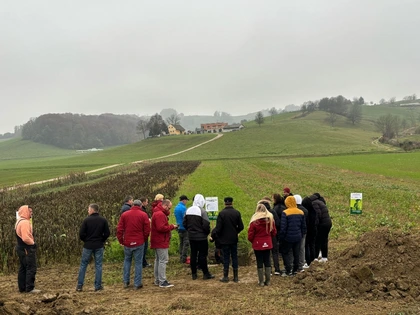
Stubble crops are sown after the harvest of cereals, early potatoes, and catch crops. Sowing stubble crops in the crop rotation has several advantages: it improves the rotation, prevents the deterioration of soil structure in the summer due to heat and summer storms, produces additional fodder for livestock, and prevents the spread of diseases and pests.
By sowing stubble crops, we reduce weed infestation, improve soil aeration and the humus balance, lessen the negative effects of rain, sun, and wind on soil structure, prevent the leaching of nutrients (especially nitrogen) into groundwater, improve the farm’s feed balance, provide bees with rich pasture in the autumn, and benefit from biofumigation, which has a suppressive effect on certain soil pests. Mixtures of several stubble crops also contribute to greater biodiversity.
Stubble crops are important because they enhance the visual appearance of the landscape. They can be sown without ploughing, using only shallow surface tillage. Stubble crops are grown for human consumption, animal feed, and green cover. Their importance is even greater in areas where manure is not ploughed in.
For human consumption, buckwheat, millet, stubble turnip, or beetroot are sown. For animal feed, the most sown crops include multi-flowered ryegrass, red clover, vetch, black clover, fodder rape, alfalfa, and clover-grass mixtures. For green cover, oil radish, white mustard, sunflowers, phacelia, and plant mixtures are used.
Stubble crops can be either winter or non-winter varieties.
Summary for Practicioners in Native Language
Strniščne dosevke sejemo po spravilu žit, zgodnjega krompirja in vmesnih posevkov. Setev strniščnih dosevkov ima v njivskem kolobarju več prednosti: izboljšamo kolobar, v poletnem času se izognemo propadanju strukture tal zaradi vročine in poletnih neviht, pridelamo dodatno krmo za živino in preprečujemo razmnoževanje bolezni in škodljivcev. S setvijo dosevkov zmanjšamo zapleveljenost , izboljšamo zračnost tal ter bilanco humusa, zmanjšamo negativne vplive dežja, sonca in vetra na strukturo tal, preprečujemo izpiranje hranil (dušika) v podtalnico, izboljšamo krmno bilanco na kmetiji, čebelam zagotavljamo bogato pašo v jesenskem času, z biofumigacijo negativno vplivamo na nekatere talne škodljivce. Z mešanicami večih dosevkov pripomoremo k večji biodiverziteti. Strniščni dosevki so pomembni, ker polepšajo tudi izgled krajine. Setev strniščnih posevkov lahko opravimo brez oranja, samo s plitvo površinsko obdelavo tal. Strniščne dosevke sejemo za prehrano ljudi, za krmo živali in za zeleni podor. Pomen setve strniščnih dosevkov je še večji na površinah na katerih ne zaoravamo hlevskega gnoja.
Za človeško prehrano sejemo ajdo, proso, strniščno repo ali rdečo peso, za prehrano živali najpogosteje sejemo mnogocvetno ljulko, inkarnatko, grašljinko, črno deteljo, krmno ogrščico, lucerno in deteljno travno mešanico, za zeleni podor pa oljno redkev, belo gorjušico, sončnice, facelijo in mešanice rastlin. Strniščni posevki so lahko prezimni ali neprezimni.
Additional Information
Sowing stubble crops is an environmentally friendly and effective way to improve soil fertility. It provides year-round soil coverage and is a highly recommended measure from a professional point of view. Given this year’s(2025) weather conditions, when there is still enough moisture in the soil, we can recommend sowing the stubble as soon as possible.
For human consumption, we sow buckwheat, millet, stubble turnip or beetroot, for animal consumption we most often sow multi-flowered ryegrass, red clover, vetch, black clover, fodder rape, alfalfa and clover grass mixture, and for green fodder we sow oil radish, white mustard, sunflowers, phacelia and plant mixtures. Stubble crops can be winter or non-winter crops. (See Table 1 and Table 2)
ADDITIONAL INFORMATION
Results of the stubble yield experiment (See more information in Table 3):
• Fertilization: 30m3 of cattle manure per ha
• Cultivation: – hoeing to a depth of 15 cm 8.8.2020
o harrow 9.8.2020
• Sowing: 10. 8. 2020
• Harvest of the experiment and weighing: 3. 11. 2020
• Mulched: 12.11.2020
• Ploughed: 15.11.2020
Sowing is mostly done with grain seeders or mineral fertilizer spreaders, but it can also be done manually. After sowing, we can also roll the seeds to ensure more even and faster emergence. If your main crop (e.g. pumpkins) has failed and was sprayed with soil herbicides, we advise you to call us for detailed instructions on how to sow follow-up crops in such a case.