



Contact/s:
Neja Žogan Čokl
neja.zogan-cokl@kgzs.si
Timotej Horvat
timotej.horvat@kmetijski-zavod.si
Subsoiling

Slovenia
Marine West Coast, Warm Summer
- Deep soil loosening,
- Soil drainage,
- Soil aeration and thus stimulating soil microbiological activity.
Thematic Areas
Production System/s
Summary for Practicioners on the Main Finding(s)/Innovative solution(s)
The main purpose of deep tillage is to break through the silt, which is created by many years of tillage at the same depth. Silt is a compacted, impenetrable layer of soil that stops air circulation and, above all, water draining into the depths. The positive effects of such deep tillage are soil drainage, soil aeration, and thus stimulating soil microbiological activity. When we loosen the soil, we achieve that the soil is less compacted and enable easier root growth into deeper layers of the soil. It is known that if the roots cannot break through the silt, they redirect their growth horizontally and continue to grow. If we have a dry period, this is very bad, because they do not reach the deeper layers of the soil, which still retain a certain amount of water, and therefore suffer drought stress more quickly. In periods of high rainfall, silt also causes water to stagnate on the surface of the soil. With deep tillage, we can alleviate this stagnation, because we loosen the soil deeply, break through the silt, and therefore the water drains faster. Also, certain versions of deep tillers have a drainage cone installed behind the head of the tiller, which creates a natural tube in the depth, which serves to drain water from the surface into the nearest drainage ditches. This measure is much more effective if we start with the processing itself next to the water drainage ditch and then process inland. This directs the flow of water into the ditch. When we deeply loosen the soil, we bring air into the depth of the soil. Air allows faster reproduction and activity of microorganisms in the soil. When we have good activity of microorganisms, we also have more nutrients available to plants.
Summary for Practicioners in Native Language
Glavni namen globinskega podrahljavanja je prebiti plazino, ki se ustvari z dolgoletno obdelavo tal na isti globini. Plazina je strnjena, neprebojna plast zemlje, ki ustavlja kroženje zraka, predvsem pa odvajanje vode v globino. Pozitivni učinki takšne obdelave tal so globinsko podrahljanje tal, drenažiranje tal, prezračevanje tal ter s tem spodbujanje mikrobiološke aktivnosti tal. Ko tla prerahljamo dosežemo to, da so tla manj zbita in omogočimo lažjo rast korenin v globlje plasti zemlje. Znano je, da korenine če ne morejo prebiti plazine, preusmerijo rast vodoravno in rastejo tako naprej. V kolikor imamo sušno obdobje je to zelo slabo, saj ne dosežejo globljih plasti zemlje, ki še zadržujejo določeno količino vode, zato hitreje utrpijo sušni stres. V obdobjih, ko imamo veliko padavin, prihaja zaradi plazine tudi do zastajanja vode na površini zemlje. S globinskim podrahljavanjem lahko to zastajanje omilimo, saj prerahljamo tla v globino, prebijemo plazino, zato voda hitreje odteče. Prav tako imajo določene izvedbe globinskih podrahljačev nameščene za glavo nogače drenažni kegelj, ki naredi v globini naravno cev, ki služi odtekanju vode iz površine v najbližje jarke za odvodnjavanje. Ta ukrep je veliko bolj učinkovit, če začnemo s samo obdelavo ob jarku za odvajanje vode in nato obdelujemo v notranjost površine. S tem usmerimo tok vode v jarek. Ko tla globinsko podrahljamo, spravimo zrak v globino tal. Zrak omogoča hitrejše razmnoževanje in delovanje mikroorganizmov v zemlji. Kadar imamo dobro delovanje mikroorganizmov imamo tudi več hranil, ki so na voljo rastlinam.
Additional Information
In agriculture, we know several methods of soil cultivation: from conventional cultivation with a plow, through minimal cultivation with tools that only work the soil shallowly, to direct sowing or no-till cultivation. All these treatments have in common that they do not work deeper than 25 30 cm into the very depth of the soil. When we work deeper, we call this subsoiling (deep soil loosening). In this mechanical work, we intervene in the soil up to a depth of 120 cm.
The main purpose of this measure is to break through the silt, which is created by many years of soil cultivation at the same depth. Silt is a compacted, impenetrable layer of soil that stops air circulation, and above all, the drainage of water into the depth. The positive effects of such soil cultivation are deep soil loosening, soil drainage, soil aeration and thus stimulating soil microbiological activity. When we loosen the soil, we achieve that the soil is less compacted and enable easier root growth in the deeper layers of the soil. It is known that if the roots cannot break through the soil, they redirect their growth horizontally and continue to grow. If we have a dry period, this is very bad, because they do not reach the deeper layers of the soil, which still retain a certain amount of water, and therefore suffer drought stress more quickly. In periods when we have a lot of precipitation, soil also causes water to stagnate on the surface of the soil. With deep loosening, we can alleviate this stagnation, because we loosen the soil deeply, break through the soil, so the water drains faster. Also, certain versions of deep looseners have a drainage cone installed behind the head of the legs, which creates a natural pipe in the depth, which serves to drain water from the surface into the nearest drainage ditches. This measure is much more effective if we start with the processing only next to the water drainage ditch and then process into the interior of the surface. This directs the flow of water into the ditch. When we deeply loosen the soil, we get air into the depth of the soil. Air allows for faster reproduction and activity of microorganisms in the soil. When microorganisms are functioning well, we also have more nutrients available to plants.
Farmers use deep loosening to the greatest extent in the summer months.
After harvesting cereals and oil seed rape and before sowing follow-up crops is the most suitable time for this task. The soil is also dry enough at this time to carry out this measure. If we have a crop present throughout the summer and have problems with water retention, deep loosening can also be carried out before sowing this crop. Of course, the soil must be suitably dry and walkable.
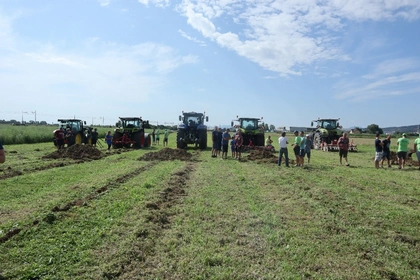
At the Agricultural Day, which took place on August 2, 2024 in Bohova, various subsoilers were presented. Subsoilers suitable for smaller tractors(70-100 HP) and those requiring much greater pulling power (250+ HP) were demonstrated. The differences were also in the shape of the tines and their effect on the soil. After the presentation of each subsoiler, we dug a hole so that we could closely observe the effects on the soil at depth. The purpose of the event was to show farmers and the general public the usefulness of subsoilers and to help them make decisions regarding their purchase and use.