




Select one or more regions of interest
by clicking on the filter elements
Drag the filter elements horizontally,
and select one or multiple
thematic areas of interest.
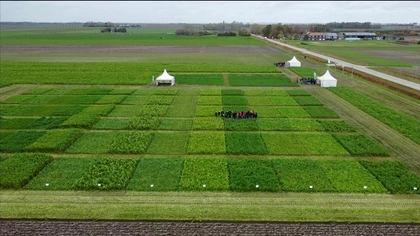
The Benefits of Cover Crops

Europe
All Zones
Benefits of the practice
- Soil health
- Climate mitigation
- Water adaptation
Production system(s)
Thematic Area(s)
Cover crops improve soil quality and boost agricultural productivity. They are often planted during fallow periods, like winter or post-harvest, to prevent bare soil and reduce erosion. Cover crops offer numerous benefits for soil and climate.
They enrich soil with nutrients like nitrogen, add organic matter, and enhance soil structure. This improves water retention, making soil more resilient to drought and heavy rainfall. Cover crops also suppress weeds by covering the soil and competing with unwanted plants, reducing the need for herbicides.
Another key advantage is erosion prevention. Cover crop roots anchor soil, preventing erosion, especially on slopes or areas prone to wind and water erosion. By reducing erosion, they help maintain long-term soil fertility.
Cover crops promote biodiversity by attracting pollinators and pest predators, reducing pesticide reliance, and supporting a healthier ecosystem.
They also aid in climate mitigation and adaptation. By sequestering carbon in the soil, they reduce CO₂ levels and lower greenhouse gas emissions. Additionally, they fix nitrogen, reducing nitrous oxide emissions, a potent greenhouse gas.
Healthier soil with more organic matter retains water better, helping farms withstand extreme weather. This reduces the impact of droughts and floods on agricultural productivity and contributes to long-term sustainable food production.
Different cover crops serve specific needs. Clover fixes nitrogen and improves soil structure, buckwheat grows quickly and suppresses weeds, winter rye enhances weed control and soil structure, phacelia attracts pollinators, and mustard reduces soil diseases while boosting biodiversity.
Groenbemesters zijn gewassen die worden geplant om de bodemkwaliteit te verbeteren en de landbouwproductiviteit te verhogen. Ze worden vaak gebruikt tijdens braakliggende periodes, zoals in de winter of aan het einde van het groeiseizoen, om te voorkomen dat de grond leeg blijft en erosie plaatsvindt1. Groenbemesters bieden tal van voordelen voor zowel de bodem als het klimaat.
Groenbemesters verrijken de bodem met voedingsstoffen, zoals stikstof, wat essentieel is voor de groei van gewassen. Ze kunnen ook organisch materiaal toevoegen aan de bodem, wat de bodemstructuur verbetert. Dit helpt bij het verbeteren van de waterretentiecapaciteit van de bodem, waardoor de bodem beter bestand is tegen droogte en extreme regenval. Bovendien kunnen groenbemesters de groei van onkruid onderdrukken door de bodem te bedekken en de competitie aan te gaan met ongewenste planten. Dit vermindert de noodzaak voor chemische onkruidbestrijdingsmiddelen, wat gunstig is voor het klimaat.
Een ander belangrijk voordeel van groenbemesters is dat ze bodemerosie helpen voorkomen. Het wortelstelsel van groenbemesters houdt de bodem stevig op zijn plaats, waardoor erosie wordt voorkomen1. Dit is vooral belangrijk in gebieden met hellingen of waar de bodem gevoelig is voor erosie door wind of water. Door erosie te verminderen, helpen groenbemesters ook bij het behoud van de bodemvruchtbaarheid op de lange termijn.
Groenbemesters bevorderen ook de biodiversiteit. Het planten van verschillende soorten groenbemesters kan gunstig zijn voor bestuivende insecten en het aantrekken van natuurlijke vijanden van plagen. Dit kan helpen bij het verminderen van de afhankelijkheid van chemische bestrijdingsmiddelen en het bevorderen van een gezonder ecosysteem.
Wat betreft de voordelen voor het klimaat, spelen groenbemesters een cruciale rol in zowel klimaatmitigatie als klimaatadaptatie. Door koolstof vast te leggen in de bodem, helpen groenbemesters bij het verminderen van de hoeveelheid koolstofdioxide (CO₂) in de atmosfeer. Dit draagt bij aan de vermindering van de broeikasgasemissies en helpt bij het bestrijden van klimaatverandering. Bovendien kunnen groenbemesters stikstof binden, wat de uitstoot van lachgas, een krachtig broeikasgas, vermindert.
Groenbemesters dragen ook bij aan klimaatadaptatie door de bodemgezondheid te verbeteren. Een gezondere bodem met meer organisch materiaal en een beter bodemleven kan meer water vasthouden, wat essentieel is voor de veranderende klimaatomstandigheden. Dit helpt bij het verminderen van de impact van extreme weersomstandigheden, zoals droogte en overstromingen, op de landbouwproductiviteit. Bovendien draagt een gezondere bodem bij aan een duurzame voedselproductie op de lange termijn.
Er zijn verschillende soorten groenbemesters die kunnen worden gebruikt, afhankelijk van de specifieke behoeften van de grond en gewassen. Enkele populaire typen groenbemesters zijn klaver, boekweit, winterrogge, phacelia en mosterd. Klaver is bijvoorbeeld bekend om zijn vermogen om stikstof te fixeren en de bodemstructuur te verbeteren, terwijl boekweit snel groeit en onkruid kan onderdrukken. Winterrogge is ideaal voor het onderdrukken van onkruid en het verbeteren van de bodemstructuur, terwijl phacelia bestuivende insecten aantrekt en de bodemstructuur verbetert. Mosterd kan schadelijke ziektes in de bodem verminderen en de biodiversiteit vergroten.
Cover crops are plants grown to improve soil quality and increase agricultural productivity. They are often used during fallow periods, such a sin winter or at the end of the growing season, to prevent the soil from remaining bare and to reduce erosion. Cover crops offer numerous benefits for both the soil and the climate.
Cover crops enrich the soil with nutrients, such as nitrogen, which is essential for plant growth. They also add organic matter to the soil, improving its structure. This enhances the soil’s water retention capacity, making it more resilient to drought and heavy rainfall. Additionally, cover crops suppress weed growth by covering the soil and competing with unwanted plants. This reduces the need for chemical herbicides, which benefits the climate.
Another key advantage of cover crops is that they help prevent soil erosion.
Their root systems hold the soil firmly in place, preventing erosion. This is especially important in areas with slopes or where the soil is prone to erosion by wind or water. By reducing erosion, cover crops also help maintain soil fertility in the long term.
Cover crops promote biodiversity. Planting different types can benefit pollinating insects and attract natural enemies of pests. This helps reduce reliance on chemical pesticides and promotes a healthier ecosystem.
Regarding climate benefits, cover crops play a crucial role in both climate mitigation and adaptation. By sequestering carbon in the soil, they help reduce the amount of carbon dioxide (CO₂) in the atmosphere, lowering greenhouse gas emissions and combating climate change.
Additionally, cover crops fix nitrogen, reducing nitrous oxide emissions, a potent greenhouse gas.
Cover crops also contribute to climate adaptation by improving soil health.
Healthier soil with more organic matter and better microbial activity retains more water, essential for changing climate conditions. This helps reduce the impact of extreme weather events, such as droughts and floods, on agricultural productivity. Moreover, healthier soil supports long-term sustainable food production.
Various types of cover crops can be used depending on soil and crop needs.
Popular options include clover, buckwheat, winter rye, phacelia, and mustard. Clover fixes nitrogen and improves soil structure, buckwheat grows quickly and suppresses weeds, winter rye enhances weed control and soil structure, phacelia attracts pollinators, and mustard reduces soil diseases while boosting biodiversity.

Profitable Climate Actions on Dairy Farms

Sweden
Nordic Cluster
Benefits of the practice
- Improved milk yields and feed ration
- Less feed waste
- Better growth and health of the animals
Production system(s)
Thematic Area(s)
Measures that benefit the environment and climate often improve farm economics by optimizing resource use and efficiency. Greppa Näringen conducted climate calculations using the Vera Klimatkollen tool on a dairy farm to assess the impact of different strategies on climate and economy.
The modeled farm has conventional production with:
200 cows
240 ha arable land (170 ha grassland/field pasture)
50 ha natural pasture
Grassland, cereals, and whole-crop silage (oats/peas)
Bull calves and some grain/straw sold
Feed Ration (kg DM/day)
Ley & whole-crop silage: 10.5
Beet pulp (molasses dried): 3.6
Grain: 1.7
Concentrate/protein mix: 4.3
ExPro (rapeseed protein): 1.6
Key Figures:
Milk yield: 10,000 kg ECM
Young heifers: 130 kg
Old heifers: 65 kg
Bull calf sale age: 2 weeks
Calving age: 27 months
Recruitment rate: 35%
Calf mortality: 5%
Calving interval: 13.2 months
Milk delivered: 92%
Forage waste: 15%
Alternative Scenarios
Option 2: Replaces soya/palm products with more self-produced feed, lowering the farm’s carbon footprint.
Option 3: Focuses on better animal growth, health, and management, reducing recruitment rates, calving ages, and calf mortality.
Option 4: Increases milk yield to 12,000 kg ECM per cow with improved management, using more silage but maintaining feed ratios.
Option 5: Reduces feed wastage from 15% to 5%, decreasing HP pulp purchases. The freed land is used to grow rapeseed and field beans for sale.
Options 6, 7, 8: Combine multiple strategies.
The greatest impacts come from higher milk yields, improved feed conversion, reduced feed waste, and better animal growth and health.
Åtgärder som är bra för miljön och klimatet är också ofta bra för gårdens ekonomi. Det handlar om att hushålla med resurser och vara så effektiv som möjligt i sin produktion. Greppa Näringen har gjort klimatberäkningar med verktyget Vera klimatkollen på en mjölkgård för att se vad olika alternativ har för effekt på gårdens klimatpåverkan och ekonomi.
Den mjölkgård som använts i klimatberäkningarna har konventionell drift med nedanstående produktion och nyckeltal (alternativ 1).
200 kor
240 ha åkermark (varav vall och åkerbete 170 ha)
50 ha naturbetesmark
Vall, spannmål och helsädesensilage (havre/ärt)
Tjurkalvar samt en del av spannmålen och halmen säljs
I alternativ 2 är soja- och palmprodukter utbytta mot mer egenproducerat foder som ger lägre klimatavtryck. De inköpta fodermedlen är totalt sett lägre då mer ensilage och spannmål ges till korna.
I alternativ 3 är bättre tillväxt, hälsa och skötsel i fokus. Detta ger lägre rekryteringsprocent, inkalvningsålder och kalvdödlighet.
I alternativ 4 med högre mjölkavkastning genom bättre management. höjs produktionen till 12 000 kg ECM per ko och år. Korna äter mer ensilage, men i övrigt är foderstaten och nyckeltalen oförändrade.
Alternativ 5 med minskning av foderspill och överutfodring av grovfoder och HP-massa, från 15 % till 5 %. Gården köper in mindre HP-massa och odlar mindre ensilage och helsäd. På den åkermarken odlas i stället raps och åkerbönor till avsalu.
Alternativ 6, 7 och 8 kombinerar flera scenario. Modelleringen visar att störst betydelse har förbättrad mjölkavkastning och foderstat, mindre foderspill samt bättre tillväxt och hälsa hos djuren.
In Sweden, two different tools, Vera Klimatkollen and Agrosfär, are used to perform climate calculations within Climate Farm Demo. Greppa Näringen, the developer of Vera Klimatkollen, has modeled several scenarios for a dairy farm to determine whether measures that benefit the climate are also economically advantageous for the farm.
The dairy farm used in the modeling has conventional farming with the following production and key figures (Option 1):
• 200 cows
• 240 ha arable land (of which 170 ha is grassland and field pasture)
• 50 ha natural pasture
• Grassland, cereals, and whole-crop silage (oats/peas)
• Bull calves and part of the grain and straw sold
Key Figures and Feed Ration (kg DM/day)
• Milk production: 10,000 kg ECM
• Ley & whole-crop silage: 10.5
• Beet pulp (molasses dried): 3.6
• Grain: 1.7
• Concentrate & protein mix: 4.3
• ExPro (rapeseed protein): 1.6
• Young heifers: 130 kg
• Old heifers: 65 kg
• Bull calf sale age: 2 weeks
• Calving age: 27 months
• Recruitment rate: 35%
• Calf mortality: 5%
• Calving interval: 13.2 months
• Milk delivered: 92%
• Forage wastage: 15%
Alternative Scenarios (see Table 1)
– Option 2: Replaces soya and palm products with more self-produced feed, which has a lower carbon footprint. The overall quantity of purchased feed is reduced as cows receive more silage and cereals.
More ley is grown, while less oats and spring wheat are cultivated. The feed ration is formulated to maintain the same milk yield as the baseline. The economic outcome remains almost unchanged, meaning that production and profitability are maintained, but with a significantly lower climate impact.
– Option 3: Focuses on improved growth, health, and management, leading to lower recruitment rates, reduced calving ages, and lower calf mortality. To distinguish between the climate footprint of replacement heifers and slaughter animals, the farm sells all heifer calves that are not recruited. This results in 75 younger heifers and 45older heifers, reducing the recruitment rate to 30%, calving age to 24months, and calf mortality to 2%. Fewer animals go to carcass and slaughter since future slaughter heifers are sold at a younger age.
While income from slaughtering animals decreases, savings are made on feed, buildings, and labor. If the farm has limited space for young animals, selling more animals earlier can be beneficial. More straw and silage are also sold.
– Option 4: Increases milk yield to 12,000 kg ECM per cow per year through better management. Cows consume more silage, but the feed ration and key figures remain unchanged. The farm grows 112tonnes (t) more forage, while producing 30 t less winter wheat and 30t less spring wheat compared to the baseline. Since more forage is grown and more cereals are retained, total income decreases, but increased milk income compensates for this.
– Option 5: Reduces feed wastage and overfeeding of forage and beet pulp from 15% to 5%. The farm purchases 40 t less beet pulp and cultivates 127 t less silage and 12 t less whole-crop silage. Instead, 21 t of rapeseed and 22 t of field beans are grown on the freed-up arable land for sale, generating an additional SEK 127,000. Reducing input losses also lowers the farm’s carbon footprint on the final products.
– Options 6, 7, and 8: Combine multiple scenarios. The most significant impacts result from improved milk yields, better feed conversion, reduced feed waste, and enhanced animal growth and health.
Green Manure: Environmental Measure for Sustainable Fruit Production

Italy
Mediterranean Area
Benefits of the practice
- Farm production efficiency
- Environmental sustainability
- Mitigation strategies
Production system(s)
Thematic Area(s)
Among the agronomic practices used to increase fertility, improve soil structure, enhance biodiversity and reduce the environmental impact of agricultural systems, green manure plays a key role. It is referred to as green manure because it can replace animal waste in the organic fertilization of cultivated land. This practice is widely used in horticulture to counteract the deterioration of soil fertility.
Green manure involves sowing specific intercalary herbaceous plants in rotation with high-income crops. The goal is to bury these plants to improve the productive performance of the next horticultural crop, orchard, or vineyard. However, its primary function is to increase organic matter in the soil by incorporating the plant mass, with all the resulting benefits.
The maximum benefit of this practice is achieved by using legumes, grasses, or buckwheat, which effectively absorb nitrogen. Ideal seed mixtures should have biological cycles of similar duration to ensure uniform flowering. Additionally, mixtures with coarse shredding should be used, with residues left to dry in the field before burial, maximizing the organic matter contribution to the soil.
Following these simple guidelines, combined with careful planning, allows farms to add large quantities of high-quality organic material to the soil. This enriches the soil with key biological fertility factors, benefiting farms by providing a more productive substrate.
A carefully chosen green manure composition also helps prepare a more favorable growing environment for the next crop, ensuring better agricultural results.
Fra le pratiche agronomiche usate per aumentare la fertilità, migliorare la struttura del suolo, migliorare la biodiversità e diminuire l’impatto ambientale dei sistemi agricoli c’è il sovescio che viene definito come letame verde, perché può, appunto, sostituire le deiezioni animali nella concimazione organica dei terreni coltivati. Questa pratica agronomica viene utilizzata nell’orticoltura per contrastare il deteriorarsi della fertilità. Il sovescio è una tecnica che consiste nella semina di specifiche erbacee intercalari in rotazione con colture ad alto reddito. Lo scopo è quello di interrare le intercalari e migliorare così le performance produttive della coltura orticola successiva in rotazione oppure di un frutteto o di un vigneto. La funzione fondamentale del sovescio è comunque l’aumento di sostanza organica nel suolo, conseguente all’interramento della massa vegetale, con tutti i benefici che ne derivano. La massima utilità di questa pratica si ottiene utilizzando leguminose, graminacee o grano saraceno che assorbono azoto; miscugli che abbiano cicli biologici di durata molto simile in modo tale da avere una fioritura omogenea, miscugli che abbiano una trinciatura grossolana i cui residui siano lasciati essiccare in campo prima dell’interramento in modo tale da apportare una levata quantità di sostanza organica nel terreno. L’osservazione di queste semplici “regole” unita ad una precisa programmazione permette alle aziende di apportare la terreno grandi quantità di sostanza organica di qualità elevata. Il terreno così si arricchisce di tutti quei fattori che ne vanno a comporre la fertilità biologica a tutto vantaggio delle aziende che possono disporre di un substrato su cui produrre con migliori risultati. La scelta oculata della composizione del sovescio consente poi di preparare, già in questa fase, un substrato più “accogliente” per la coltura che lo seguirà.
Among the agronomic practices used to increase fertility, improve soil structure, enhance biodiversity, and reduce the environmental impact of agricultural systems, green manure plays a key role. It is called green manure because it can replace animal waste in the organic fertilization of cultivated land. This practice is used not only on conventional and organic farms but is also widely adopted in fruit-producing farms to counteract soil fertility loss.
Green manure involves alternating normal crops with specific plant families that have particular characteristics. These plants are chopped and buried, enriching soil fertility. This technique allows for a significant increase in organic matter when manure is not available.
The benefits of green manure include:
• Better nitrogen management: Root nodules, especially those of legumes, fix atmospheric nitrogen (N₂), making it directly available to plants.
• Improved soil structure: Makes the soil softer and more workable while increasing water and nutrient retention.
• Erosion prevention: Enhances structural stability and protects against erosion and weathering, thanks to the surface layer of plant sand the root system in the subsoil.
• Natural pest control: Green manure crops act as natural pesticides by releasing biocidal molecules (biofumigation) from their roots, unlike intensive agriculture, which relies on chemical pesticides that release ammonia into the air.
• Weed suppression: Helps control weed growth by competing for resources.
• Aesthetic and ecological benefits: During flowering, mixed-species sowing creates colorful landscapes, while honey-producing plants attract beneficial insects such as bees.
The most used green manure plants belong to these categories:
• Legumes (clover, vetch, broad bean, sainfoin, protein pea) provide nitrogen through root symbiosis with nitrogen-fixing bacteria.
• Grasses (barley, rye, oats, fescue) and buckwheat help absorb nitrogen from the soil.
A good green manure practice involves selecting varieties with similar biological cycles to ensure uniform flowering. Proper shredding and drying of residues before burial maximizes the organic matter supply, which also depends on the carbon-to-nitrogen (C/N) ratio.
Following these simple principles, combined with precise planning, allows farms to enrich the soil with large quantities of high-quality organic matter. This enhances biological fertility, providing farmers with a more productive substrate for future crops. The careful selection of green manure composition ensures that the soil is well-prepared for the next crop, creating a more favorable growing environment right from the start.
Fat Supplementation of Dairy Cow Diets

Latvia
Temperate, Humid Continental
Benefits of the practice
- Feed enrichment
- Reduction of methane emissions
- Fats in dairy cow diets
Production system(s)
Thematic Area(s)
Fat enrichment involves increasing the proportion of certain feed ingredients—such as fatty substances (rapeseed, linseed, sunflower oil, rapeseed oil)—to 5–6% of dry matter in the feed. The primary effect of fat supplementation is to replace other energy sources, mainly carbohydrates, and to reduce methane production.
Scientific studies on sheep, cattle, and dairy cows in other countries (Beauchemin et al., 2008) have shown that for every 1% increase in fat (on a dry matter basis), CH₄ emissions decrease by 2.2–7.3%:
⦁ Coconut oil: 7.3% reduction
⦁ Soybean and sunflower oil: 4.1% reduction
⦁ Linseed oil: 4.8% reduction
⦁ Rapeseed oil: 2.5% reduction
⦁ Fats (saturated): 3.5% reduction
By formulating feed rations for dairy cows, it is evident that including rapeseed or rapeseed oil can reduce methane emissions by approximately 9%. This approach is a viable option not only for conventional farms but also for organic farms.
Reducing microbial activity in the rumen lowers fiber digestion and alters volatile fatty acid (VFA) profiles—acetic (60–70%), propionic (20–25%), and butyric acid (10–15%). Imbalances affect milk fat/protein and methane emissions. The acetic-to-propionic acid ratio influences hydrogen use for methane production; typical ratios range from 9:1 to 4:1. Proper feed composition can reduce methane losses. Studies show 5% dietary fat improves early lactation milk yield, with cows able to utilize 0.45 g/day of added fat. Grain-based diets with fat maintain energy and fiber intake. Supplementing up to 5% fat is effective, especially in large herds grouped by lactation phase. Fat enrichment reduces CH₄ emissions—1% more fat lowers emissions by 5%. Feed modeling shows rapeseed oil reduces methane by ~9%, offering a promising strategy for both organic and conventional farms to cut GHG emissions while maintaining productivity.
Barības bagātināšana ar taukvielām pamatojas uz atsevišķu barības sastāvdaļu, t.i. taukvielu (rapšu sēklas, linsēklas, saulespuķu eļļa, rapša eļļas), īpatsvara palielināšanu barībā 5 līdz 6% apmērā no sausnas. Galvenā tauku ietekme izpaužas tā, ka ar taukiem barībā aizvieto citus enerģijas avotus, pamatā ogļhidrātus un samazina metāna veidošanos.
Zinātnieku pētījumos citās valstīs ar aitām, liellopiem un slaucamām govīm (Beauchemin et al., 2008), noskaidrots, ka katrs 1% tauku (uz sausni), samazina CH4 emisiju par 2,2–7,3% apmērā:
⦁ kokosriekstu eļļa par 7,3%;
⦁ sojas un saulespuķu eļļa par 4,1%;
⦁ linsēklu eļļa par 4,8%;
⦁ rapšu eļļa par 2,5%;
⦁ tauki ( piesātinātās taukskābes) par 3,5%.
Sastādot barības devas (sk.1.attēlu) slaucamajām govīm, redzams, ka metāna emisiju samazinājumu par ~9% varam panākt iekļaujot rapšu sēklas vai rapšu eļļu, kas ir reāls risinājums ne tikai konvencionālajās, bet arī bioloģiskajās saimniecībās.
Samazinot mikrobu aktivitāti spureklī, samazinās kokšķiedras sagremošana un mainās gaistošo taukskābju (VFA) – etiķskābes (60-70 %), propionskābes (20-25 %) un sviestskābes (10-15 %) – profils. Disbalanss ietekmē piena tauku/proteīnu un metāna emisiju. Etiķskābes un propionskābes attiecība ietekmē ūdeņraža izmantošanu metāna ražošanai; tipiskā attiecība ir no 9:1 līdz 4:1. Pareizs barības sastāvs var samazināt metāna zudumus. Pētījumi liecina, ka 5 % tauku daudzums barības devā uzlabo izslaukumu laktācijas sākumā, un govis var izmantot 0,45 g pievienoto tauku dienā. Uz graudiem balstītas barības devas ar taukiem saglabā enerģijas un kokšķiedras uzņemšanu. Tauku piedevas līdz 5 % ir efektīvas, jo īpaši lielos ganāmpulkos, kas sagrupēti pēc laktācijas fāzes. Tauku pievienošana samazina CH₄ emisijas – par 5% vairāk tauku samazina emisijas par 5%. Barības devu modelēšana liecina, ka rapšu eļļa samazina metānu par ~9%, piedāvājot daudzsološu stratēģiju gan bioloģiskajām, gan tradicionālajām saimniecībām, lai samazinātu SEG emisijas, vienlaikus saglabājot produktivitāti.
Fat enrichment involves increasing the proportion of certain feed ingredients, specifically fatty substances (rapeseed, linseed, sunflower oil, rapeseed oil), to 5–6% of dry matter in the feed. The primary effect of fat supplementation is to replace other energy sources, mainly carbohydrates, and to reduce methane production.
Research by international scientists has explored various strategies to reduce methane emissions from the intestinal tract of cattle, with one proposed solution being fat enrichment in feed through the inclusion of fatty acids.
Fat enrichment involves increasing the proportion of fatty acids in the diet by incorporating various vegetable oils (e.g., sunflower, rapeseed, linseed, hemp, cottonseed). Animal nutrition scientists in Latvia recommend adding vegetable oils to compound or complete mixed rations (TMR) at 5% of dry matter for dairy cows, pregnant heifers, breeding heifers, young stock (6–12months), and calves (3–6 months), and 3% for fattening and beef cattle(Latvian, 1991, 1998, 2013; Ositis, 2000).
Scientific studies on sheep, cattle, and dairy cows (Beauchemin et al., 2008)indicate that every 1% increase in fat (on a dry matter basis) reduces CH₄ emissions by 2.2–7.3%:
• Coconut oil: 7.3% reduction
• Soybean and sunflower oil: 4.1% reduction
• Linseed oil: 4.8% reduction
• Rapeseed oil: 2.5% reduction
• Saturated fats: 3.5% reduction
Fat supplementation partially replaces carbohydrates, which are fermented in the rumen, producing CH₄ as a by-product. In contrast, fat is processed in the intestine, where methane is not generated. Additionally, unsaturated fatty acids found in linseed, rapeseed, and sunflower seeds selectively inhibit certain microorganisms in the rumen, reducing their activity and there by lowering CH₄ emissions.
The reduction in microbial activity (infusoria, yeast fungi, bacteria) in the rumen decreases fiber digestion (cellulose, hemicellulose), impacting the formation of volatile fatty acids (VFAs):
• Acetic acid: 60–70%
• Propionic acid: 20–25%
• Butyric acid: 10–15%
An imbalance in these VFAs affects production, metabolism, and milk composition, as milk fat and protein content can decrease rapidly (Latvian,1991). The rumen fermentation mechanism regulates hydrogen availability for methane production. The acetic-to-propionic acid ratio is a key factor:
• If the ratio is 5:1, methane energy loss is 0%.
• If all carbohydrates ferment into acetic acid without propionic acid production, methane energy loss can reach 33%.
• Typical acetic-to-propionic acid ratios range from 9:1 to 4:1(Johnson and Johnson, 1995).
Since the formation of VFAs is influenced by feed composition, proper diet formulation plays a crucial role in methane reduction strategies.
Impact on Milk Production and GHG Emissions
Long-term studies indicate that 5% fat in total dry matter optimizes milk production in early lactation (Palmquist, 1983). In addition to naturally occurring fats, cows can utilize an additional 0.45 g/day of fat (Palmquist,1983).
The most accessible energy source for dairy cows is grain. Adding fat to starchy, grain-based diets maintains high energy levels while allowing for adequate fiber intake (Palmquist and Conrad, 1980). Fat supplementation up to 5% of dry matter at the start of lactation helps address energy deficits without negatively impacting metabolism and production. This strategy is particularly effective on farms grouping cows by lactation phase, especially in herds with more than 50 cows (Project report: “Development of a methodology for estimation of GHG emissions from the agricultural sector and data analysis with modeling tools integrating climate change” Contract No 2014/94).
Impact of Fat Enrichment on GHG Emissions
Studies have shown that increasing dietary fat by 1% reduces CH₄ emissions by 5% (Grainger, Beauchemin, 2011). Feed ration modeling (see Figure 1)suggests that incorporating rapeseed or rapeseed oil can lower methane emissions by ~9%, making it a viable solution for both conventional and organic farms.
Dairy Cow Feed Rations and Ammonia Emissions
Latvia
Temperate, Humid Continental
Benefits of the practice
- Reducing nitrogen losses
- Balancing feed rations
- Ammonia emissions
Production system(s)
Thematic Area(s)
On farms, reducing nitrogen losses in livestock not only helps to preserve the environment, but also improves the farm’s bottom line.
Ruminant livestock are not very efficient at using the nitrogen they take up in feed. If rations are very precisely calculated, 30 to 35 percent of the nitrogen in feed proteins and non-protein compounds becomes a component of milk. The rest of the nitrogen is excreted from the body mainly in urine and faeces. About 60 to 80 per cent of urinary nitrogen is in the form of urea.
Urea concentration in urine is an important indicator of ammonia emissions in dairy farming. It is possible to adjust both the urine output, the urinary urea concentration and the total manure output with the feed ration. It must be clearly understood that urine and faeces separately emit very minimal quantities of ammonia, but only after they reach the floor surfaces in the housing and these two fractions of excreta physically mix, ammonia is released.
There are additional factors that influence the evaporation of ammonia in cow housing. These include temperature, air velocity, pH, size of floor surfaces, moisture content of manure and storage time. For example, high pH and temperature contribute to increased ammonia emissions. Dairy cow manure typically has a pH between 7.0 and 8.5, which allows ammonia to be released into the atmosphere quite quickly.
The deposition of atmospheric ammonia and chemical compounds resulting from atmospheric chemical reactions with ammonia (i.e. ammonium aerosol) is thought to contribute to water and soil acidification and eutrophication.
Thus, one solution is to balance feed rations as closely as possible to the amino acid needs of the cow: the amount of crude protein in the diets of high-yielding cows can be safely reduced, allowing farms to maintain high milk yields (above 35 kg per cow per day) while improving nitrogen use efficiency.
Saimniecībās, samazinot slāpekļa zudumus ganāmpulkā, palīdzam ne tikai vides saglabāšanai, bet arī uzlabojam saimniecības peļņas rādītājus.
Atgremotāji ne īpaši efektīvi izmanto ar barību uzņemto slāpekli. Ja barības devas ir ļoti precīzi sarēķinātas, tad 30 līdz 35 procenti no slāpekļa, kas ir barības olbaltumvielu sastāvā un neproteīna savienojumos, kļūst par piena sastāvdaļu. Pārējais slāpeklis no organisma tiek izvadīts pamatā ar urīnu un fēcēm. Apmēram 60 līdz 80 procenti no urīna slāpekļa ir urīnvielas formā.
Urīnvielas koncentrācija urīnā ir būtisks indikatorrādītājs amonjaka emisijām piena lopkopībā. Ar barības devām ir iespējams koriģēt gan urīna daudzumu, gan urīnvielas koncentrāciju urīnā, gan kopējo mēslu daudzumu. Ir pilnīgi skaidri jāsaprot, ka urīns un fēces atsevišķi emitē ļoti minimālus amonjaka daudzumus, bet tikai pēc nonākšanas uz grīdu virsmām novietnēs un abām šīm izdalījumu frakcijām fiziski sajaucoties notiek amonjaka izdalīšanās.
Ir arī papildu faktori, kas ietekmē amonjaka iztvaikošanu govju novietnēs. Tie ir temperatūra, gaisa plūsmas ātrums, pH, grīdas virsmu laukumu lielums, kūtsmēslu mitruma saturs un uzglabāšanas laiks. Piemēram, augsts pH un temperatūra veicina paaugstinātu amonjaka emisiju. Slaucamo govju kūtsmēslu pH parasti svārstās no 7,0 līdz 8,5, kas ļauj amonjakam diezgan ātri izdalīties atmosfērā.
Tiek uzskatīts, ka atmosfēras amonjaka un ķīmisko savienojumu nogulsnēšanās, kas rodas atmosfēras ķīmiskās reakcijās ar amonjaku (t.i., amonija aerosolu), veicina ūdens un augsnes paskābināšanos un eitrofikāciju. 1. attēlā parādīts slāpekļa cikls un ietekme gan uz ūdens, gan gaisa kvalitāti.
On farms, reducing nitrogen losses in livestock not only helps to preserve the environment but also improves the farm’s bottom line.
Ruminant livestock are not very efficient at using the nitrogen they take up in feed. If rations are very precisely calculated, 30 to 35 percent of the nitrogen in feed proteins and non-protein compounds becomes a component of milk. The rest of the nitrogen is excreted from the body, mainly in urine and faeces. About 60 to 80 percent of urinary nitrogen is in the form of urea.
Urea concentration in urine is an important indicator of ammonia emissions in dairy farming. It is possible to adjust both urine output, urinary urea concentration, and total manure output with the feed ration. It must be clearly understood that urine and faeces separately emit very minimal quantities of ammonia, but only after they reach the floor surfaces in housing and these two fractions of excreta physically mix is ammonia released.
There are additional factors that influence the evaporation of ammonia in cow housing. These include temperature, air velocity, pH, size of floor surfaces, moisture content of manure, and storage time. For example, high pH and temperature contribute to increased ammonia emissions.
Dairy cow manure typically has a pH between 7.0 and 8.5, which allows ammonia to be released into the atmosphere quite quickly.
The deposition of atmospheric ammonia and chemical compounds resulting from atmospheric chemical reactions with ammonia (i.e. ammonium aerosol) is thought to contribute to water and soil acidification and eutrophication. Figure 1 shows the nitrogen cycle and its impact on both water and air quality.
There are two ways to reduce nitrogen losses from cows. First, the microorganisms living in the rumen must effectively “consume” the protein and nitrogen present. The second is to balance feed rations as closely as possible to the amino acid needs of the cow so that the total amount of protein is reduced, and the amount of excess nitrogen is correspondingly lowered.
Feeding high-protein diets is not only harmful to the environment but also to the animals. Making the most of nitrogen in the animal is also a way to reduce the cost of milk production. If the liver is overloaded with ammonia, blood urea levels will increase, as will the amount of milk urea (MUN). This can have adverse effects on cow health and reproduction. Excessive ammonia build-up in the cow results from overfeeding, when too much nitrogen and/or protein reaches the micro-organisms in the rumen.
Additional energy is required to remove the excess nitrogen from the body, which can lead to a reduction in milk yield and other performance parameters. Excess ammonia is converted to urea in the kidneys and liver.
Urea is a small organic compound formed from carbon, nitrogen, oxygen, and hydrogen. It is primarily eliminated from the body in the urine, but as blood urea levels rise, so does the amount of urea in milk.
This is why the amount of urea in milk is measured—to assess how much of the protein (nitrogen) intake is being lost due to inefficient utilization.
By balancing rations according to amino acid requirements, the amount of crude protein in the diets of high-yielding cows can be safely reduced from17.5% to 16.6%, allowing farms to maintain high milk yields (above 35 kg per cow per day) while improving nitrogen use efficiency.
There is a second benefit: the amount of nitrogen in the manure is reduced, which means fewer hectares are needed for manure spreading to stay within nitrogen limits per hectare.
A very important factor in successfully reducing crude protein in the ration is accurate on-farm feeding and knowing the chemical composition of the forage very precisely—or conducting forage analyses on the farm
Pea-Rapeseed Rotation: Improving Performance and Reducing Production Costs

France
Oceanic & Continental Zones
Benefits of the practice
- Improvement of soil fertility: Nitrogen fixation by peas increases mineral soil nitrogen for rapeseed and hence reduces GHG emissions
- Improvement of rapeseed establishment and weed management
- Increased rapeseed yield by 1.9 quintals per hectare
Production system(s)
Thematic Area(s)
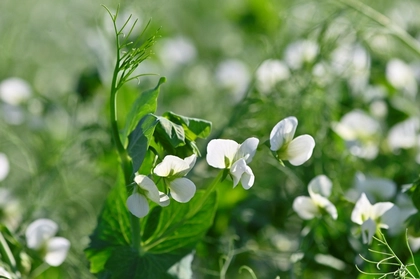
Feasibility trials of growing rapeseed after protein peas have demonstrated several practical advantages for farmers. Peas fix atmospheric nitrogen, enriching the soil for rapeseed, which reduces the need for nitrogen fertilizers, thereby lowering production costs and GHG emissions. Rapeseed efficiently absorbs the residual nitrogen from peas, resulting in better nutrient utilization and enhanced growth.
Peas leave minimal crop residues, facilitating rapeseed planting without plowing. This rotation improves soil preparation and reduces the risk of phytotoxicity from herbicides, compared to a wheat predecessor. Optimized seeding conditions further promote good rapeseed emergence.
Regarding weed management, cereal regrowth before rapeseed may require a specific grass herbicide, whereas pea regrowth is frost-sensitive and does not pose a major issue. The diversification of rotations with peas also improves weed control at the rotation level, thanks to staggered sowing dates and the use of different herbicide molecules.
Observations revealed no significant differences in sclerotinia levels between pea and cereal precedents, indicating that the pea-rapeseed rotation does not increase disease risk. This helps maintain good crop health without requiring additional fungicide treatments.
Trial results also show that the nitrogen fertilizer requirement for rapeseed is, on average, reduced by 19 kg N/ha after peas compared to cereals. This fertilizer saving, combined with a yield increase of 1.6 quintals per hectare, enhances the profitability of growing rapeseed after peas. Farmers can thus benefit from lower production costs, improved economic performance, and reduced GHG emissions.
Les essais de faisabilité de la culture du colza après un pois protéagineux ont montré plusieurs avantages pratiques pour les agriculteurs. Le pois fixe l’azote atmosphérique, enrichissant le sol pour le colza suivant. Cela permet de réduire les besoins en engrais azotés, diminuant ainsi les coûts de production et les émissions de gaz à effet de serre. Le colza valorise bien l’azote résiduel du pois, ce qui se traduit par une meilleure utilisation des ressources en nutriments et une croissance accrue.
Le pois laisse peu de résidus de culture, facilitant l’implantation du colza sans labour. Cette rotation permet une meilleure préparation du sol et réduit les risques de phytotoxicité par rapport à une culture précédente de blé. Les conditions de semis sont ainsi optimisées, favorisant une bonne levée du colza.
En termes de gestion des adventices, les repousses de céréales cultivées avant le colza peuvent nécessiter l’application d’un désherbant antigraminées spécifique, tandis que les repousses de pois sont généralement gélives et ne posent pas de problème majeur. La diversification de la rotation avec le pois permet également de mieux gérer l’enherbement à l’échelle de la rotation, grâce à un décalage des dates de semis et à l’utilisation de différentes molécules herbicides.
Les observations n’ont pas révélé de différence significative dans les niveaux d’attaque de sclérotinia entre les précédents pois et céréales, indiquant que la succession pois-colza n’augmente pas le risque de cette maladie. Cela permet de maintenir une bonne santé des cultures sans nécessiter de traitements fongicides supplémentaires.
Les résultats des essais montrent également que la dose d’engrais azoté nécessaire pour le colza est en moyenne réduite de 19 kg N/ha après un pois par rapport à une céréale à paille. Cette économie d’engrais, combinée à l’augmentation du rendement de 1.6 quintaux par hectare, contribue à améliorer la rentabilité de la culture du colza après un pois. Les agriculteurs peuvent ainsi bénéficier d’une réduction des coûts de production, d’une meilleure performance économique et d’une diminution de leurs émissions de gaz à effet de serre.
Feasibility trials of growing rapeseed after peas have demonstrated several practical advantages for farmers. Peas are legume crops that fix atmospheric nitrogen through symbiotic bacteria, increasing soil mineral nitrogen content and benefiting subsequent crops such as rapeseed. As a result, the need for nitrogen fertilizers is reduced, lowering production costs and GHG emissions. Rapeseed efficiently absorbs residual nitrogen from peas, improving nutrient utilization and promoting better growth. Trial shave shown that the nitrogen fertilizer requirement for rapeseed is, on average, reduced by 19 kg N/ha after peas compared to cereals, while also achieving higher seed yields.
Peas leave fewer crop residues, facilitating rapeseed planting without plowing. This rotation enhances soil preparation and reduces the risk of phytotoxicity from herbicides, compared to a wheat predecessor.
Optimized seeding conditions further support good rapeseed emergence.
Experiments have shown that rapeseed grown after peas produces 1.6 quintals more per hectare than rapeseed following cereals. This yield increases results from better nitrogen utilization and more favorable seeding conditions.
Regarding weed management, cereal regrowth before rapeseed may require a specific grass herbicide, whereas pea regrowth is frost-sensitive and does not pose a major issue. Crop diversification with peas improves weed control at the rotation level due to staggered sowing dates and the use of different herbicide molecules. Observations indicate that the pea rapeseed rotation reduces weed pressure, particularly from grasses, and limits herbicide interventions, contributing to more sustainable crop management.
Sclerotinia, a common pathogen affecting both crops, does not pose a higher risk when rapeseed follows peas instead of cereals. This ensures good crop health without requiring additional fungicide treatments, reducing costs and environmental impacts associated with phytosanitary products.
The trial results confirm that fertilizer savings, combined with increased yields, improve the profitability of growing rapeseed after peas. Farmers benefit from lower production costs, better economic performance, and reduced GHG emissions.
In conclusion, the pea-rapeseed rotation offers significant agronomic and economic advantages, particularly in terms of soil fertility, weed management, yield improvement, production cost reduction, and GHG emissions mitigation. These results encourage the adoption of this practice to enhance the sustainability and profitability of cropping systems.
How to Reduce the Carbon Footprint in Arable Crop Production?

Croatia
Continental and Mediterranean
Benefits of the practice
- Decrease GHG emission in arable production
- Cover crop sowing methods
- Positive effect of introducing legumes into the crop rotation
Production system(s)
Thematic Area(s)
We have been witnessing climate change, and its impact on agriculture is enormous. Agriculture is one of the most vulnerable sectors affected by climate change. Therefore, several agricultural producers who are aware of this impact, as well as the need to adapt their production and implement climate-smart practices on their farms, have joined the Climate Farm Demo project.
It is important to present to farmers engaged in arable production the structure of sowing on farms, the method of tillage, and whether, and which, cover crops are sown (winter or spring). As integral stakeholders of the ecosystem, seed producers and distributors—with their offer of leguminous seeds and mixtures of seeds from different botanical species for various purposes—must be included in efforts to adapt agriculture to climate change.
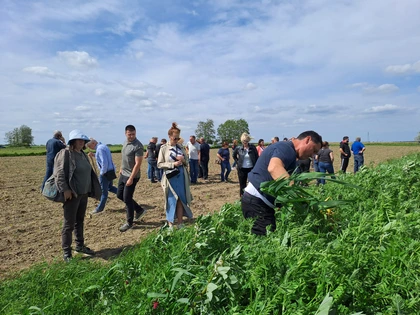
It is also very important to show farmers different types of winter cover crops, such as mixtures of winter vetch, winter broad beans, black beans, and broad bean crops intended for processing. Demonstrating the nodules on the roots of legumes and emphasizing the positive effects of introducing legumes into crop rotation is essential.
However, it is important to emphasize that sowing cover crops involves several soil maintenance measures that include the presence of vegetation on the land, with the aim of maintaining or increasing soil organic matter content, improving the physical properties of the soil (soil structure, water-air relations), accumulating nitrogen in the soil through legume cultivation, enhancing soil microbiological activity, and controlling weeds through biological methods—in general, increasing soil fertility.
Additionally, cover crops serve the important function of “soil cover” with the intention of preventing erosion (by water and/or wind) and nutrient leaching, primarily nitrates, thereby helping to prevent groundwater pollution.
Svjedoci smo klimatskih promjena, a utjecaj klime na poljoprivredu je ogroman. Poljoprivreda je jedan od najranjivijih sektora na koje utječu klimatske promjene. Stoga su se poljoprivredni proizvođači koji su svjesni utjecaja klimatskih promjena na poljoprivrednu proizvodnju, ali i potrebe da svoju poljoprivrednu proizvodnju prilagode te implementiraju klimatski pametne prakse na svom gospodarstvu, uključili u CFD projekt. Stoga je bitno poljoprivrednicima koji se bave ratarskom proizvodnjom predstaviti strukturu sjetve na gospodarstvima, način obrade tla te siju li pokrovne usjeve i koje (ozime ili jare). Kao sastavni dionici AKIS-a, u prilagodbu na klimatske promjene u ratarstvu moraju se uključiti i proizvođači i distributeri sjemena sa svojom ponudom sjemena mahunarki, ali i smjesa sjemena različitih botaničkih vrsta za različite namjene. Također, vrlo je bitno ratarima tijekom obilaska parcela prikazati različite tipove ozimog pokrovnog usjeva poput smjese ozime grahorice, ozimog boba i inkarnatke te usjeva boba namijenjenog preradi. Svakako treba prikazati nodule na korijenu mahunarki i istaknuti pozitivan učinak uvođenja mahunarki u plodored. Međutim, bitno je naglasiti da sjetva pokrovnih usjeva podrazumijeva više različitih mjera održavanja tla uz prisutnost vegetacije na zemljištu, a s namjerom održanja ili povećanja sadržaja organske tvari tla, poboljšanja fizikalnih svojstava tla (struktura tla, vodozračni odnosi u tlu), akumulacije dušika u tlu uzgojem mahunarki (leguminoza), poboljšanja mikrobiološke aktivnosti tla, suzbijanja korova biološkim mjerama, odnosno, općenito – podizanja plodnosti tla. Pri tome pokrovni usjevi imaju dodatnu funkciju “pokrivača tla” s namjerom sprječavanja erozije (vodom i/ili vjetrom) i ispiranja hranjiva, prije svega nitrata, a time i sprječavanja onečišćenja podzemnih voda.
For the past ten or more years, we have witnessed climate change causing significant disruptions in everyday social activities. Unfortunately, alongside energy and transport as the main sources of greenhouse gas (GHG) emissions, agriculture and forestry are considered the third largest sources of GHGs in most countries.
The Republic of Croatia does not belong to the group of leading European GHG emitters, but we certainly cannot—and do not want to—remain isolated in the long-term effort to achieve zero emissions by 2050. The numerical indicators and forecast models related to climate change, which are circulating within the scientific and professional communities, are concerning in many respects. They call for serious and urgent changes in our way of thinking, living, eating, transporting, supplying energy, managing waste, and making interventions in agriculture and forestry.
The agricultural sector, in particular, will face major challenges in adapting to and mitigating climate change. In this effort to reduce carbon emissions, the agricultural knowledge and innovation ecosystem—embedded in the very foundations of the Common Agricultural Policy—must be inclusive and open to all actors.
It is encouraging to note that the Climate Farm Demo (CFD) project is a shining example of this ecosystem in action at both the national and EU levels. The exchange of knowledge at all levels and the application of innovative techniques in agriculture represent the starting point in the fight against climate change.
Agriculture is one of the most vulnerable sectors affected by climate change. Therefore, agricultural producers who recognize the impact of climate change on agricultural production—as well as the need to adapt their practices and implement climate-smart approaches—have joined the CFD project.
It is important to present to farmers engaged in arable production the structure of sowing on farms, the methods of tillage, and whether (and which) cover crops are sown (winter or spring). As integral stakeholders in the AKIS system, producers and distributors of seeds—particularly those offering leguminous seeds and seed mixtures of different botanical species for various purposes—must be involved in agricultural adaptation to climate change.
It is also important to demonstrate to farmers the variety of winter cover crops, such as mixtures of winter vetch, winter broad beans, and black beans, as well as broad bean crops intended for processing. It is essential to show the nodules on legume roots and to emphasize the benefits of incorporating legumes into crop rotation.
However, it must also be emphasized that sowing cover crops involves several different soil maintenance measures, supported by vegetation on the land. These measures aim to maintain or increase soil organic matter, improve the physical properties of the soil (including structure and water air balance), accumulate nitrogen in the soil through legume growth, enhance soil microbiological activity, and control weeds through biological means—in general, to increase soil fertility.
Additionally, cover crops serve the function of “soil cover,” intended to prevent erosion (by water and/or wind) and nutrient leaching, particularly nitrates, thus reducing the risk of groundwater pollution.
Digitalization and Precision Livestock Farming: What are the Benefits for Reducing the Environmental Impact in Dairy Farms
Italy
Mediterranean area
Benefits of the practice
- Animal welfare
- Farm production efficiency
- Environmental sustainability
Production system(s)
Thematic Area(s)
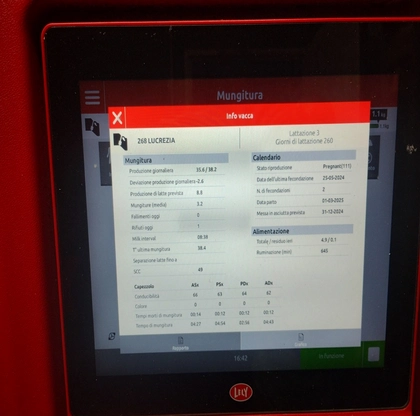
Precision Livestock Farming (PLF) represents a new opportunity for dairy farms to address market challenges by improving the efficiency of company production, enhancing both animal welfare, thanks to the ability to monitor and manage the individual and not just the group, and the sustainability of production. PLF is the use of technologies to measure physiological, behavioral, productive and reproductive indicators on individual animals, with the aim of improving management strategies and the performance of the subjects raised. The application of these technologies allows the collection and management of a large amount of information, which, if managed optimally, can be of great help in managing and controlling the herd in an effective and profitable way.
With PLF, various parameters can be monitored to evaluate the state of health, animal welfare, productive and reproductive performance of the farm, which are closely related to the environmental impact. It has been shown that the reduction of mastitis resulting from the timely recognition of the pathology can lead to a 2.5% decrease in global warming potential as well as a reduction in the use of antibiotics. (See Tullo et. Al, 2019) Good management of the reproductive status of animals can contribute to reducing environmental impact. In fact, by maintaining fertility at the highest level, it is believed possible to reduce the farm’s GHG emissions by more than 20%. (See Tullo et. Al, 2019) The PLF, if used well, allows the breeder to make some decisions more promptly, thus improving the productivity and profitability of his farm. To make the most of the information obtained with these technologies and interpret them correctly, it is essential that they are integrated with computerized information systems capable of managing and processing the enormous “amount” of data produced and that there are qualified personnel in the stable who knows how to interpret them.
La zootecnia di precisione (Precision Livestock Farming, PLF), rappresenta la nuova opportunità per gli allevamenti da latte per affrontare le sfide dei mercati attraverso un miglioramento dell’efficienza di produzione aziendale, valorizzando sia il benessere animale, grazie alla possibilità di monitorare e gestire il soggetto e non solo il gruppo, sia la sostenibilità delle produzioni. La PLF è l’utilizzo di tecnologie per misurare indicatori fisiologici, comportamentali, produttivi e riproduttivi sui singoli animali, con l’obiettivo di migliorare le strategie gestionali e le performance dei soggetti allevati. L’applicazione di queste tecnologie permette il rilievo e la gestione di un grande numero di informazioni, che, se gestito in maniera ottimale, può risultare di grande aiuto per gestire e controllare la mandria in maniera efficace e remunerativa. Con la PLF si possono monitorare diversi parametri con cui si valuta lo stato di salute, il benessere animale, le performance produttive e riproduttive dell’allevamento, che sono strettamente correlati all’impatto ambientale. E’ stato dimostrato che la riduzione delle mastiti derivante dal riconoscimento tempestivo della patologia può comportare una diminuzione del 2,5% del potenziale di riscaldamento globale oltre che ad una riduzione nell’utilizzo degli antibiotici. Una buona gestione dello stato riproduttivo degli animali può contribuire alla riduzione dell’impatto ambientale. Infatti, mantenendo la fertilità al massimo livello, si ritiene possibile ridurre l’emissione di gas serra aziendale per più del 20%. La PLF, se ben utilizzata, consente all’allevatore di prendere con più tempestività alcune decisioni, migliorando in questo modo la produttività e la redditività del proprio allevamento. Per sfruttare al massimo le informazioni ottenute con queste tecnologie ed interpretarle in maniera corretta, è fondamentale che queste siano integrate con sistemi informativi computerizzati in grado di gestire ed elaborare l’enorme “mole” di dati prodotti e che ci sia in stalla del personale qualificato che li sappia interpretare.
Precision Livestock Farming (PLF) represents a valuable opportunity for dairy farms to respond to market challenges by increasing production efficiency, enhancing animal welfare—thanks to the ability to monitor and manage animals individually rather than as a group—and improving the overall sustainability of production.
PLF refers to the application of engineering principles and techniques in livestock farming to automatically monitor, model, and manage animal production. Through these technologies, it is possible to measure physiological, behavioral, productive, and reproductive indicators at the individual animal level. The goal is to improve management strategies and animal performance, making livestock farms more sustainable economically, environmentally, and socially.
The use of PLF technologies enables the collection and management of large volumes of data, which—if handled effectively—can significantly improve herd control in a cost-efficient and productive manner. Animal scan be identified and tracked via GPS and image analyzers, which are useful for observing animal behavior and conducting automated assessments of body weight, Body Condition Score, and foot lesions. Realtime monitoring tools such as activometers, collars, body temperature sensors, milking robots, and devices based on near-infrared spectroscopy(NIRS) provide valuable information on health status, welfare, and productive and reproductive performance, all of which are closely linked to environmental impacts and milk quality.
Studies have shown that timely identification and management of mastitis through PLF technologies can lead to a 2.5% reduction in global warming potential, in addition to decreased antibiotic usage. Proper reproductive management can also reduce environmental impacts; maintaining optimal fertility levels may decrease greenhouse gas emissions from the farm by more than 20%.
Furthermore, monitoring the chemical composition of animal diets using precision feeding technologies can boost herd productivity while reducing enteric methane emissions and nitrogen excretion, thereby lowering emissions from livestock waste.
When effectively implemented, PLF empowers farmers to make more timely and informed decisions, improving productivity, profitability, and veterinary drug use on the farm. However, to fully capitalize on the potential of these technologies, it is crucial to integrate them with computerized information systems capable of processing the vast amount of data generated. Equally important is the presence of qualified personnel on-site who can correctly interpret and act on this information.
Subsoiling

Slovenia
Marine West Coast, Warm Summer
Benefits of the practice
- Deep soil loosening,
- Soil drainage,
- Soil aeration and thus stimulating soil microbiological activity.
Production system(s)
Thematic Area(s)
The main purpose of deep tillage is to break through the silt, which is created by many years of tillage at the same depth. Silt is a compacted, impenetrable layer of soil that stops air circulation and, above all, water draining into the depths. The positive effects of such deep tillage are soil drainage, soil aeration, and thus stimulating soil microbiological activity. When we loosen the soil, we achieve that the soil is less compacted and enable easier root growth into deeper layers of the soil. It is known that if the roots cannot break through the silt, they redirect their growth horizontally and continue to grow. If we have a dry period, this is very bad, because they do not reach the deeper layers of the soil, which still retain a certain amount of water, and therefore suffer drought stress more quickly. In periods of high rainfall, silt also causes water to stagnate on the surface of the soil. With deep tillage, we can alleviate this stagnation, because we loosen the soil deeply, break through the silt, and therefore the water drains faster. Also, certain versions of deep tillers have a drainage cone installed behind the head of the tiller, which creates a natural tube in the depth, which serves to drain water from the surface into the nearest drainage ditches. This measure is much more effective if we start with the processing itself next to the water drainage ditch and then process inland. This directs the flow of water into the ditch. When we deeply loosen the soil, we bring air into the depth of the soil. Air allows faster reproduction and activity of microorganisms in the soil. When we have good activity of microorganisms, we also have more nutrients available to plants.
Glavni namen globinskega podrahljavanja je prebiti plazino, ki se ustvari z dolgoletno obdelavo tal na isti globini. Plazina je strnjena, neprebojna plast zemlje, ki ustavlja kroženje zraka, predvsem pa odvajanje vode v globino. Pozitivni učinki takšne obdelave tal so globinsko podrahljanje tal, drenažiranje tal, prezračevanje tal ter s tem spodbujanje mikrobiološke aktivnosti tal. Ko tla prerahljamo dosežemo to, da so tla manj zbita in omogočimo lažjo rast korenin v globlje plasti zemlje. Znano je, da korenine če ne morejo prebiti plazine, preusmerijo rast vodoravno in rastejo tako naprej. V kolikor imamo sušno obdobje je to zelo slabo, saj ne dosežejo globljih plasti zemlje, ki še zadržujejo določeno količino vode, zato hitreje utrpijo sušni stres. V obdobjih, ko imamo veliko padavin, prihaja zaradi plazine tudi do zastajanja vode na površini zemlje. S globinskim podrahljavanjem lahko to zastajanje omilimo, saj prerahljamo tla v globino, prebijemo plazino, zato voda hitreje odteče. Prav tako imajo določene izvedbe globinskih podrahljačev nameščene za glavo nogače drenažni kegelj, ki naredi v globini naravno cev, ki služi odtekanju vode iz površine v najbližje jarke za odvodnjavanje. Ta ukrep je veliko bolj učinkovit, če začnemo s samo obdelavo ob jarku za odvajanje vode in nato obdelujemo v notranjost površine. S tem usmerimo tok vode v jarek. Ko tla globinsko podrahljamo, spravimo zrak v globino tal. Zrak omogoča hitrejše razmnoževanje in delovanje mikroorganizmov v zemlji. Kadar imamo dobro delovanje mikroorganizmov imamo tudi več hranil, ki so na voljo rastlinam.
In agriculture, we know several methods of soil cultivation: from conventional cultivation with a plow, through minimal cultivation with tools that only work the soil shallowly, to direct sowing or no-till cultivation. All these treatments have in common that they do not work deeper than 25 30 cm into the very depth of the soil. When we work deeper, we call this subsoiling (deep soil loosening). In this mechanical work, we intervene in the soil up to a depth of 120 cm.
The main purpose of this measure is to break through the silt, which is created by many years of soil cultivation at the same depth. Silt is a compacted, impenetrable layer of soil that stops air circulation, and above all, the drainage of water into the depth. The positive effects of such soil cultivation are deep soil loosening, soil drainage, soil aeration and thus stimulating soil microbiological activity. When we loosen the soil, we achieve that the soil is less compacted and enable easier root growth in the deeper layers of the soil. It is known that if the roots cannot break through the soil, they redirect their growth horizontally and continue to grow. If we have a dry period, this is very bad, because they do not reach the deeper layers of the soil, which still retain a certain amount of water, and therefore suffer drought stress more quickly. In periods when we have a lot of precipitation, soil also causes water to stagnate on the surface of the soil. With deep loosening, we can alleviate this stagnation, because we loosen the soil deeply, break through the soil, so the water drains faster. Also, certain versions of deep looseners have a drainage cone installed behind the head of the legs, which creates a natural pipe in the depth, which serves to drain water from the surface into the nearest drainage ditches. This measure is much more effective if we start with the processing only next to the water drainage ditch and then process into the interior of the surface. This directs the flow of water into the ditch. When we deeply loosen the soil, we get air into the depth of the soil. Air allows for faster reproduction and activity of microorganisms in the soil. When microorganisms are functioning well, we also have more nutrients available to plants.
Farmers use deep loosening to the greatest extent in the summer months.
After harvesting cereals and oil seed rape and before sowing follow-up crops is the most suitable time for this task. The soil is also dry enough at this time to carry out this measure. If we have a crop present throughout the summer and have problems with water retention, deep loosening can also be carried out before sowing this crop. Of course, the soil must be suitably dry and walkable.
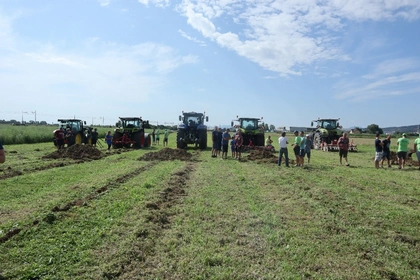
At the Agricultural Day, which took place on August 2, 2024 in Bohova, various subsoilers were presented. Subsoilers suitable for smaller tractors(70-100 HP) and those requiring much greater pulling power (250+ HP) were demonstrated. The differences were also in the shape of the tines and their effect on the soil. After the presentation of each subsoiler, we dug a hole so that we could closely observe the effects on the soil at depth. The purpose of the event was to show farmers and the general public the usefulness of subsoilers and to help them make decisions regarding their purchase and use.
Sowing Stubble Crops
Slovenia
Marine West Coast, Warm Summer
Benefits of the practice
- Improve soil fertility,
- Improve crop rotation,
- Avoid soil structure deterioration due to heat and summer storms in the summer.
Production system(s)
Thematic Area(s)
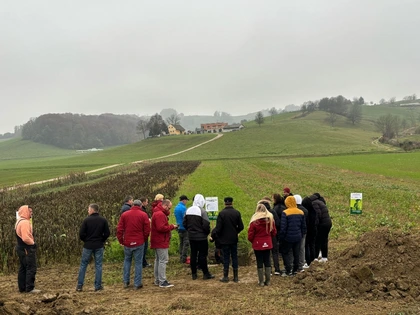
Stubble crops are sown after the harvest of cereals, early potatoes, and catch crops. Sowing stubble crops in the crop rotation has several advantages: it improves the rotation, prevents the deterioration of soil structure in the summer due to heat and summer storms, produces additional fodder for livestock, and prevents the spread of diseases and pests.
By sowing stubble crops, we reduce weed infestation, improve soil aeration and the humus balance, lessen the negative effects of rain, sun, and wind on soil structure, prevent the leaching of nutrients (especially nitrogen) into groundwater, improve the farm’s feed balance, provide bees with rich pasture in the autumn, and benefit from biofumigation, which has a suppressive effect on certain soil pests. Mixtures of several stubble crops also contribute to greater biodiversity.
Stubble crops are important because they enhance the visual appearance of the landscape. They can be sown without ploughing, using only shallow surface tillage. Stubble crops are grown for human consumption, animal feed, and green cover. Their importance is even greater in areas where manure is not ploughed in.
For human consumption, buckwheat, millet, stubble turnip, or beetroot are sown. For animal feed, the most sown crops include multi-flowered ryegrass, red clover, vetch, black clover, fodder rape, alfalfa, and clover-grass mixtures. For green cover, oil radish, white mustard, sunflowers, phacelia, and plant mixtures are used.
Stubble crops can be either winter or non-winter varieties.
Strniščne dosevke sejemo po spravilu žit, zgodnjega krompirja in vmesnih posevkov. Setev strniščnih dosevkov ima v njivskem kolobarju več prednosti: izboljšamo kolobar, v poletnem času se izognemo propadanju strukture tal zaradi vročine in poletnih neviht, pridelamo dodatno krmo za živino in preprečujemo razmnoževanje bolezni in škodljivcev. S setvijo dosevkov zmanjšamo zapleveljenost , izboljšamo zračnost tal ter bilanco humusa, zmanjšamo negativne vplive dežja, sonca in vetra na strukturo tal, preprečujemo izpiranje hranil (dušika) v podtalnico, izboljšamo krmno bilanco na kmetiji, čebelam zagotavljamo bogato pašo v jesenskem času, z biofumigacijo negativno vplivamo na nekatere talne škodljivce. Z mešanicami večih dosevkov pripomoremo k večji biodiverziteti. Strniščni dosevki so pomembni, ker polepšajo tudi izgled krajine. Setev strniščnih posevkov lahko opravimo brez oranja, samo s plitvo površinsko obdelavo tal. Strniščne dosevke sejemo za prehrano ljudi, za krmo živali in za zeleni podor. Pomen setve strniščnih dosevkov je še večji na površinah na katerih ne zaoravamo hlevskega gnoja.
Za človeško prehrano sejemo ajdo, proso, strniščno repo ali rdečo peso, za prehrano živali najpogosteje sejemo mnogocvetno ljulko, inkarnatko, grašljinko, črno deteljo, krmno ogrščico, lucerno in deteljno travno mešanico, za zeleni podor pa oljno redkev, belo gorjušico, sončnice, facelijo in mešanice rastlin. Strniščni posevki so lahko prezimni ali neprezimni.
Sowing stubble crops is an environmentally friendly and effective way to improve soil fertility. It provides year-round soil coverage and is a highly recommended measure from a professional point of view. Given this year’s(2025) weather conditions, when there is still enough moisture in the soil, we can recommend sowing the stubble as soon as possible.
For human consumption, we sow buckwheat, millet, stubble turnip or beetroot, for animal consumption we most often sow multi-flowered ryegrass, red clover, vetch, black clover, fodder rape, alfalfa and clover grass mixture, and for green fodder we sow oil radish, white mustard, sunflowers, phacelia and plant mixtures. Stubble crops can be winter or non-winter crops. (See Table 1 and Table 2)
ADDITIONAL INFORMATION
Results of the stubble yield experiment (See more information in Table 3):
• Fertilization: 30m3 of cattle manure per ha
• Cultivation: – hoeing to a depth of 15 cm 8.8.2020
o harrow 9.8.2020
• Sowing: 10. 8. 2020
• Harvest of the experiment and weighing: 3. 11. 2020
• Mulched: 12.11.2020
• Ploughed: 15.11.2020
Sowing is mostly done with grain seeders or mineral fertilizer spreaders, but it can also be done manually. After sowing, we can also roll the seeds to ensure more even and faster emergence. If your main crop (e.g. pumpkins) has failed and was sprayed with soil herbicides, we advise you to call us for detailed instructions on how to sow follow-up crops in such a case.
How Soil Cover and Reduced Tillage Enhance the Stability and Resilience of Agriculture to Extreme Weather Events

Switzerland
Temperate Climatic
Benefits of the practice
- Maintaining soil health
- Increase resilience
- Emission mitigation
Thematic Area(s)
The Climate Farm Demo event in Bavois, Switzerland, in October 2024 focused on educating and training agricultural professionals about the essential role of cover crops as well as methods like direct seeding, in addressing the challenges posed by climate change.
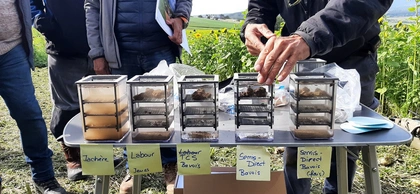
Research presented at the event showed that soil covered by plants can absorb rainwater more effectively, reduce erosion, and heat up less in summer. In contrast, uncovered soils are vulnerable to water and nutrient losses, as well as soil erosion. An aggregate stability test conducted on-site illustrated how soil stability is affected by management practices and how plant cover can improve soil stability.
Individuals from agricultural practice and advisory can leverage these insights by integrating strategies for implementing cover crops and reduced tillage into their farming practices. These methods improve soil quality and fertility, contributing to long-term yield stability and increases.
At the end of the event, Hanspeter Liniger (University of Bern) shared findings from the “Hot earth is not cool” project, highlighting how uncovered soils are highly vulnerable to erosion, runoff, and heat stress. He explained that covered soils absorb and store rainwater better, protecting against erosion and drought. Rain simulator studies show that up to 50% of heavy rainfall runs off uncovered soils, causing major losses of water, soil, and nutrients. In contrast, soils under permanent pasture or cover crops with no-till practices showed minimal runoff and erosion. Uncovered soils can heat up to over 60°C in summer, harming soil life. Mulch can lower topsoil temperatures by 15–20°C, while living plant covers are even more effective and help stabilize soil structure. Frequent ploughing disrupts roots and soil microbes, weakens soil stability and increases erosion risks.
Die Climate Farm Demo Veranstaltung in Bavois, Schweiz, im Oktober 2024 legte den Schwerpunkt auf die Aufklärung und Weiterbildung von Fachleuten in der Landwirtschaft über die wesentliche Rolle von Bodenbedeckungspflanzen, wie Gründüngungen und Zwischenfrüchten und Methoden wie der Direktsaat, zur Bewältigung der Herausforderungen des Klimawandels.
An der Veranstaltung präsentierte Forschungsergebnisse zeigten auf, dass durch Pflanzen bedeckte Böden Regenwasser effektiver aufnehmen, Erosion reduzieren und sich im Sommer weniger stark erhitzen. Unbedeckte Böden hingegen sind anfällig für Wasser- und Nährstoffverluste sowie Bodenerosion. Ein vor Ort durchgeführter Aggregatsstabilitätstest illustrierte, wie die Bodenstabilität durch die Bodenbewirtschaftungsart beeinflusst wird, und wie eine Bodenbedeckung durch Pflanzen die Stabilität des Bodens verbessert.
Personen aus der landwirtschaftlichen Praxis und Beratung können die gewonnenen Erkenntnisse nutzen, indem sie Strategien für die Implementierung der Bodenbedeckung durch Pflanzen und der reduzierten Bodenbearbeitung in ihren Anbau integrieren. Diese Methoden verbessern die Bodenqualität und -fruchtbarkeit und tragen dazu bei, die Erträge langfristig zu stabilisieren und zu steigern.
Zum Abschluss der Veranstaltung stellte Hanspeter Liniger (Universität Bern) die Ergebnisse des Projekts „Hot earth is not cool“ vor und zeigte auf, dass unbedeckte Böden sehr anfällig für Erosion, Abfluss und Hitzestress sind. Er erläuterte, dass bedeckte Böden Regenwasser besser aufnehmen und speichern und so vor Erosion und Trockenheit schützen. Studien mit Regensimulatoren zeigen, dass bis zu 50 % der starken Regenfälle von unbedeckten Böden abfließen und große Verluste an Wasser, Boden und Nährstoffen verursachen. Im Gegensatz dazu wiesen Böden unter Dauergrünland oder Deckfrüchten mit Direktsaatverfahren nur minimale Abfluss- und Erosionswerte auf. Unbedeckte Böden können sich im Sommer auf über 60 °C aufheizen und das Bodenleben schädigen. Mulch kann die Oberbodentemperaturen um 15-20 °C senken, während lebende Pflanzendecken noch wirksamer sind und zur Stabilisierung der Bodenstruktur beitragen. Häufiges Pflügen stört Wurzeln und Bodenmikroben, schwächt die Bodenstabilität und erhöht das Erosionsrisiko.
As a result of climate change, agricultural soils are increasingly exposed to extreme weather conditions such as heatwaves, droughts and heavy rainfall.
These changes threaten soil fertility and therefore also agricultural yields.
At the well-attended Climate Farm Demo event on 9 October 2024 in BavoisVD, the crucial role of soil cover was illustrated in a practice-oriented event.
After a welcome to the attendees by a consultant from the Prométerre association, the Climate Farm Demo farmer Thierry Salzmann shared his experiences with cover cropping and reduced tillage. He explained how he practically implements techniques such as no-till farming on his farm and the advantages he sees in it. Afterwards, the agricultural experts had the opportunity to experience at various stations how soil cover has a positive effect on various soil properties, such as soil structure, nutrient availability, biodiversity and soil organisms.
Towards the end of the event, Hanspeter Liniger from the University of Bern presented important research findings on the topic of soil protection. As part of the ‘Hot earth is not cool’ project, Liniger explained the problems that uncovered soils can lead to and which agricultural practices can help to protect soils from extreme weather events and maintain soil fertility in the long term:
• Covered soils can absorb and store rainwater more effectively and are therefore better protected against erosion and drought. Uncovered and freshly tilled soils, on the other hand, are particularly susceptible to surface runoff and erosion. Studies with rain simulators show that as much as half of the simulated heavy rainfall runs off on uncovered soil, resulting in substantial losses of water, soil and nutrients.
Conversely, soils cultivated with permanent pasture or protected by a green cover crop sown using no-till practices markedly diminished surface runoff and minimized erosion to nearly zero.
• Uncovered soils can heat up to over 60°C in summer, stressing soil life.
Mulch cover can lower the top soil temperature by 15 to 20 °C. A living soil cover is even more effective and also improves the stability of the soil structure.
• Roots and soil microbes are crucial for soil stability. Frequent ploughing disturbs soil life and leads to unstable soils, which in turn favours runoff and erosion.
As a conclusion, the investigations of Hanspeter Liniger und Jovana Askrabic in summer 2023 and 2024 showed that protecting soils from heat stress, surface runoff and erosion is crucial for resilient agriculture. Adapted cultivation methods can make soils more resistant to climatic extremes, secure yields and also protect the environment in the long term.
The full article on Liniger and Askrabic’s research can be read here
Optimisation of Irrigation in Olive Cultivation Using Sensors, Drip Irrigation and Monitoring of Climatic Conditions

Greece
Mediterranean
Benefits of the practice
- Irrigation optimisation to reduce water loss
- Increasing production even in periods of severe drought
Production system(s)
Thematic Area(s)
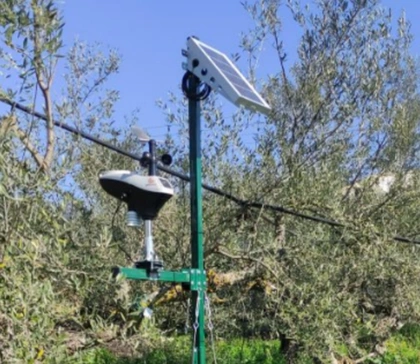
Optimising irrigation in olive groves is critical for increasing efficiency and ensuring sustainability, especially in regions with limited water resources. Proper irrigation management reduces water waste and supports higher olive yields.
Meteorological stations are essential tools for efficient irrigation, providing real-time data on temperature, humidity, wind, and rainfall. These parameters help estimate water evaporation from soil and plants (EVP). In hot, dry conditions, EVP rises, and irrigation needs increase, while rain or high humidity reduce water demand. Forecasting rain also helps avoid unnecessary irrigation, improving water use efficiency.
This climate data supports informed decisions tailored to the olive grove’s real needs. Modern technologies further enhance optimisation. Soil moisture sensors, for example, monitor water needs in real time, enabling precise irrigation planning and avoiding over- or under-watering.
Drip irrigation systems, which deliver water directly to the plant roots in controlled amounts, are highly efficient, minimizing evaporation and runoff. Advanced systems combining moisture sensors with weather forecasts allow automated adjustments, maximising water efficiency.
Integrating data from soil monitoring, moisture levels, and climate conditions enables significant water savings while maintaining soil quality and tree health.
Although initial investments are required, the long-term benefits are substantial. Optimised irrigation increases productivity, reduces costs, and supports sustainable resource management, helping ensure the economic viability of olive groves.
Η βελτιστοποίηση της άρδευσης σε ελαιώνες αποτελεί κρίσιμο παράγοντα για την αύξηση της αποδοτικότητας και τη διασφάλιση της βιωσιμότητας των καλλιεργειών, ειδικά σε περιοχές με περιορισμένους υδάτινους πόρους. Η σωστή διαχείριση της άρδευσης μειώνει τη σπατάλη νερού, ενώ παράλληλα διασφαλίζει τη μέγιστη απόδοση της παραγωγής ελιάς.
Οι μετεωρολογικοί σταθμοί αποτελούν σημαντικό εργαλείο για την αποδοτική διαχείριση της άρδευσης στους ελαιώνες, καθώς παρέχουν ακριβή και έγκαιρη πληροφόρηση για τις καιρικές συνθήκες που επηρεάζουν την ανάγκη των φυτών για νερό. Μέσω της παρακολούθησης παραμέτρων όπως η θερμοκρασία, η υγρασία, η ταχύτητα του ανέμου, οι βροχοπτώσεις και άλλες κλιματικές συνθήκες, οι μετεωρολογικοί σταθμοί επιτρέπουν την ακριβή εκτίμηση των αναγκών άρδευσης σε πραγματικό χρόνο.
Για παράδειγμα, οι μετεωρολογικοί σταθμοί βοηθούν στην εκτίμηση της εξάτμισης του νερού από το έδαφος και τα φυτά (ΕΒP), η οποία εξαρτάται από τη θερμοκρασία και την υγρασία του αέρα. Όταν οι συνθήκες είναι ξηρές και ζεστές, η εξάτμιση αυξάνεται και απαιτείται μεγαλύτερη άρδευση, ενώ όταν οι καιρικές συνθήκες είναι υγρές ή έχει προηγηθεί βροχή, η ανάγκη για άρδευση μειώνεται.
Επιπλέον, οι μετεωρολογικοί σταθμοί συμβάλλουν στην πρόβλεψη επικείμενων βροχοπτώσεων, επιτρέποντας στους αγρότες να προγραμματίσουν την άρδευση ανάλογα, αποφεύγοντας την άσκοπη σπατάλη νερού. Εάν αναμένονται βροχές, οι αγρότες μπορούν να αναβάλουν ή να μειώσουν την άρδευση, βελτιώνοντας τη διαχείριση των υδάτινων πόρων.
Αυτός ο συνδυασμός δεδομένων και τεχνολογίας διευκολύνει τη λήψη αποφάσεων με βάση τις πραγματικές ανάγκες του ελαιώνα και τις καιρικές συνθήκες.
Οι σύγχρονες τεχνολογίες αποτελούν τον πυρήνα αυτής της βελτιστοποίησης. Η χρήση αισθητήρων υγρασίας στο έδαφος, για παράδειγμα, επιτρέπει την ακριβή παρακολούθηση της ανάγκης του φυτού για νερό σε πραγματικό χρόνο. Αυτοί οι αισθητήρες παρέχουν δεδομένα που επιτρέπουν στον αγρότη να προγραμματίσει την άρδευση με βάση τις πραγματικές ανάγκες της καλλιέργειας, μειώνοντας την υπερβολική ή ανεπαρκή άρδευση.
Η μέθοδος άρδευσης στάγδην είναι επίσης μια από τις πιο αποδοτικές για ελαιώνες, καθώς προσφέρει νερό απευθείας στη ρίζα του φυτού με ελεγχόμενη ποσότητα, μειώνοντας τις απώλειες λόγω εξάτμισης και απορροής. Επίσης, η εφαρμογή συστημάτων άρδευσης που συνδυάζουν αυτόματα συστήματα με κλιματικές προβλέψεις μπορεί να προσαρμόσει την άρδευση με βάση τις καιρικές συνθήκες, εξασφαλίζοντας τη μέγιστη δυνατή αποδοτικότητα.
Αξιοποιώντας τα δεδομένα από την παρακολούθηση του εδάφους, την υγρασία και τις καιρικές συνθήκες, οι αγρότες μπορούν να εξοικονομήσουν σημαντικά ποσά από τη χρήση νερού, ενώ ταυτόχρονα προστατεύουν την ποιότητα του εδάφους και την υγεία των δέντρων.
Η εφαρμογή αυτών των τεχνολογιών απαιτεί αρχικά μια επένδυση, αλλά τα μακροπρόθεσμα οφέλη είναι σημαντικά. Η βελτιστοποίηση της άρδευσης μπορεί να αυξήσει την παραγωγή, να μειώσει το κόστος και να συμβάλλει στην αειφόρο διαχείριση των φυσικών πόρων, εξασφαλίζοντας την οικονομική βιωσιμότητα των ελαιώνων.
Optimising irrigation in olive groves is a critical factor for increasing efficiency and ensuring the sustainability of crops, especially in areas with limited water resources. Proper irrigation management reduces water wastage while ensuring maximum yield of olive production.
Meteorological stations are an important tool for the efficient management of irrigation in olive groves, as they provide accurate and timely information on weather conditions that affect the plants’ need for water. By monitoring parameters such as temperature, humidity, wind speed, precipitation and other climatic conditions, weather stations allow accurate estimation of irrigation needs in real time.
For example, weather stations help to estimate the evaporation of water from soil and plants (EVP), which depends on air temperature and humidity.
When conditions are dry and hot, evaporation increases and more irrigation is required, while when the weather is wet or preceded by rain, the need for irrigation is reduced.
In addition, weather stations help to predict upcoming rainfall, allowing farmers to plan irrigation, accordingly, avoiding unnecessary waste of water.
If rain is expected, farmers can postpone or reduce irrigation, improving water management.
This combination of data and technology makes it easier to make decisions based on actual olive grove needs and weather conditions
Modern technologies are at the core of this optimisation. The use of moisture sensors in the soil, for example, allows the precise monitoring of the plant’s need for water in real time. These sensors provide data that allow the farmer to plan irrigation based on the actual needs of the crop, reducing over- or under-irrigation.
Drip irrigation is also one of the most efficient methods for olive groves, as it delivers water directly to the root of the plant in a controlled amount, reducing losses due to evaporation and runoff. Also, the implementation of irrigation systems that combine automatic systems with climate forecast scan adjust irrigation based on weather conditions, ensuring maximum efficiency.
By utilizing data from soil monitoring, moisture and weather conditions, farmers can save significant amounts of water while protecting soil quality and tree health.
Implementing these technologies requires an initial investment, but the long-term benefits are significant. Optimizing irrigation can increase production, reduce costs and contribute to sustainable management of natural resources, ensuring the economic viability of olive groves
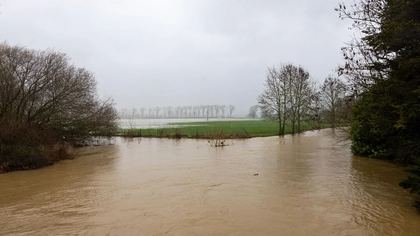
Adaptation to Climate Change in Crop Production

Luxembourg
Continental Europe
Benefits of the practice
- Challenges for crop production due to climate change
- Adaptation measures
- Research needs
Production system(s)
Thematic Area(s)
In Luxembourg, climate change is making itself felt in various ways, including the rise in temperature, the rapid alternation of extremely dry and wet periods and ever shorter winters, which result in a longer growing season. There are various strategies to meet these challenges. These relate to the following areas:
⦁ Breeding new plant varieties. These should ensure better adaptation to the changed climate conditions.
⦁ Diversification of crop rotation. This will make crop cultivation more resilient to climate fluctuations
⦁ Arable farming. The choice of the right sowing date and increasing the humus content in the soil are particularly important here.
⦁ Fodder production. In this area, the creation of fodder reserves and increasing biodiversity in grassland are crucial.
⦁ Introduction of new plant species. Grain millet, soya beans, sunflowers and sorghum are particularly promising in this respect.
⦁ Consideration of new pests and plant diseases. Defense against more aggressive types of pests and parasites has become essential due to climate change.
There is no generally applicable strategy for adapting to climate change in crop production. Only a combination of different existing techniques can successfully master the challenges posed by climate change.
There is a need for research in the following areas:
⦁ Provision of grass growth models for better adaptation of stock management to weather conditions
⦁ Specification of the possibilities and limits of using autumn gras growth to derive maximum benefit from it.
⦁ Breeding varieties with higher adaptation to climate change.
⦁ Maximizing nutrient efficiency under unfavorable weather conditions.
⦁ Provision of reliable meteorological information.
⦁ Clarification of the influence of humus balance and biochar on the water balance.
In Luxemburg macht sich der Klimawandel auf verschiedene Weise bemerkbar, unter anderem durch den Temperaturanstieg, die rasche Abwechselung von extrem Trocken- und Nässeperioden und immer kürzere Winter, welche eine längere Vegetationsperiode als Folge haben. Um diese Herausforderungen zu begegnen, gibt es verschiedene Strategien. Diese betreffen folgende Gebiete:
⦁ Züchtung neuer Pflanzensorten. Diese sollen eine bessere Anpassung an die veränderten Klimabedingungen gewährleisten.
⦁ Diversifizierung der Fruchtfolge. Dadurch wird eine höhere Resilienz im Pflanzenbau gegenüber Klimaschwankungen erreicht
⦁ Ackerbau. Hier sind besonders die Wahl des richtigen Saattermins und die Steigerung der Humusgehalte im Boden zu nennen.
⦁ Futterproduktion. Auf diesem Gebiet sind das Anlegen von Futterreserven sowie die Steigerung der Artenvielfalt im Grünland ausschlaggebend.
⦁ Einführung neuer Pflanzenarten. Diesbezüglich sind vor allem die Körnerhirse, die Sojabohne, die Sonnenblume und das Sorghum vielversprechend.
⦁ Berücksichtigung von neuen Schädlingen und Pflanzenkrankheiten. Sich gegen aggressivere Arten von Schädlingen und Parasiten ist durch den Klimawandel unabdingbar geworden.
Eine allgemeingültige Strategie zur Anpassung an den Klimawandel im Pflanzenbau ist nicht vorhanden. Nur eine Kombination aus verschiedenen vorhandenen Techniken kann erfolgreich die Herausforderungen durch den Klimawandel meistern.
Forschungsbedarf besteht auf folgenden Gebieten:
⦁ Bereitstellung von Grasaufwuchs-Modellen zur besseren Anpassung der Bestandsführung an die Witterungsbedingungen
⦁ Präzisierung von Möglichkeiten und Grenzen der Nutzung von Herbstaufwuchs, um ein maximales Nutzen daraus zu ziehen.
⦁ Züchtung von Sorten mit höherer Anpassung an den Klimawandel.
⦁ Maximierung der Nährstoffeffizienz unter ungünstiger Witterungsbedingungen.
⦁ Bereitstellung von verlässlichen Meteo-Informationen.
⦁ Klärung des Einflusses von Humushaushalt und Pflanzenkohle auf den Wasserhaushalt.
In Luxembourg, climate change is making itself felt in various ways, including the rise in temperature, the rapid alternation of extremely dry and wet periods and ever shorter winters, which result in a longer growing season. To meet these challenges, there are various strategies that differ depending on the area of application. These are as follows:
• Breeding. In addition to providing drought- and frost-tolerant varieties, breeding should focus on producing varieties with long roots, good juvenile development and early maturity.
• The farm level. Here, attention should be paid to the diversification of crop rotation, the creation of forage reserves and greater flexibility in crop production when selecting varieties. At the same time, the cost of machinery should not be disregarded.
• Arable farming. The most important strategies in arable farming were named as choosing the right sowing date, increasing soil fertility by increasing humus, selecting water-saving varieties, covering the soil as much as possible all year round and keeping C4 crops such as maize and sorghum, which consume a lot of water, to a minimum in favor of C3 crops.
• Forage production. In the area of forage production, in addition to the aforementioned creation of forage reserves, the management of denser plant populations, the increase of species diversity in grassland, the site-appropriate selection of crops and the use of more favorable conditions are also possible.
• New plant species. The cultivation of new types of plants is a promising field. The most promising of these are grain millet, soya beans, sunflowers and sorghum. The soya bean deserves a special mention here. The rise in temperatures is likely to have a positive effect on the expansion of the cultivation area of this plant, which has hardly been considered in Luxembourg to date due to the local climatic conditions. Coupled with the breeding of drought- and frost-resistant varieties, this could provide a viable alternative to other grain legumes.
• Consideration of new pests and plant diseases. It should not be unmentioned that climate change also harbors risks about the spread of pests and plant diseases. For example, the European corn borer is spreading more frequently due to warmer temperatures, as are a number of pests in fruit and vegetable cultivation. In general, theshorter the winter period, the easier it is for fungi and viruses to survivethe winter and develop a higher infestation potential.
To summarise, there is no universal strategy for adapting to climate change in crop production. Rather, a combination of different existing techniques must be used to successfully master the challenges posed by climate change. This also requires a great deal of advice.
There is a need for research in the following areas:
• Grassland. The provision of grass growth models can help to better adapt crop management to weather conditions. Efforts should also be made to clarify the possibilities and limits of using autumn growth so that maximum benefit can be derived from it.
• Forage production. In this area, the breeding of varieties that are better adapted to climate change was given top priority. This is also with a view to maximising nutrient efficiency under unfavourable weather conditions.
• Arable farming. Helpful research results will be obtained above all in the provision of reliable meteorological information. Further research is needed to clarify the relationships between plants, soil and humus, as well as the influence of biochar on the water balance.
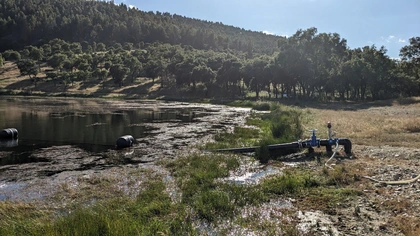
The Impact of Climate Change on Water Management in Agriculture

Portugal
Mediterranean pedoclimatic zone
Benefits of the practice
- Water use efficiency
- Water management
- Crop management under water scarcity
Production system(s)
Thematic Area(s)
There has been growing concern about the efficient use of water in the agricultural sector, particularly in the Mediterranean region, but not excluding other areas of Europe. With increasing pressure from drought scenarios, unpredictable rainfall or other extreme climatic events, the valorization and management of this resource has become increasingly urgent.
Water management varies by region. While in the Mediterranean Basin, reduced rainfall causes water scarcity, that leads to water restrictions for agriculture, in Belgium, drainage systems are outdated and hinder water retention with the current (reduced) average rainfall, and in the Netherlands, rising sea levels increase water salinity.
Water management thematic area can be segmented into quantity and quality, impacting four key areas:
⦁ On-Farm Water Management | Efficient use depends on farm type, irrigation systems, farming practices, and monitoring techniques. Adoption of new technologies and investment in irrigation equipment are crucial.
⦁ Infrastructure & Distribution | Water availability is influenced by regional/national systems adapted to the local needs. These systems need to be maintained to be efficient.
⦁ Regulation and investment mechanisms | Efficiency is shaped through (1) policies, incentives, and regulations adapted to local needs, (2) public investment in water infrastructure, (3) crisis management and contingency plans and (4) alternative water sources (re-used, desalinated).
⦁ Climate Change Impact | Changing weather patterns affect water availability, requiring new practices, technologies, and mindsets to ensure long-term sustainability.
Efficient water management is key to food security and agricultural sustainability, demanding the implementation of new practices, the investment in infrastructure, technology, and adapted regulations to build climate resilience.
A preocupação com o uso eficiente da água no setor agrícola tem aumentado. Diante das pressões causadas por cenários de seca, variações na precipitação e outros eventos extremos, a gestão desse recurso tornou-se ainda mais urgente.
Ao considerar a eficiência da gestão da água na agricultura, é essencial ter em conta o contexto regional. Na bacia mediterrânica, a redução da disponibilidade de água causada pela seca limita a produtividade agrícola e impulsiona a adoção de práticas mais eficientes. Na Bélgica, os sistemas de gestão hídrica estão desatualizados em relação aos padrões atuais de precipitação, comprometendo a retenção de água. Já nos Países Baixos, a qualidade da água é afetada pelo aumento da salinidade, consequência da subida do nível do mar. Cada região enfrenta desafios e impactos distintos, exigindo abordagens específicas.
A gestão da água pode ser segmentada em quatro áreas-chave que impactam a quantidade e qualidade de água disponível:
⦁ Gestão da água na exploração agrícola | A utilização eficiente depende do tipo de exploração, dos sistemas de rega, das práticas culturais e da monitorização. A adoção de novas tecnologias e equipamentos de monitorização são cruciais para o aumento de eficiência.
⦁ Infraestruturas e distribuição | A disponibilidade de água é influenciada por sistemas regionais/nacionais. Os sistemas por gravidade mais tradicionais têm menores custos energéticos, mas perdem mais água por evaporação, enquanto os sistemas pressurizados têm menos perdas e permitem uma melhor monitorização.
⦁ Mecanismos de regulação e investimento | A regulação contribui para a eficiência através de políticas e incentivos, investimento público em infraestruturas hídricas, gestão de risco e planos de contingência, e potencialidade do uso de fontes alternativas de água.
⦁ Impacto das alterações climáticas | A alteração dos padrões climáticos afeta a disponibilidade de água, exigindo novas práticas, tecnologias e alteração da mentalidade, para garantir a sustentabilidade a longo prazo.
O futuro da gestão eficiente da água será fundamental para a segurança alimentar e a sustentabilidade da produção agrícola. Para garantir a resiliência às alterações climáticas, será necessário mudar mentalidades, adotar novas tecnologias e práticas agrícolas, investir em infraestruturas adequadas e implementar uma regulação eficaz.
There has been growing concern about the efficient use of water in the agricultural sector, particularly in the Mediterranean region, but not excluding other areas of Europe. With increasing pressure from drought scenarios, unpredictable rainfall or other extreme climatic events, the valorization and management of this resource has become increasingly urgent.
However, when considering the efficiency of water management in agriculture, the regional context has to be taken into account. While in the Mediterranean Basin, reduced rainfall causes water scarcity, that leads to water restrictions for agriculture, in Belgium, drainage systems are outdated and hinder water retention with the current (reduced) average rainfall, and in the Netherlands, rising sea levels increase water salinity.
Different regions have different priorities and will need different approaches. Water management can be addressed into two sub-themes quantity and quality, and into four types of impact:
1. On-farm management | Efficient water management on the farm is imperatively linked to the type of farm and farmer (size of farm and type of production, farmer profile), irrigation systems and equipment(types of irrigation systems used, retention capacity, distribution and drainage), cultural practices that promote water retention in the soil(soil tillage, water management, etc.) and monitoring and review(decision support systems, water content measuring probes, regular audits of the irrigation system). The evolution of efficient irrigation and water management is strongly conditioned by the decision of the farmer or decision-maker to invest in equipment and staff specialized in irrigation and water management.
2. Infrastructure and distribution systems | Regional and nationaldistribution systems influence the availability of water on the farm.
Traditional systems such as gravity distribution systems in open channels, although they have lower energy costs, have higher evaporation losses. Pressurized systems, on the other hand, are more automated in their distribution to primary production, allowing for more efficient monitoring of consumption.
3. Regulation and investment mechanisms | The existence of regulation in water management plays a crucial role in efficient water management, influencing the practices and equipment used, risk management on the farm and at regional level, among others.
a. Development of policies, incentive programs and regulations adapted to the local context and promoting water efficiency.
b. Public investment in water infrastructure.
c. Crisis management, through the development of emergency/contingency plans.
d. Exploitation of alternative water sources (recycled, desalinized).
4. Climate change | The variability of climatic events is one of the clearest effects and has the greatest impact on primary production, directly translating into the amount of water available. The need to change practices, use new equipment and alter mindsets to perceive change is becoming increasingly evident to guarantee water sustainability.
The future of efficient water management will be essential for food security and the sustainability of agricultural production, requiring a change of mindset, the adoption of new equipment, technologies and changes in farming practices, infrastructures and appropriate regulations to guarantee resilience to climate change.
Water Management on Raspberry Farm on the South of Portugal
Portugal
Mediterranean zone
Benefits of the practice
- Water Use Efficiency
- Environmental Sustainability
- Agricultural Resilience
Production system(s)
Thematic Area(s)
Water management plays a key role in Portuguese agriculture, considering the challenges posed by climate change. Rising temperatures, more frequent drought periods, and increasing variability in precipitation and in water availability, making the adoption of more efficient strategies essential.
In the specific case of The Summer Berry Company, located in semi-arid regions of Portugal, a responsible water management and mitigating the risks associated with water scarcity are key objectives of the company’s environmental strategy. The main commitments include:
⦁ Maintaining continuous assessment of the farm’s water resources and developing a management plan adapted to their current state
⦁ Reducing water consumption and increasing overall efficiency in its use (irrigation systems adapted to local conditions, regular water consumption monitoring through precision equipment (humidity sensors))
⦁ Preserving and improving water quality in ecosystems by planting species in water lines to avoid nutrient runoff
⦁ Maximizing water reuse and recycling by installing water reservoirs
⦁ Using greywater for hedge irrigation and other unproductive areas
In 2024, the company successfully increased the use of sustainable water sources, with 60% of the water used on its farms coming from storing rainwater and using open and closed hydraulic irrigation systems. This figure represents an increase compared to 2023 (53%) and 2022 (43%). As a result, dependence on the Santa Clara Dam was reduced to just 40%.
Finally, light and shade regulation is another key strategy. Shading nets are periodically adjusted according to weather conditions, covering plants on hot days to reduce excessive evaporation. On more humid days, the nets are removed to stimulate plant activity and maintain the photosynthesis process. This approach not only promotes the healthy development of crops but also contributes to water conservation, reinforcing the company’s commitment to sustainability.
A gestão da água no setor agrícola assume um papel fundamental em Portugal, especialmente face aos desafios impostos pelas alterações climáticas. O aumento das temperaturas, a maior frequência de períodos de seca e a variabilidade na precipitação (sendo em média cada vez mais reduzida), comprometem a disponibilidade hídrica, tornando essencial a adoção de estratégias mais eficientes.
A exploração agrícola The Summer Berry Company Portugal, localizada em regiões semiáridas de Portugal, tem como objetivo desenvolver uma gestão responsável da água e a redução dos riscos decorrentes da sua escassez, tendo como principais compromissos:
⦁ Manter uma avaliação contínua dos recursos hídricos da exploração e desenvolver um plano de gestão adaptado ao seu estado atual
⦁ Reduzir o consumo de água e aumentar a eficiência do seu uso (através da instalação de sistemas de rega adaptados às condições locais, reservatórios para armazenamento de água e utilização de equipamentos de monitorização hídrica)
⦁ Preservar e melhorar a qualidade da água nos ecossistemas, através da instalação de plantas nas linhas de água para evitar a lixiviação de nutrientes) (Figura 1)
⦁ Maximizar a reutilização da água (e.g. utilização de águas cinzentas para regar sebes e outras áreas improdutivas, utilização de sistemas de rega de recirculação) (Figura 3)
Em 2024, a empresa conseguiu aumentar a utilização de fontes de água sustentáveis, com 60% da água utilizada nas suas explorações agrícolas a ter origem na captação de água da chuva e na reutilização através de um sistema de recirculação. Este valor representa um aumento em comparação com 2023 (53%) e 2022 (43%).
Por último, a regulação da luz e temperatura nos túneis é outra estratégia fundamental para a gestão dos recursos hídricos. As redes de ensombramento são periodicamente ajustadas, consoante as condições meteorológicas, cobrindo as plantas nos dias quentes para reduzir a evaporação excessiva. Nos dias mais húmidos, as redes são retiradas para estimular a atividade das plantas e manter o processo de fotossíntese. Esta abordagem não só promove o desenvolvimento saudável das culturas, como também contribui para a poupança de água, reforçando o compromisso que a empresa tem para com a sustentabilidade.
Water management plays a key role in Portuguese agriculture, particularly considering the challenges posed by climate change. Rising temperatures, more frequent drought periods, and increasing variability in precipitation and in water availability, making the adoption of more efficient strategies essential.
In the specific case of The Summer Berry Company, located in semi-arid regions of Portugal, a responsible water management and mitigating the risks associated with water scarcity are key objectives of the company’s environmental strategy. The main commitments include:
• Maintaining continuous assessment of the farm’s water resources and developing a management plan adapted to their current state
• Reducing water consumption and increasing overall efficiency in its use (irrigation systems adapted to local conditions)
• Preserving and improving water quality in ecosystems by planting species in water lines to avoid nutrient runoff (Error! Reference source not found. Photo 1)
• Maximizing water reuse and recycling by installing water reservoirs
• Using greywater for hedge irrigation
In 2024, the company successfully increased the use of sustainable water sources, with 60% of the water used on its farms coming from storing rainwater and using open and closed hydraulic irrigation systems. This figure represents an increase compared to 2023 (53%) and 2022 (43%).
As a result, dependence on the Santa Clara Dam was reduced to just 40%.
To optimize water use, irrigation systems are adapted to local conditions, particularly soil type:
• In plots with clay soils, raspberry plants are placed in pots and irrigated through an advanced drip irrigation system, ensuring that each plant receives the exact amount of water needed for its development, and that the drained water is collected and re-used by the system
• In the plots with sandy soil, plants are installed on the ground, and a 30% water drained goal has been established to irrigate the plants but also maintain the continuous grass cover in the inter rows.
Both methods contribute to the systems’ efficiency differently by adapting to local conditions (e.g soil type). Additionally, to prevent unnecessary water loss, water consumption is regularly monitored, periodic inspections are carried out across different sectors, and potential leaks are identified throughout the day. To ensure accurate tracking of environmental conditions, relative humidity sensors are installed every three hectares.
Finally, light and shade regulation is another key strategy. Shading nets are periodically adjusted according to weather conditions, covering plants on hot and humid days to reduce excessive evaporation. On more humid days, the nets are removed to stimulate plant activity and maintain the photosynthesis process. This approach not only promotes the healthy development of crops but also contributes to water conservation, reinforcing the company’s commitment to sustainability.
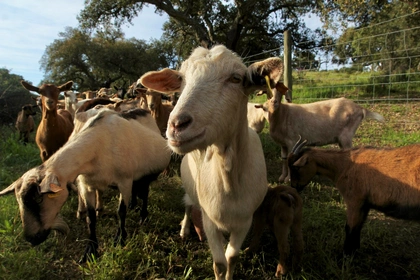
Establishing a Rotational Grazing Calendar in Mixed Farming Systems in Portugal
Portugal
Mediterranean zone
Benefits of the practice
- Improving soil health
- Promoting grassland regeneration
- Establishing a holistic farm management
Production system(s)
Thematic Area(s)
The impact of climate change on the Montado system is severe, causing soil degradation, water scarcity, high temperatures, extreme weather events, and pest and disease proliferation. These factors affect tree health and productivity, and animal welfare. To ensure the system’s resilience and sustainability, it is essential to balance forest density and livestock stocking rates, influencing grazing strategies.
Optimized grazing management is crucial, especially in systems with high stocking rates or multiple livestock types. Overgrazing can lead to soil compaction, reduced tree health, and compromised vegetation regeneration. Well-managed pastures, however, reduce the need for supplementary feed, lowering farm costs. Defining grazing areas, rest periods, and animal numbers per plot helps to adapt the Montado system to climate change and improves pasture management.
Implementing a rotational grazing calendar varies depending on farm characteristics and livestock type but is key to system resilience. This strategy can be expanded to other mixed and extensive livestock systems, strengthening sustainability.
At Monte da Silveira, a 700-hectare farm in Castelo Branco, Portugal, livestock includes pigs, sheep, and goats, alongside crops and pastures. Grazing is rotational: each plot subdivided into small plots where a high number of animals graze for a short period (hours or days) and then rest for a long period (months or years). The number of animals and grazing time is controlled to avoid overgrazing, erosion and soil degradation, promoting soil regeneration. The system follows a specific grazing sequence: local-breed black pigs feed on acorns first, followed by sheep grazing on herbaceous species, and finally goats controlling shrubs. This model adds value to acorn-fed pigs, reduces wildfire risk, and prevents overgrazing.
O sistema do Montado enfrenta impactos significativos das alterações climáticas, como degradação do solo, escassez de água, temperaturas elevadas, fenómenos extremos e proliferação de pragas e doenças, afetando a produtividade e sanidade das árvores e o bem-estar animal. Para aumentar a resiliência e sustentabilidade, é essencial equilibrar densidade florestal, efetivo animal e gestão das pastagens. A estratégia de pastoreio é crucial, especialmente em sistemas com um efetivo animal elevado ou diversificado.
A adoção de um calendário rotativo ajuda a minimizar a compactação do solo e otimizar a regeneração das pastagens, sendo possível adaptar a estratégia consoante a dimensão da exploração e tipo de gado. Esta estratégia pode ser aplicada a outros sistemas mistos e extensivos, promovendo a resiliência dos mesmos.
No Monte da Silveira, uma exploração com 700 hectares em Castelo Branco, o pastoreio é rotacional: cada parcela é subdivida em pequenas parcelas onde um número elevado de animais pasta por um curto período de tempo (horas ou dias), ficando a regenerar durante um longo período de tempo (meses ou anos). O número de animais por área e o tempo de pastoreio são controlados para evitar o sobre-pastoreio, erosão e degradação do solo, promovendo a regeneração dos solos.
O calendário segue uma ordem específica: os porcos entram primeiro para consumir bolotas, seguidos das ovelhas que se alimentam das espécies herbáceas, e das cabras, que controlam as espécies arbustivas. Além do sobre-pastoreio ser evitado, este método valoriza a carne de porco preto alentejano, alimentado com bolota, e reduz o risco de incêndios devido ao controlo da vegetação arbustiva.
The impact of climate change on the Montado system is severe. Soil degradation, water scarcity, high temperatures, extreme weather events and pest and disease proliferation are some of the identified effects on climate change in the system that affect tree health and productivity and animal welfare. The system needs to be adapted to increase its resilience and economic viability and sustainability. One of the farmers’ priorities regarding this system is how to balance the three components: forest density versus livestock stock rate, leading to different grazing strategies indifferent farms.
The grazing strategy is crucial, particularly in systems with higher stocking rates or with more than one type of livestock. If not well managed, overgrazed grassland can lead to soil degradation and compaction, decrease in tree health and productivity, reduced restoration in the following years, among other impacts. Additionally, the more available grassland for the livestock to feed on, less additional forage or feed is needed, which translates into fewer costs for the farm.
This measure contributes to the adaptation of the Montado system to climate change, as it aims to decrease soil compaction and improve grassland management, by defining various factors such as grazed area, grazing time and non-grazing time and number of animals per plot.
Depending on the farm dimension and on the type of livestock, the calendar will have different timeline and structure, however it is a key aspect to promote the system’s resilience.
While the establishment of a rotational grazing calendar is dependable of existing animals, this strategy can be scaled up to other mixed systems or extensive livestock production systems, allowing an improved system
resilience.
In Monte da Silveira, a 700-hectare farm in Castelo Branco in Portugal, has a diverse range of livestock from pigs, sheep and goats and various crops and pastures. each plot subdivided into small plots where a high number of animals graze for a short period (hours or days), and then rest for a long period (months or years). The number of animals and grazing time is controlled to avoid overgrazing, erosion and soil degradation, promoting soil regeneration.
The key difference is the establishment of a rotational grazing calendar according to the existing animals. The first animals to graze the plots are local-breed black pigs to feed on the acorn, followed by sheep that feed on the herbaceous species, and finally goats that control the shrubs. The benefit of these grazing systems is that acorn-fed pigs have higher value, wildfires occurrence is reduced due to shrubs control and excessive grazing is avoided.
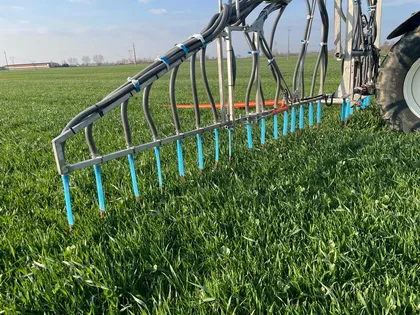
Carbon Farming as a Climate Change Adaptation and Mitigation Tool for Forage Production
Italy
Mediterranean area
Benefits of the practice
- Soil organic matter
- Carbon farming
- Biodiversity
Production system(s)
Thematic Area(s)
The phenomena that characterise climate change include rising temperatures, extreme events such as prolonged periods of drought followed by intense rainfall events, and a decrease in rainfall resulting in a decrease in agricultural production. The Mediterranean area is considered a climate change hotspot, i.e. where the phenomena listed above occur most frequently and most intensively. Carbon farming is considered a tool for facing and mitigating climate change because it aims to preserve soil fertility by maintaining or increasing organic matter. Maintaining soil fertility is essential to continue producing forage in terms of both quantity and quality.
Good practices that can be adopted include the following:
⦁ Reduce tillage:
⦁ Avoiding ploughing – high costs, limits soil bearing capacity and lengthens working time
⦁ Minimum tillage and/or no-tillage techniques
⦁ Biodiversity and crop rotation
⦁ Crops and genotypes adapted to new climatic conditions (e.g. from Southern Italy)
⦁ Crop associations (e.g. alfalfa and foxtail millet; wheat and forage peas; etc.)
⦁ Cover crop
⦁ Permanent meadows
⦁ Rational manure management
⦁ Maturation of manure and slurry
⦁ Spreading according to crop needs
I fenomeni che caratterizzano i cambiamenti climatici sono anche l’innalzamento delle temperature, eventi estremi come periodi prolungati di siccità seguiti da eventi piovosi intensi e la diminuzione della piovosità con conseguente calo delle produzioni agricole. Il mediterraneo è considerato un hotspot dei cambiamenti climatici, ossia dove i fenomeni sopra elencati avvengo più frequentemente ed in maniera più intensa. Il carbon farming è considerato uno strumento di contrasto e mitigazione dei cambiamenti climatici perché mira a preservare la fertilità dei suoli attraverso il mantenimento o l’incremento della sostanza organica. Il mantenimento della fertilità è fondamentale per continuare a produrre foraggio in termini sia quantitativi che qualitativi.
Le buone pratiche che si possono adottare sono le seguenti:
⦁ Ridurre le lavorazioni
⦁ Evitare l’aratura – costi elevati, limitano la capacità portante del suolo e allungano i tempi di lavoro
⦁ tecniche di minima lavorazione e/o no-tillage
⦁ Biodiversità e rotazione delle colture
⦁ Colture e genotipi adattati alle nuove condizioni climatiche (ad esempio, dal Sud Italia)
⦁ Associazione di colture (es. erba medica e panico; grano e piselli da foraggio; ecc.)
⦁ Cover crop
⦁ Prati permanenti
⦁ Gestione razionale del letame
⦁ maturazione del letame e del liquame
⦁ spandimento in base alle esigenze delle colture
The phenomena that characterise climate change are also rising temperatures, extreme events such as prolonged periods of drought followed by intense rainfall events, and a decrease in rainfall resulting in a decrease in agricultural production. The Mediterranean area is considered a climate change hotspot, i.e. where the phenomena listed above occur most frequently and most intensively. Carbon farming is considered a tool for facing and mitigating climate change because it aims to preserve soil fertility by maintaining or increasing organic matter that it is fundamental for continuing to produce forage in both quantitative and qualitative terms.
Carbon farming involves the application of good practices that aim to reduce energy, chemical and labour inputs. In Italy and Europe, numerous projects have been carried out and are still ongoing that have identified good practices according to pedoclimatic areas, water availability, crop cycle and type of farm.
Carbon farming aims to reduce tillage by trying to disturb the soil as little as possible, preserving the organic matter and favouring micro and macro porosity, soil biodiversity and at the same time reducing the use of fuel with consequent savings also in economic terms. Reduced tillage also means fewer hours/hectare are used, allowing better planning of all farm activities.
The reduced availability of water associated with the occurrence of extreme phenomena such as prolonged periods of drought and/or intense rainfall and temperature peaks requires the use of new species and/or varieties in crop rotations that are better adapted to the new soil and climate conditions. Genetic improvement by seed companies plays a key role, but also the use of agronomic techniques such as crop associations enable the production of high-quality forage. The use of cover crops is a valuable tool to protect the soil between two cash crops, to fertilise (e.g. leguminous crops) or to reduce leaching (catch crops). Converting part of the land to permanent meadows can bring both environmental (increased biodiversity and soil carbon stock) and forage quality benefits.
European agriculture accounts for about 10 % of GHG emissions, of which 70% from the livestock sector due in part to poor manure management.
Rational manure management would reduce GHG and NH3 emissions but also reduce the purchase of chemical fertilisers if used when crops need it.
Good practices that can be adopted include the following:
• Reduce tillage
o Avoiding ploughing – high costs, limits soil bearing capacity and lengthens working time
o Minimum tillage and/or no-tillage techniques
• Biodiversity and crop rotation
o Crops and genotypes adapted to new climatic conditions (e.g. from Southern Italy)
o Crop associations (e.g. alfalfa and foxtail millet; wheat and forage peas; etc.)
o Cover crop
o Permanent meadows
• Rational manure management
o Maturation of manure and slurry
o Spreading according to crop needs
Precision Farming
Europe
All zones
Benefits of the practice
- Right measure in the right place
- Decreased carbon footprint
- Increased crop yield and quality
Production system(s)
Thematic Area(s)
Precision farming means adapting measures to the variability of fields and crops. Within a field, conditions can vary greatly, and this depends on several factors. One important element is the soil type – the composition of clay, sand and coarse material and this in turn affects the movement of water in the soil. Other things that affect crop conditions are how well-drained the soil is, the soil’s organic matter content, previous years’ fertilisation, pH value and the crop’s access to various plant nutrients.
There are various measures that can be taken in precision farming. The basis for several of the measures is soil mapping, where soil samples are analysed based on soil type, pH, plant nutrients (P, K, Mg, Ca, Cu) and soil organic matter.
P and K applications are adjusted based on analyses of available P and K. Control files are then made for the fertiliser spreader so that more nutrients are applied in areas where P and K availability is low and less in areas with good plant nutrient status. Control files can be made in several different programmes, two examples are markkartering.se and markdata.se. Seed can be varied based on clay content and the higher the clay content, the higher the number of seed to get the same number of shoots/m2. Liming can also be adapted based on pH value, clay content and soil organic matter.
To vary N fertilisation, other data than soil mapping is needed. Several tools are available to calculate the N requirement of the crop, such as N tests or nitrogen stickers. This, combined with satellite images of the biomass of a field, provides a basis for varying N application rates. Maps of biomass, converted from satellite images, are available on Cropsat. On the site, it is also possible to make control files for the fertiliser spreader.
The greater the difference across the field in, for example, clay content, soil content, pH value or nutrient status, the more effect varied inputs of fertiliser, liming and seed will have.
Precisionsodling innebär att man anpassar åtgärder efter fältens och grödornas variation. Inom ett fält kan förutsättningarna variera väldigt mycket och det beror på flera olika saker. En viktig del är jordarten – sammansättningen av lera, sand och grövre material och detta påverkar i sin tur vattnets rörelse i marken. Andra saker som påverkar grödans förutsättningar är hur väldränerad jorden är, markens innehåll av organiskt material, tidigare års gödsling, pH-värde samt grödans tillgång av olika växtnäringsämnen.
Det finns olika åtgärder man kan göra inom precisionsodling. Grunden för flera av åtgärderna är markkartering där jordproverna analyseras utifrån jordart, pH, växtnäring (P, K, Mg, Ca, Cu) och mullhalt.
Givor av P och K anpassas utifrån analyser av tillgängligt P och K. Man gör då styrfiler till gödningsspridaren så det sprids mer näring på de platser där tillgången på P och K är låg och mindre på de delar med god växtnäringsstatus. Styrfiler kan göras i en rad olika program, två exempel är markkartering.se och markdata.se. Utsäde kan varieras utifrån lerhalten och ju högre lerhalt desto högre utsädesmängd för att få samma antal skott/m2. Kalkning kan också anpassas utifrån pH-värde, lerhalt och mullhalt.
För att variera gödsling av N behövs annat underlag än markkartering. Det finns flera olika hjälpmedel för att beräkna N-behovet hos grödan, till exempel N-tester eller kvävestickor. Detta i kombination med satellitbilder av biomassan på ett fält ger ett underlag för att variera N-givan. Kartor över biomassa biomassa, som är omgjorda från satellitbilder, finns tillgängliga på Cropsat. På sidan finns det också möjlighet att göra styrfiler till gödningsspridaren.
Ju större skillnad det är över skiftet i exempelvis lerhalt, mullhalt, pH-värde eller näringsstatus desto mer effekt kommer varierade insatser med gödning, kalkning och utsäde att ge.
Precision farming means adapting measures to the variability of fields and crops. Within a field, conditions can vary greatly, and this depends on a number of factors. One important element is the soil type – the composition of clay, sand and coarse material and this in turn affects the movement of water in the soil. Other things that affect crop conditions are how well drained the soil is, the soil’s organic matter content, previous years’ fertilisation, pH value and the crop’s access to various plant nutrients.
Especially around hollows and hills, conditions can differ greatly.
Precision farming is a fairly broad concept and there are various measures you can take. The basis for several of the measures is soil mapping where the fields are sampled at a density of 1 sample/ha. More frequent sampling is often done at the first soil mapping, with highly variable soils and in vegetable production. Samples are analysed for soil type, pH, plant nutrients(P, K, Mg, Ca, Cu) and soil content. Soil type is only analysed in the first mapping.
P and K rates are adjusted based on soil mapping analyses of available P and K. Control files are then made for the fertiliser spreader so that morenutrients are applied to the parts of the field where P and K availability islow and less to the parts with good plant nutrient status. Control files canbe made in a variety of programs. Two examples are markkartering.se andmarkdata.se. Seed can be varied based on clay content as emergence isoften better on lighter soils. So, the higher the clay content, the higher thenumber of seeds to get the same number of shoots/m2. Liming can also beadjusted based on the soil mapping results of pH, clay content and soilorganic matter. pH affects the availability of many plant nutrients and a pHbetween 6.5 and 7.5 is best for most crops. If the pH is higher or lower, manyplant nutrients become unavailable to the crop.
To vary N fertilisation, other data than soil mapping is needed. There are several tools available to calculate crop N requirements, such as N tests or nitrogen stickers. This, combined with satellite images of the biomass of afield, provides a basis for varying N application rates. Maps of biomass, converted from satellite images, are available on Cropsat. The site also offers the possibility to make control files for the fertiliser spreader.
In autumn oilseed rape, spring application of N can be calculated using the crop’s nitrogen uptake in autumn – the cutting method. This involves cutting and weighing the oilseed rape within 1 m2 at 3-5 locations in the field. Instructions are available at greppa.nu
It is also possible to use a tractor-mounted measuring instrument, N-sensor.
This scans the crop and varies the nitrogen rate directly according to need.
The technology is based on the difference in the amount of light emitted to the crop and how much the crop reflects. Based on the value, a calculation is made of the crop’s biomass, which is a good value to vary the nitrogen rate.
Of course, equipment is needed to apply precision farming and in short it is:
• Data from soil mapping, satellite, drone or similar
• GPS positioning in tractor
• GPS coordinates for the inputs
• Communication between GPS and machine control computer
• Implements with the possibility to change the output while driving• Tools to produce control file for implements
There are additional measures in precision farming, such as track control and quantity regulation of plant protection products and crop yield mapping.
Taking variation into account, inputs to each part of the field are streamlined and optimised to give the crop the best possible conditions. This increases yields and improves quality while reducing environmental impact and carbon footprint.
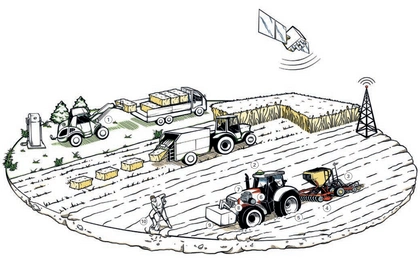
Saving Fuel in Agriculture - How much Savings Potential is in your Farm?

Austria
All zones
Benefits of the practice
- Reducing emissions
- Saving costs
- Saving time
Production system(s)
Thematic Area(s)
The measures for reducing diesel consumption are very diverse, some are very easy to implement, while others only need to be considered when purchasing the next machine. However, all measures have one thing in common: the comprehensive knowledge of the farm manager and active implementation in practice are the prerequisites for successful fuel savings.
Regardless of whether you implement just one measure in your business or several – the fact is that every litre of diesel consumed unnecessarily has a negative impact on the carbon footprint and the economic results of your business. It is therefore very important to include fuel-saving solutions in your daily decision-making.
The greatest potential savings are:
⦁ 70-80 % E-mobility
⦁ 10-20 % Controlled traffic farming
⦁ 10-15 % Electric drives
⦁ 25-30 % Working width and working depth
⦁ 10-15 % Tyre pressure
⦁ 15-20 % Transmission
⦁ 15-20 % Engine
⦁ 5-10 % Maintenance
⦁ 5-10 % Ballasting
⦁ Taking a soil sample – your start for more vitality and efficiency in the field
Die Maßnahmen zur Reduktion des Dieselverbrauchs sind sehr vielfältig, manche sind sehr einfach umzusetzen, andere wiederum erst beim nächsten Maschinenkauf zu berücksichtigen. Eines haben jedoch alle Maßnahmen gemeinsam: Das umfassende Wissen des Betriebsleiters und die aktive Umsetzung im praktischen Einsatz sind die Voraussetzung für erfolgreiches Spritsparen.
Egal ob Sie nur eine Maßnahme in Ihrem Betrieb umsetzen, oder aber mehrere – Fakt ist, dass jeder unnötig verbrauchte Liter Diesel negative Auswirkungen auf die Klimabilanz und das betriebswirtschaftliche Ergebnis Ihres Betriebs hat. Es ist daher von großer Bedeutung, treibstoffsparende Lösungen in die täglichen Entscheidungen miteinzubeziehen.
Die größten Einsparungspotentiale sind dabei:
⦁ 70–80 % E-Mobilität
⦁ 10–20 % Controlled Traffic Farming
⦁ 10–15 % Elektrische Antriebe
⦁ 25–30 % Arbeitsbreite und Arbeitstiefe
⦁ 10–15 % Reifendruck
⦁ 15–20 % Getriebe
⦁ 15–20 % Motor
⦁ 5–10 % Wartung
⦁ 5–10 % Ballastierung
⦁ Entnahme einer Bodenprobe – Ihr Start für mehr Vitalität und Effizienz am Acker
The majority of diesel is reserved for use in agricultural tractors and harvesters. The measures for reducing diesel consumption are very diverse, some are very easy to implement, others only need to be considered when purchasing the next machine. This factsheet explains five potential savings in diesel consumption.
Engine
Modern diesel engines are highly efficient and yet have poor overall efficiency. For every 20 litres of diesel used in heavy tillage, only 4 litres of diesel reach the ground as pure tractive power. The remaining 16 litres are lost to the environment in the form of waste heat as well as friction and slip losses.
As the operator of the machine, we cannot change this fact – but we can become aware of how every litre of diesel used can be converted more efficiently into working energy. If you try to operate the engine at a speed of 70 % of the nominal speed, you will save a lot of fuel and, with modern diesel engines, there is little or no loss of power.
Transmission
Even with continuously variable transmissions, diesel can be saved by knowing the efficiency curve. Each transmission has specific efficiency curves depending on the driving range. For example, one transmission may have the highest efficiency ranges when changing to the next driving range, while another transmission has the highest efficiency in the middle of the respective driving ranges. The different efficiency curves have a direct effect on fuel consumption. (See Photo 2)
Equipment settings
Agricultural machines and equipment have very complex adjustment options. The correct setting of a machine not only influences the improvement of work, but also on diesel consumption. Particularly with equipment that is difficult to adjust, such as a plough, diesel consumption rises sharply if the draft point, side tilt or camber are set incorrectly.
E-Mobility
As in the automotive sector, electric motors will increasingly find their way into agricultural technology in the future. The major advantages of the electric motor are the immediately available torque, superior efficiency and, finally, the possibility of producing electricity for charging the battery with renewable energy, e.g. photovoltaics, on the farm itself.
Machines with low power requirements and approximately the same number of operating hours per day are particularly suitable for the use of electric motors. Electric forklifts and farmyard loaders have been available on the market as standard products from various companies for years. Other advantages of electric forklift trucks and yard loaders include lower noise levels and the absence of pollutant emissions in enclosed spaces.
Controlled Traffic Farming
The use of digital technology can utilize or increase further savings potential.
The first step is to equip the tractor with a satellite-based guidance system.
This avoids overlaps of between 2 % and 7 % during tillage, depending on the field size, field shape and width of the implement. The faster turning times at the headland because of the bed cultivation made possible by the guidance system increase the overall cultivation speed of the field by up to5%. If the satellite technology is then also used for other applications – e.g. cultivation, fertilizer spreading or crop protection – the reduced use of operating resources can be seen not only as an ecological and economic measure, but also as an energy-efficient one.
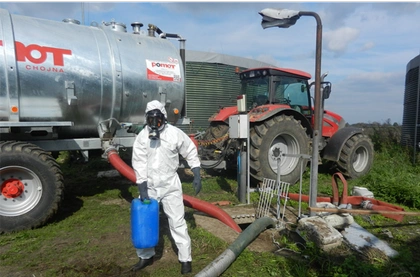
How to Keep Nitrogen in Slurry by Acidification?
Europe
All zones
Benefits of the practice
2. Improving animal welfare
3. Reducing odors
Production system(s)
Thematic Area(s)
High pH of slurry is the main reason for very rapid evaporation of ammonia during its application to the field. During storage of slurry in tanks, significant nitrogen losses also occur. These losses can be reduced by covering tanks, cooling the slurry to slow down the processes occurring in it, or acidifying it.
Currently, in Denmark 20% of slurry is acidified. There are only a few pilot plants outside Denmark. Interest in this technique is growing in other countries, and the current BAT (Best Available Techniques) document indicates slurry acidification as a mandatory best available technique in all EU countries. Within the Climate Farm Demo project, we want to achieve a significant reduction in GHG emissions during the project by promoting climate mitigation practices. Animal production is responsible for significant GHG emissions, and it is important to promote practices that reduce them.
⦁ Practical implications/recommendations: There are 3 methods of slurry acidification: “in house”, “in field” and “in storage”. It is very important to follow safety rules in each system. Particular attention should be paid to personal protective equipment, such as eye protection goggles, a mask absorbing toxic fumes, acid-resistant gloves and shoes, and a hooded suit. The cost of purchasing sulphuric acid is low, around 15 EUR per litre, and it is easily available. Main cost is equipment. The first slurry acidification system appeared on the market in 1999 in Denmark and it was a system of acidification in house. Then around 2009 a system of acidification in the field was introduced. The last one on the market appeared a system of acidification of slurry in storage.
⦁ Target Audience: farmers
⦁ Wysokie pH gnojowicy to główny powód bardzo szybkiego ulatniania się amoniaku w czasie jej aplikacji na polu. Podczas przechowywania gnojowicy w zbiornikach także dochodzi do znacznych strat azotu. Straty te można ograniczyć poprzez zadaszanie zbiorników, ochładzanie gnojowicy w celu spowolnienia procesów w niej zachodzących lub zakwaszanie.
⦁ Obecnie w Danii 20% gnojowicy jest zakwaszane. Poza granicami tego kraju istnieje tylko kilka pilotażowych instalacji. Zainteresowanie tą techniką ze strony innych krajów rośnie, a obecny dokument BAT (Best Available Techniques) wskazuje zakwaszanie gnojowicy jako najlepszą dostępną technikę obowiązkową we wszystkich krajach UE.
W ramach projektu Climate Farm Demo chcemy osiągnąć 30% redukcji emisji gazów cieplarnianych w trakcie trwania projektu poprzez upowszechnianie praktyk łagodzących zmiany klimatu. Produkcja zwierzęca jest odpowiedzialna za znaczne emisje gazów cieplarnianych dlatego ważne jest aby promować praktyki, które wpływają na ich obniżenie.
⦁ Praktyczne rekomendacje: Istnieją 3 metody zakwaszania “w budynku”, “na polu” i “w zbiorniku”. Bardzo ważne w każdym systemie jest zachowanie zasad bezpieczeństwa. Szczególnie należy zwrócić uwagę na środki ochrony osobistej tj. gogle do ochrony oczu, maskę pochłaniającą toksyczne opary, rękawice i buty kwasoodporne oraz kombinezon z kapturem. Koszt zakupu kwasu siarkowego jest niski ok 60 zł za litr i jest on łatwo dostępny. Pierwszy system zakwaszania gnojowicy pojawił się na rynku w 1999 roku i był to system zakwaszania w budynku. Następnie wprowadzono ok. 2009 roku system zakwaszania na polu. Ostatni na rynku pojawił się system zakwaszania gnojowicy w zbiorniku jako prostszy i tańszy od systemu zakwaszania gnojowicy na polu.
⦁ Grupa docelowa: rolnicy
The high pH of slurry is the primary reason for the rapid evaporation of ammonia during field application. Significant nitrogen losses also occur during slurry storage in tanks. In Denmark, slurry acidification has been practiced for over 20 years. The process uses concentrated 96% sulfuric acid, which is highly toxic and irritating. Therefore, appropriate personal protective equipment (PPE) is essential, including protective goggles, a mask for toxic fumes, acid-resistant gloves and footwear, and a hooded suit.
There are three main methods of slurry acidification:
1. In-House Acidification
This system includes a main slurry tank, a process tank with a mixer, a sulfuric acid tank, and a computer-controlled unit. Slurry is pumped from channels in the livestock building to the process tank. Sulfuric acid is added and mixed until the slurry reaches a pH of 5.5. A flow sensor ensures the slurry circulates back into the building until the desired pH is maintained. To stabilize pH, this process is repeated daily.
2. In-Tank Acidification
This method uses a tractor-mounted system comprising a mixer with an acid dosing nozzle, a slurry pump, a piping system with a nonreturn valve, and an acid dosing pump. The sulfuric acid is stored in a container beside the slurry tank and added directly into the stored slurry. Since acidification generates foam, the slurry tank should be filled to no more than two-thirds capacity. If excessive foam forms, pause acid addition until it subsides.
3. In-Field Acidification
Considered the safest method for handling sulfuric acid, this system consists of a slurry tanker with a pump and trailing hoses, a pH meter, and a tractor. Acid is dosed using a stainless steel pump with electronic control. The system measures the initial pH of the slurry and adjusts it to the target pH entered in the computer. A pH sensor placed near the distribution boom ensures accurate application. To prevent clogging from foam, acid and slurry are mixed quickly, andthe acid is injected as close to the distributor as possible.
Benefits of Slurry Acidification
Decades of Danish experience confirm multiple benefits of acidifying slurry:
• Ammonia emission reduction by up to 40%
• Sulfur supplementation to the soil
• Improved animal health, particularly with in-house systems
• Higher crop yields
• Minimal odor during field application
• Increased carbon sequestration, according to long-term SEGES studies
Additionally, sulfuric acid is widely available and relatively inexpensive, costing around €15 per liter.
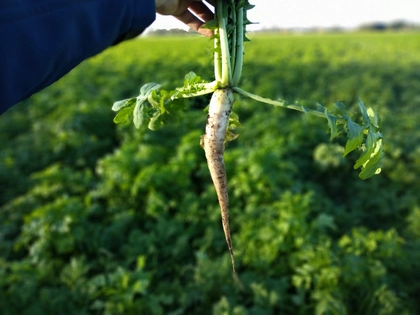
Increasing Organic Matter by Intercrops

Poland
Cool Temperate Dry
Benefits of the practice
- Prevention of soil erosion, increasing organic matter
- Carbon sequestration
- Weed control
Production system(s)
Thematic Area(s)
The use of intercrops has changed over the years; their earlier function on Polish farms was to produce fodder for animals. Today, their primary function is to provide protection against wind and water erosion, as well as to enrich the soil with organic matter.
A properly composed intercrop mixture should consist of plants whose root system is either bundled or stilt, which influences soil structure: respectively, plants with a bundled system increase soil microporosity, while stilt loosens compacted soil layers.
Intercrops impede the escape of certain elements into the environment through runoff, leaching or volatilisation, as well as conserving moisture and retaining snow. Intercrops are also grown for green manure, which is the case when cover crops are selected precisely to loosen up the soil or to fertilise another crop. In general, atmospheric nitrogen-fixing legumes are grown for use as green manure and once destroyed, supply the soil with nitrogen.
The vegetation cover also contributes to soil fertility by storing atmospheric carbon through photosynthetic action. Later, when plant residues are at least partially decomposed, they provide a source of organic matter and allow the humus content of the soil to increase.
To a lesser extent, farmers use catch crops to reduce the weed infestation on arable fields. The introduction of fast-growing species allows strong competition with weed growth at a time when arable fields are most vulnerable to weed infestation. Competition for resources (light, water and nutrients in the soil) helps reduce weed biomass and seed production which avoids feeding the soil seed bank and future weed emergence. Some species also reduce weed emergence through allelopathic effects e.g.: rye, buckwheat.
Zastosowanie międzyplonów uległo zmianom na przestrzeni lat, wcześniejszą ich funkcją w polskich gospodarstwach była produkcja paszy dla zwierząt. Obecnie ich podstawową funkcją jest zapewnienie ochrony przed erozją wietrzną oraz wodną, jak również wzbogacanie gleby w materię organiczną.
Prawidłowo skomponowana mieszanka międzyplonowa powinna składać się z roślin, których system korzeniowy jest wiązkowy lub palowy, ma to wpływ na strukturę gleby: odpowiednio rośliny z sytemem wiązokowym zwiększają wzrost mikroporowatości gleby natomiast palowy rozluźnia zbite warstwy gleby.
Rośliny mięzyplonowe utrudniają ucieczkę pewnych pierwiastków do otoczenia poprzez spływ , wymywanie lub ulatnianie się jak również utrzymują wilgotność i zatrzymują śnieg. Międzyplony są również uprawiane na zielony nawóz. O nawozie zielonym mówimy wówczas, gdy rośliny okrywowe dobierane są precyzyjnie w celu spulchnienia gleby lub nawożenia kolejnej rośliny uprawnej. Na ogół z przeznczeniem na zielony nawóz uprawia się rośliny strączkowe wiążące azot atmosferyczny , po zniszczeniu zasilają one glebę w azot
Szata roślinna przyczynia się również do żyzności gleby poprzez magazynowanie węgla atmosferycznego dzięki fotosyntetycznemu działaniu. Później, gdy resztki roślinne zostanąprzynajmniej częściowo rozłożone, stanową źródło materii organicznej i pozwalają na zwiększenie zawartości próchnicy w glebie.
W mniejszym stopniu rolnicy wykorzystują międzyplony do redukcji zachwaszczenia pól uprawnych. Wprowadzenie gatunków szybko rosnących pozwala na silną konkurencję z rozwojem chwastów w okresie, gdy pole uprawne jest najbardziej wrażliwe na zachwaszczenie. Konkurencja o zasoby: światło, wodę i składniki odżywcze w glebie pomaga zmniejszyć biomasę chwastów i produkcję nasion co pozwala uniknąć zasilania glebowego banku nasion i przyszłych wschodów. Niektóre gatunki ograniczają także wschody chwastów dzięki działaniu allelopatycznemu np.: żyto, gryka.
The use of intercrops has changed over the years; their earlier function on Polish farms was to produce fodder for animals. Today, their primaryfunction is to provide protection against wind and water erosion, as well asto enrich the soil with organic matter.
A properly composed intercrop mixture should consist of many plantsdiffering in their morphological characteristics. The most importantdifference is the root system, which can be either bunching or taproot,which has a great influence on soil structure: respectively, plants with abunching system increase the microporosity of the soil, while a taprootsystem loosens compacted soil layers; Japanese radish is a very goodexample of such a plant. It can successfully replace machinery that deeplyloosens the soil. The tiered root system helps to consolidate the soil structurecreated by tillage machines.
Intercrops support biodiversity. They provide shelter and a food source forpopulations of many animal species and micro-organisms. Earthworms area very good indicator of soil fertility, and the cultivation of cover cropscontributes greatly to their populations in arable fields. Cover crops alsocontribute to soil fertility by storing atmospheric carbon throughphotosynthetic action. Later, when plant residues are at least partiallydecomposed, they provide a source of organic matter and allow the humuscontent of the soil to increase. Organic matter is also fed on by earthworms,which also influences their population. The roots of intercrops, their diversityin size and depth have a positive effect on earthworm populations. The rootsand earthworms interact in such a way that the roots grow in the earthwormtunnels and the earthworms use the old root channels as they move through the soil profile.
Mollusc plants impede the escape of certain elements into the environmentthrough runoff, leaching or volatilisation as well as maintaining moistureand retaining snow. These plants also often can take up elements that arenot available to other crops, e.g.phacelia, buckwheat and sunflower take upphosphorus, which is not available to cereals. In general, atmosphericnitrogen-fixing legumes are grown for use as green manure; once
destroyed, they supply the soil with nitrogen.
To a lesser extent, farmers use catch crops to reduce the weed infestationon arable fields. The introduction of fast-growing species allows strongcompetition with weed growth at a time when the arable field is mostsusceptible to weed infestation. These are usually plants belonging to thecabbage family. On the other hand, the least competitive are broad beanplants that are not useful for weed reduction. Competition for resources(light, water and nutrients in the soil) helps to reduce weed biomass andseed production, which avoids feeding the soil seed bank and future weedemergence. Some species also reduce weed emergence through allelopathic effects (capacity to produce toxic compounds that are releasedinto the soil when plant tissue is incorporated) e.g.: rye, buckwheat. The largebiomass produced by some species with slow residue decomposition e.g. rough oats, rye, sorghum, contributes to weed reduction by forming a mulchlayer on the surface that hinders weed emergence. This practice isparticularly recommended if the crops are sown in wide rows, e.g. sugarbeet, maize, and it reduces the weed infestation between rows.
Intercropping has many different functions with a positive effect on soilfertility, some of which can be combined through the right choice of plants,the right timing of the destruction of the cover crop. By growing cover crops,it is possible to adapt to climate change and mitigate its negative effects.
Probiotechnology - Probiotics technology in agricultural production
Poland
Warm – Transition - Temperate Climate Zone
Benefits of the practice
2. Improve the health and efficiency of farm animals.
3. Improve soil fertility by increasing organic carbon and humus content.
Production system(s)
Thematic Area(s)
Probiotics have a very wide range of uses. In agriculture, they are allowed for use in both conventional and organic production. They are used in crops and animal production.
Effects of using probiotics in crop production:
1. Accelerate the decomposition of post-harvest residues, straw, catch crops, manure, which leads to the formation of soil humus.
2. A high level of soil humus means: more earthworms, which means natural fertilizer production and soil loosening
3. greater water storage capacity in the soil = plants cope better during drought periods
4. activate unavailable mineral components already present in the soil = more micro and macro elements without the use of fertilizers
break down toxins, such as residues from plant protection products or diseases, so that crop diseases are not transmitted between successive growing seasons
5. reduce the number of fertilizers used, thereby saving money and time
probiotics improve the composting process.
Effects of using compositions of beneficial microorganisms in animal production:
1. improve the digestion process
2. alleviate the course of food poisoning
3. reduce the incidence of diarrhea
4. accelerate the healing of abrasions and wounds
5. improve physical condition and physiological functions
6. eliminate odors from animal products, such as manure and slurry
7. reduce the population of insects, especially flies, midges and mosquitoes
8. when using preparations inside livestock buildings, such as on walls, floors, ceilings, litter, etc., the possibility of spreading pathogenic
9. pathogens is reduced
10. improve the quality and nutritional value of silage. The ensiling process is more efficient and effective. Silage is richer in easily digestible nutrients, so animals fed with such prepared feed have better production results
water revitalization.
Probiotyki mają bardzo szeroki zakres użytkowania, w rolnictwie
są dozwolone do stosowania w produkcji konwencjonalnej,
jak i ekologicznej. Mają zastosowanie w produkcji roślinnej oraz zwierzęcej.
Efekty stosowania probiotyków w produkcji roślinnej:
przyspieszenie procesu rozkładu resztek pożniwnych, słomy, poplonów, obornika, czyli tworzenia się próchnicy glebowej,
wysoki poziom próchnicy glebowej to:
– więcej dżdżownic, czyli produkcja naturalnego nawozu oraz spulchnianie podłoża;
– większa możliwości magazynowania wody w glebie = roślina lepiej sobie radzi w okresach suszy.
uruchamiają niedostępne dla roślin składniki mineralne już zawarte;
w glebie = więcej mikro i makroelementów bez stosowania nawozów;
rozkładanie toksyn, np. pozostałości po środkach ochrony roślin
czy chorobach, dzięki czemu nie są przenoszone choroby roślin uprawnych pomiędzy kolejnymi sezonami wegetacyjnymi;
można ograniczyć ilość stosowanych nawozów, a tym samym zaoszczędzić pieniądze oraz czas;
probiotyki usprawniają proces kompostowania.
Efekty stosowania kompozycji pożytecznych mikroorganizmów w produkcji zwierzęcej:
poprawiają proces trawienia;
łagodzą przebieg zatruć pokarmowych;
zmniejszenie częstości występowania biegunek;
przyspieszają gojenie otarć i zranień;
poprawiają kondycję fizyczną i funkcje fizjologiczne;
likwidują odory produktów odzwierzęcych, np. obornik, gnojowica;
redukują populację insektów, szczególnie much, meszek i komarów;
w przypadku stosowania preparatów wewnątrz budynków inwentarskich, np. na ściany, podłogę, sufity, ściółkę itp., ogranicza się możliwość rozprzestrzeniania chorobotwórczych patogenów;
poprawa jakość i wartość odżywczej kiszonek. Proces kiszenia przebiega sprawniej i efektywniej. Kiszonki są bogatsze w łatwo przyswajalne składniki odżywcze, przez co zwierzęta karmione tak przygotowaną paszą mają lepsze wyniki produkcyjne;
rewitalizacja wody.
Farmer face numerous positive and negative effects on the climate and adaptiveness to climate change. Using two sorts of policy approaches— those of “carrots,” or “sticks”—broadly speaking, legislators and the private sector can inspire farmers to adopt measures regarding climate change effects mitigation (i.e., lower emissions or enhance carbon removals) and adaptability to climate change. “Sticks” comprise taxes, regulatory restrictions or prohibitions, quotas or quantitative limitations, and taxes—all of which penalise or make it unlawful to carry out negative activities, therefore changing behaviour. On the other hand, legislators or the private sector might pay farmers for doing good deeds, therefore encouraging positive change – “carrots”.
We focus on these so-called “carrots,” which we see as rewarding mechanisms, in this Practice Abstract. Rewards for agricultural activities that lower or avoid emissions, remove carbon from the atmosphere, adapt to climate change are defined as mechanisms that reward farmers in return for implementing a desired action or delivering a desired outcome and can be sourced from public or private entity or even a mix of both. Aiming to promote a behavioural change, using positive incentives, and their voluntary character define rewarding systems. Among other things, these motivating systems can take the following format: regulatory responsibilities (that are rewarded), voluntary public money, R&D, voluntary carbon markets and price premiums/labelling.
Furthermore, on EU agricultural land, there is a wide spectrum of climate action on plot, field, and landscape level which are captured to different degrees in the several present or proposed rewarding systems. One can classify them as follows:
- emission reduction which is mainly methane (CH4) from enteric fermentation and N2O emissions from managed agricultural soils, which together represent over 80% of agricultural emission in the EU.
- the removal of CO2 from the atmosphere by converting between land cover types and managing the agricultural soils to increase carbon sequestration and
- the response to climate change by increasing the adaptive capacity of the agricultural sector.
Moreover, two basic types define rewarding sources: public and private ones. While most of the current systems rely on monetary financing, both might entail both financial and non-financial benefits. With public rewarding we refer to financing or help from the international community, EU, State or regional level e.g. Common Agricultural Policy (CAP), R&D initiatives, etc. Any kind of funding from the private sector—companies, private groups, and consumers—through carbon markets or price premiums and labelling qualifies as private rewarding. Public/private funding sources include market-based strategies whereby the Government plays a major role either supplying or distributing the funds also exist.
There are several ways to reward land users and farmers for their environmental activity. They can be generally divided between the delivery of result-based or action-based results. Action-based rewarding gives the farmer in line with generally quite particular agricultural methods satisfying results. Independent of the outcome of those designated management activities, farmer or landowner gets a compensation or incentive for carrying out such activities. Result-based rewarding is linked to a confirmed outcome and calls for a direct, explicit relationship between the result delivered—e.g., emission decreased or avoided, carbon sequestered—and the incentive the farmer gets.
Lastly, there are several design choices about the timing of the rewarding, that is, when and how often the rewarding is occurring. Ex-ante rewarding is the (typically financial) prelude to climate action. While the real result of climate change might take years, long-term initiatives requiring significant upfront expenditures may find relevance for this payment mechanism. Expost rewarding is done following the farmer’s generated climate action. Over the course of the project, the rewarding might be one-off or continuous, multi-year. Also, combinations of the timing of rewarding are feasible.
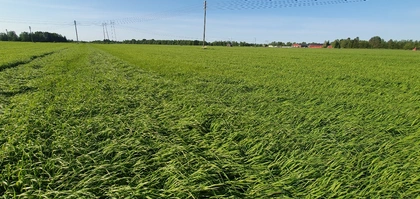
Climate Smart Farming of Finnish Peatlands

Finland
Nordic Climate
Benefits of the practice
- Peatland adaptation and mitigation
- Water management
- Peatland cover crops
Production system(s)
Thematic Area(s)
Peatlands account for a significant 80% of the carbon dioxide emissions of the entire Finnish agricultural area, which is why Finland has been seeking carbon dioxide emission reduction solutions for farms for decades.
Peatlands cover about 4–7% of Finland’s arable land, depending on the measurement method. They are defined as thick peats if the peat cover exceeds 40 cm. Most peatlands are located from the central to northern part of Finland, in areas dominated by livestock farming.
Peatlands are better able to bind water than mineral soils, so yield is higher during the dry growing season than on mineral soils.
Various solutions have been sought for climate-smart cultivation of peat fields to reduce carbon dioxide emissions. There are several different emission reduction solutions depending on how many peat fields there are on the farmer’s farm. The simplest way is to map the yield capacity of peat fields, i.e. to focus on high-yielding parcels and leave low-yielding, small-scale parcels with challenging shapes covered with vegetation or possibly even restore these fields. The farmer himself is the best expert in determining the yield capacity of his own peat fields
In peat fields cultivated in Finland, climate-smart cultivation solutions to slow down the decomposition of peat include the following measures:
⦁ Maintaining and regulating the water level in fields and regulating drainage
⦁ Cultivation of perennial crops
⦁ Winter plant cover
⦁ Direct seeding or lightened tillage
⦁ Use and cultivation of crops for bioenergy, such as energy willow
⦁ Avoid plowing or deep tillage
⦁ Keeping low yielding small parcels of arable land as grassland or converse them into wetlands
Most of Finland’s peat fields are in livestock farming areas, so plant cover is thus automatically allocated to a large part of peat fields. Farmers and researchers have tried and continue to experiment with new practical farming methods to slow down the degradation of peatlands.
Koko Suomen maatalosmaan hiilidioksidipäästöistä turvemaiden osuus on merkittävä noin 80% ja siksi eri tiloille sopivia hiilidioksidin päästövähennysratkaisuja on haettu jo useita vuosia turvemaiden osalta.
Turvemaiden osuus Suomen peltopinta-alasta eri mittausmenetelmistä riippuen on noin 4-7 % . Turvemaat määritellään paksuturpeisiksi, jos niiden turvepeite on yli 40 cm. Suurin osa turvemaista sijaitsee Suomen keskiosasta pohjoiseen karjatalousvaltaisilla viljelyalueilla.
Turvemaat pystyvät sitomaan vettä kivennäismaita paremmin, joten satotuotto on suurempi kuivana kasvukautena kuin kivennäismaalla.
Turvepeltojen ilmastoviisaaseen viljelyyn on haettu erilaisia ratkaisuja hiilidioksipäästöjen vähentämiseksi. Päästövähennysratkaisuja on useita erilaisiariippuen siitä, kuinka paljon viljelijän tilalla on turvepeltoja.
Yksinkertaisin keino on kartoittaa turvepeltojen sadontuottokyky eli keskittyä hyvätuottoisiin peltolohkoihin ja jättää heikkotuottoiset, pinta-alaltaan pienet ja muodoltaan haastavat lohkot kasvipeitteiseksi tai mahdollisesti jopa ennallistaa nämä pellot. Viljelijä itse on paras asiantuntija määrittämään omien turvepeltojensa sadontuottokyvyn
Suomessa viljellyillä turvepelloilla ilmastoviisaita viljelyratkaisuja turpeen hajoamisen hidastamiseksi ovat mm. Seuraavat toimenpiteet.
⦁ Pellon vedenpinnan korkeuden ylläpitäminen ja säätely sekä säätösalaojitus
⦁ Monivuotisten kasvien viljely
⦁ Talviaikainen kasvipeitteisyys
⦁ Suorakylvö tai kevennetty muokkaus
⦁ Sadon käyttö ja viljely bioenergiaksi, kuten energiapaju
⦁ Kyntömuokkauksen tai syvämuokkauksen välttäminen
⦁ Heikkotuottoisten pienten peltolohkojen pitäminen luonnonhoitonurmena tai muuttaminen kosteikoksi
Suurin osa Suomen turvepelloista sijaitsee karjatalousalueilla, joten kasvipeitteisyys kohdentuu näin ollen automaattisesti suurelle osalle turvepelloista. Viljelijät ja tutkijat ovat kokeilleet ja kokeilevat edelleen uusia käytännönläheisiä viljelykeinoja turvemaiden hajoamisen hidastamiseksi
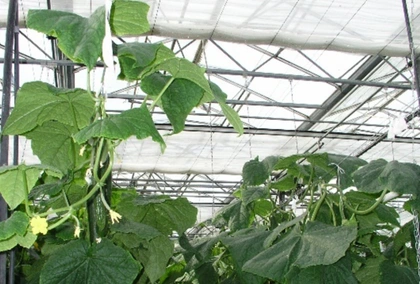
Using Thermal Screen to Reduce Energy Consumption in Greenhouses
France
Temperate
Benefits of the practice
- Reducing energy consumption
- Improving climate control
- Yield efficiency
Production system(s)
Thematic Area(s)
The thermal screen is the first equipment to be installed to reduce the energy consumption of greenhouses. The objective of the thermal screen is to reduce heat losses in the greenhouse when they are most significant, namely at night. High-performance thermal insulation is achieved by limiting both convective exchanges (a well-closed and relatively airtight screen) and radiative exchanges (using reflective and low-emissivity materials). The screens are made from various materials (polyethylene, polyester, acrylic), in film, mesh, woven, or non-woven forms, and are more or less metallized. Thermal efficiency increases as the emissivity and transmission of the screen decreases. Manufacturers generally specify the light transmission and the expected energy savings.
The thermal screen is deployed above the crops at the beginning of the night when heating demand becomes significant and is gradually retracted at sunrise to avoid thermal shock. During normal nighttime operation, the screen remains closed, but a slight temporary opening may be necessary to control humidity and temperature. It is possible to use a perforated screen to allow water vapor to pass through and prevent excessive humidity levels. Additionally, devices can be used to dehumidify the greenhouse. Double screens are used in which the highest energy savings are combined with transparent materials for flexible usage during dull days and nighttime.
Finally, implementing the thermal screen requires automatic control. Management of the screen is crucial to avoid health issues and yield losses, especially concerning humidity. Energy savings from using a thermal screen are about 20–25%, and 30–35% with a double screen, compared to a greenhouse without a screen.
L’objectif de l’écran thermique est de réduire les pertes thermiques de la serre au moment où elles sont les plus importantes, c’est-à-dire de nuit. Une bonne isolation thermique est obtenue en limitant à la fois les échanges convectifs (écran bien fermé et relativement étanche) et radiatifs (matériaux réfléchissants et à faible émissivité). Les toiles sont constituées de matériaux divers (polyéthylène, polyester, acrylique), en film, à maille, tissés ou non et plus ou moins métallisés. L’efficacité thermique augmente lorsque l’émissivité et la transmissivité de la toile décroissent. Les fabricants indiquent généralement la transmission lumineuse et l’économie d’énergie attendue.
L’écran thermique est déployé au-dessus de la culture en début de nuit, quand la demande de chauffage devient importante, et est retiré au lever du soleil de manière progressive pour éviter le choc thermique. En fonctionnement normal de nuit, l’écran est fermé, mais une légère ouverture temporaire peut être nécessaire pour maîtriser l’hygrométrie et la température. L’utilisation d’un écran ajouré est possible, afin de laisser passer la vapeur d’eau et éviter des taux d’hygrométrie trop importants. Il est également possible d’utiliser des systèmes pour déshumidifier la serre en complément. Enfin, la mise en œuvre de l’écran thermique nécessite un pilotage automatique. La gestion de l’écran doit en effet être bien maîtrisée, pour éviter les problèmes sanitaires et les pertes de rendement, notamment par rapport à l’hygrométrie.
L ‘écononomie d’énergie par la mise en place d’un écran thermique est de 20-25% et de 30-35% avec un double écran par rapport à une serre sans écran. L’interêt du double écran est également d’avoir deux toiles avec des propriétés différentes permettant de l’utiliser de nuit et pendant les jours sombres.
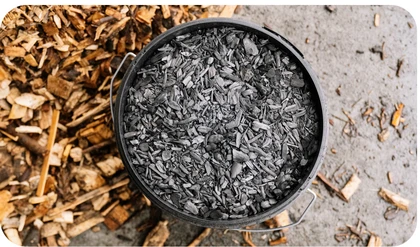
Use of Biochar in German Farms - Benefits for Climate, Soil and Animal Health

Germany
Warm-temperate Mid-latitude
Benefits of the practice
- GHG Reduction & Carbon Storage: CO₂ sequestration in soil, biochar as a carbon sink.
- Soil Fertility Enhancement: Improved structure, aeration, water retention, nutrient availability, higher yields.
- Animal Health Optimization: Feed and bedding additive benefits—reduces toxins, enhances hygiene, supports hoof health.
Production system(s)
Thematic Area(s)
Biochar is a porous, carbon-rich material that is produced when plant biomass is heated at very high temperatures in the absence of air (pyrolysis). During this process, a large proportion of the carbon that was originally bound in the plants is not released into the atmosphere as CO₂ but remains stably bound in the biochar for many years. In this way, it can actively contribute to climate protection and optimize the carbon footprint of agricultural farms.
Soil fertility plays a decisive role in yield stability. Biochar can make a positive contribution to this by promoting water retention and optimizing soil aeration. In addition, biochar can bind nutrients and so contribute to higher nutrient availability. This can reduce the leaching of nutrients and lower the need for synthetic fertilizers. One practical way of applying biochar is to use it as a manure additive.
One advantage of using biochar in cattle farming is the optimization of animal health. Biochar can be used as a feed additive to support the animals’ digestive tract. It binds toxins, harmful substances and gases in the gastrointestinal tract. This can prevent illness and promote the general health of the animals. Biochar can also be used as bedding, e.g. in dairy farming. Due to the ability of biochar to absorb moisture and dirt, the lying surfaces remain drier. This can inhibit the growth of bacteria and other pathogens and thus reduce the risk of infections or skin problems. In addition, dry and clean bedding helps to prevent claw diseases.
Overall, special attention should be paid to the origin, production and quality of biochar so that the benefits described can unfold.
Pflanzenkohle ist ein poröses, kohlenstoffreiches Material, welches entsteht, wenn pflanzliche Biomasse unter Luftabschluss bei sehr hohen Temperaturen erhitzt wird (Pyrolyse). Während dieses Prozesses wird ein großer Teil des Kohlenstoffs, der ursprünglich in den Pflanzen gebunden war, nicht in die Atmosphäre als CO₂ freigesetzt, sondern bleibt in der Pflanzenkohle viele Jahre stabil gebunden. So kann sie aktiv zum Klimaschutz beitragen und die Klimabilanz von landwirtschaftlichen Betrieben optimieren.
Die Bodenfruchtbarkeit spielt für die Ertragsstabilität eine entscheidende Rolle. Pflanzenkohle kann hierzu positiv beitragen, indem sie die Wasserspeicherung fördert sowie die Bodenbelüftung optimiert. Außerdem kann Pflanzenkohle Nährstoffe an sich binden und so zu einer höheren Nährstoffverfügbarkeit beitragen. Dies kann die Auswaschung von Nährstoffen verringern und den Bedarf an synthetischen Düngemitteln reduzieren. Eine praxistaugliche Möglichkeit zur Ausbringung von Pflanzenkohle ist die Nutzung als Güllezusatz.
Ein weiterer Vorteil des Einsatzes von Pflanzenkohle ist die Optimierung der Nutztiergesundheit. Pflanzenkohle kann als Futtermittelzusatz verwendet werden, um den Verdauungstrakt der Tiere zu unterstützen. Sie bindet Toxine, Schadstoffe und überschüssige Gase im Magen-Darm-Trakt. Dies kann Erkrankungen vorbeugen und die allgemeine Gesundheit der Tiere fördern. Pflanzenkohle kann auch als Einstreu z.B. in der Milchviehhaltung verwendet werden. Durch ihre Fähigkeit, Feuchtigkeit und Schmutz zu absorbieren, bleiben die Liegeflächen so trockener. Dies kann das Wachstum von Bakterien und anderen Krankheitserregern hemmen und somit das Risiko von Infektionen oder Hautproblemen verringern. Zudem trägt eine trockene und saubere Einstreu zur Vorbeugung von Klauenerkrankungen bei.
Insgesamt sollte ein besonderes Augenmerk auf die Herkunft, Herstellung sowie Qualität der Pflanzenkohle gelegt werden, damit sich die beschriebenen Vorteile entfalten können.
Tool to Discuss Climate Change Adaptation at a Farm Level
Europe
All Zones
Benefits of the practice
- Quantify climate change effect at the farm level
- Discuss solutions to adapt specific farmer issues
- Simple tool to understand farmer issues
Most European farmers face climatic hazards on their farms due to climate change. This climatic instability makes multi-year projections difficult. To help advisors understand what farmers are experiencing, we developed a simple climate adaptation tool in an Excel sheet during the project. One of the goals was to keep it simple to discuss climate change without adding too many questions to the already planned mitigation audit.
This is a questionnaire divided into four parts. The first part describes the farm’s production. The second part, titled “Climatic Risks,” aims to determine whether the farmer has experienced more climatic incidents in the past five years than before (such as drought, excess water, frost, storm damage, or biotic stress) and how these have impacted their livestock or crop production.
The third part covers farm-specific characteristics related to adaptation of climate change, such as climate insurance, access to irrigation, and soil type. The final section addresses practices the farmer has already tested on the farm.
This short survey has two objectives: quantifying climatic incidents at the farm level and opening a discussion with the farmer on adaptation in a simple way. It is linked to the adaptation measures library also developed during the project. In this way, advisors can suggest tailored measures to farmers and contribute practical examples from the field to enrich the library.
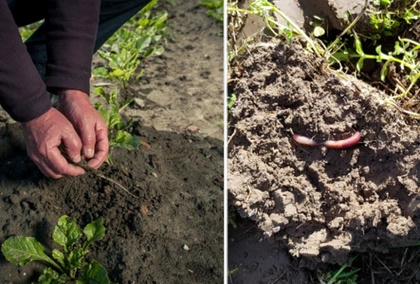
The Benefits of Carbon Farming
Europe
All zones
Benefits of the practice
2. Climate Mitigation
3. Water Adaptation
Production system(s)
Thematic Area(s)
Carbon Sequestration in Agriculture
Benefits of Carbon Sequestration:
⦁ Improvement of Soil Health: Carbon sequestration enhances soil health by improving soil structure, water retention, and nutrient availability.
⦁ Reduction of Carbon Footprint: By sequestering carbon, the agricultural sector can contribute to the reduction of overall CO2 emissions.
⦁ Financial Benefits: Farmers can financially benefit from carbon sequestration by participating in carbon farming projects and selling carbon credits.
⦁ Support for Sustainable Agricultural Practices: Carbon sequestration promotes the use of sustainable agricultural practices such as cover crops, compost, and organic fertilizers.
Ways Carbon Can Be Sequestered in Agriculture:
⦁ In the Soil: Through crop residues, roots, and animal manure, organic material enters the soil, where soil organisms partially break it down. Some of the carbon forms stable organic matter that remains in the soil for a long time.
⦁ In Living Plants (Trees): For example, through agroforestry, where carbon is sequestered in the biomass of trees as long as the trees remain standing.
⦁ In Processed Biomass: Such as building materials made from hemp, which sequester carbon for a long time.
Factors Affecting Carbon Sequestration:
⦁ The effectiveness of carbon sequestration in the soil depends on factors such as moisture availability, temperature, clay content, soil structure, pH, and soil life. Clay soils generally have a higher carbon sequestration capacity than sandy soils.
Effective Measures for Carbon Sequestration: To increase the amount of organic matter in the soil, there are two options:
⦁ Increase Organic Matter Input: For example, by using cover crops, compost, and solid manure.
⦁ Reduce Organic Matter Decomposition: For example, by leaving crop residues on the land
Koolstofvastlegging in de landbouw
Voordelen koolstofvastlegging:
⦁ Verbetering van de bodemgezondheid:
Koolstofvastlegging verhoogt de gezondheid van de bodem door verbetering van de bodemstructuur, waterretentie en beschikbaarheid van voedingsstoffen
⦁ Verlaging van de koolstofvoetafdruk:
Door koolstof vast te leggen, kan de landbouwsector bijdragen aan de vermindering van de totale CO2-uitstoot
⦁ Financiële voordelen:
Boeren kunnen financieel profiteren van koolstofvastlegging door deel te nemen aan carbon farming projecten en het verkopen van koolstofcertificaten
⦁ Ondersteuning van duurzame landbouwpraktijken: Koolstofvastlegging stimuleert het gebruik van duurzame landbouwpraktijken zoals groenbemesters, compost en organische meststoffen
Koolstof kan op verschillende manieren worden vastgelegd in de landbouw:
⦁ In de bodem: Via gewasresten, wortels en dierlijke mest komt organisch materiaal in de bodem, waar het bodemleven het gedeeltelijk afbreekt. Een deel van de koolstof vormt stabiele organische stof die langdurig in de bodem blijft1.
⦁ In levende planten (bomen): Bijvoorbeeld via agroforestry, waarbij koolstof in de biomassa van bomen wordt vastgelegd zolang de bomen blijven staan1.
⦁ In verwerkte biomassa: Zoals bouwmaterialen van hennep, die langdurig koolstof vastleggen1.
Factoren die koolstofvastlegging beïnvloeden:
⦁ De effectiviteit van koolstofvastlegging in de bodem hangt af van factoren zoals vochtbeschikbaarheid, temperatuur, kleigehalte, bodemstructuur, zuurgraad en bodemleven. Kleibodems kunnen over het algemeen meer koolstof vasthouden dan zandbodems.
Effectieve maatregelen voor koolstofvastlegging:
Om de hoeveelheid organische stof in de bodem te verhogen, zijn er twee opties:
⦁ Meer organische stof aanvoeren: Bijvoorbeeld door het gebruik van groenbemesters, compost en vaste mest.
⦁ Afbraak van organische stof remmen: Bijvoorbeeld door gewasresten achter te laten op het land.
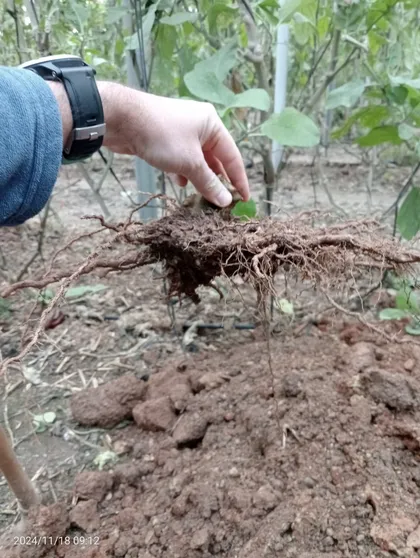
Sustainable Soil Management Strategies to Improve Fertility and Water Efficiency in Agriculture

Spain
Mediterranean and Semi-arid Climate
Benefits of the practice
- Improved soil fertility & structure
- Enhanced water retention & efficiency
- Reduction of soil degradation & erosion
Production system(s)
Thematic Area(s)
Poor soil management leads to degradation and inefficient water use in agriculture. This document presents sustainable strategies to improve fertility and water retention, ensuring higher productivity and long-term sustainability. The study highlights the benefits of using organic amendments, reduced tillage, and cover crops. These techniques increase organic matter, improve soil structure, and enhance water infiltration, reducing erosion and the need for chemical inputs. Farmers can adopt these methods to improve crop yields, reduce costs, and strengthen climate resilience.
Sustainable soil management is essential for climate adaptation in agriculture. Reduced tillage, organic amendments, and cover crops enhance water retention, reduce erosion, and improve microbial biodiversity. These strategies have proven effective in Mediterranean and semi-arid systems where water is a limiting factor. Their adoption can lead to lower input costs, more stable yields, and increased crop resilience against extreme weather events. Additionally, these practices contribute to climate change mitigation by increasing soil carbon sequestration.
El manejo inadecuado del suelo contribuye a su degradación y a un uso ineficiente del agua en la agricultura. Esta práctica propone estrategias sostenibles para mejorar la fertilidad y la retención de agua, asegurando una mayor productividad y sostenibilidad a largo plazo. El estudio destaca los beneficios del uso de enmiendas orgánicas, reducción del laboreo y cultivos de cobertura. Estas técnicas aumentan la materia orgánica, mejoran la estructura del suelo y optimizan la infiltración de agua, reduciendo la erosión y la necesidad de insumos químicos. Los agricultores pueden aplicar estas técnicas para mejorar el rendimiento de sus cultivos, reducir costes y fortalecer la resiliencia climática.
El manejo sostenible del suelo es clave para la adaptación al cambio climático en la agricultura. Las prácticas de laboreo reducido, enmiendas orgánicas y cultivos de cobertura permiten incrementar la retención de agua en el suelo, reducir la erosión y mejorar la biodiversidad microbiana. Estas estrategias han demostrado ser efectivas en sistemas mediterráneos y semiáridos, donde el agua es un recurso limitado. Su adopción puede traducirse en un ahorro en insumos, mayor estabilidad en los rendimientos y una mejora en la resiliencia de los cultivos ante eventos climáticos extremos. Además, estas prácticas contribuyen a la mitigación del cambio climático al incrementar la captura de carbono en el suelo.
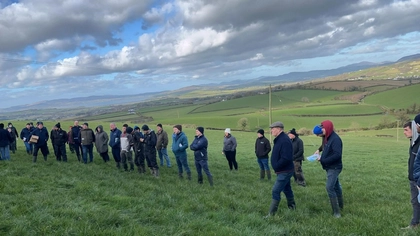
Reducing the Age of Slaughter to Mitigate GHG Emissions and Increasing Farm Profitability

Ireland
All Zones
Benefits of the practice
- Reduction of GHG emissions
- Increased farm profitability
- Reducing the age of slaughter
Production system(s)
Thematic Area(s)
One of the key mitigation measures gaining popularity among beef pilot demo farmers in Ireland is reducing the age of slaughter. This action not only lowers total farm GHG emissions but also allows farmers to increase profitability by selling animals earlier. At a recent farm walk, Gareth Peoples set a goal to reduce the slaughter age from 27 months to 24 months.
Reducing slaughter age by three months can cut methane emissions by approximately 19 kg per animal over its lifetime. Since methane is more harmful than CO₂, this reduction is a valuable climate achievement.
Gareth explained that achieving greater weights at younger ages depends on several factors. Hitting key targets at weaning, yearling, and finishing stages ensures animals stay on track for optimal performance. He emphasized the importance of selecting dairy beef calves with higher genetic merit, using the Dairy Beef Index to purchase better-quality stock, focusing on carcass weight and conformation.
Another major advantage is the cost savings associated with earlier finishing. Farmers benefit from lower feed costs and reduced enteric fermentation emissions. To ensure continuous animal growth, farmers must focus on calf rearing, housing, and spring grassland management.
The demo event in Donegal highlighted the importance of adaptation and mitigation measures for reducing on-farm emissions. It also reinforced the value of knowledge sharing and collaboration in advancing sustainable agriculture through climate-smart farming.
Upcoming events in Ireland and across Europe will allow farmers to exchange insights, learn from each other, and work collectively toward a more resilient, climate-smart agricultural sector.
Optimized Fertilization in Olive Cultivation Using Soil Analysis, New Stabilized Fertilizers and New Technologies
Greece
Mediterranean
Benefits of the practice
- Increase in oil yields
- Reduction of water pollution
Production system(s)
Thematic Area(s)
Optimized fertilization in olive cultivation is vital to increase yields and achieve high quality fruit while protecting the environment. The modern approach to fertilization is based on the use of advanced technologies such as soil analysis, stabilized fertilizers and precision systems to improve efficiency and minimize nutrient wastage.
Soil analyses are the first and most important step in the approach to optimized fertilization. Through soil analysis, we can understand the actual nutrient needs of the soil and adjust the amount and type of fertilizer required for each area of the grove. This process helps to identify deficiencies or excesses of nutrients, such as nitrogen, phosphorus and potassium, and allows the precise application of fertilizer according to the needs of the soil.
Stabilized fertilizers are an innovative solution for fertilizing olive groves. These fertilizers are designed to release nutrients gradually and precisely, preventing losses through erosion or evaporation. By using them, nutrients remain available in the soil for longer periods of time, enhancing their availability to plants and reducing the need for frequent applications.
New technologies such as precision systems and satellite imagery offer excellent possibilities for monitoring plant health and accurately applying fertilizers. Through the use of GPS and satellite systems, farmers can apply fertilizer only where it is needed, avoiding waste and reducing the impact on the environment.
Overall, the combined use of soil analysis, stabilized fertilizers and new technologies allows for a more efficient, economical and environmentally friendly approach to olive fertilization.
Η βελτιστοποιημένη λίπανση στην καλλιέργεια ελιάς είναι ζωτικής σημασίας για την αύξηση της απόδοσης και την επίτευξη υψηλής ποιότητας καρπών, ενώ παράλληλα προστατεύει το περιβάλλον. Η σύγχρονη προσέγγιση στη λίπανση βασίζεται στη χρήση προηγμένων τεχνολογιών, όπως οι εδαφικές αναλύσεις, τα σταθεροποιημένα λιπάσματα και τα συστήματα ακριβείας για τη βελτίωση της αποδοτικότητας και την ελαχιστοποίηση της σπατάλης θρεπτικών συστατικών.
Οι εδαφικές αναλύσεις αποτελούν το πρώτο και πιο σημαντικό βήμα στην προσέγγιση της βελτιστοποιημένης λίπανσης. Μέσω της ανάλυσης του εδάφους, μπορούμε να κατανοήσουμε τις πραγματικές ανάγκες του εδάφους σε θρεπτικά συστατικά και να προσαρμόσουμε την ποσότητα και τον τύπο λιπάσματος που απαιτείται για κάθε περιοχή του ελαιώνα. Αυτή η διαδικασία βοηθά στον προσδιορισμό των ελλείψεων ή των υπερβολών σε θρεπτικά συστατικά, όπως άζωτο, φώσφορο και κάλιο, και επιτρέπει την ακριβή εφαρμογή λιπασμάτων σύμφωνα με τις ανάγκες του εδάφους.
Τα σταθεροποιημένα λιπάσματα αποτελούν μία καινοτόμο λύση στη λίπανση των ελαιώνων. Αυτά τα λιπάσματα έχουν σχεδιαστεί με τέτοιο τρόπο ώστε να απελευθερώνουν τα θρεπτικά συστατικά σταδιακά και με ακρίβεια, αποτρέποντας τις απώλειες μέσω διάβρωσης ή εξάτμισης. Με τη χρήση τους, τα θρεπτικά συστατικά παραμένουν διαθέσιμα στο έδαφος για μεγαλύτερο χρονικό διάστημα, ενισχύοντας τη διαθεσιμότητά τους για τα φυτά και μειώνοντας την ανάγκη για συχνές εφαρμογές.
Οι νέες τεχνολογίες όπως τα συστήματα ακριβείας και οι δορυφορικές εικόνες προσφέρουν εξαιρετικές δυνατότητες για την παρακολούθηση της υγείας των φυτών και την ακριβή εφαρμογή λιπασμάτων. Μέσω της χρήσης GPS και δορυφορικών συστημάτων, οι καλλιεργητές μπορούν να εφαρμόζουν τα λιπάσματα μόνο στις περιοχές που το χρειάζονται, αποφεύγοντας τη σπατάλη και μειώνοντας την επίδραση στο περιβάλλον.
Συνολικά, η συνδυασμένη χρήση των εδαφικών αναλύσεων, των σταθεροποιημένων λιπασμάτων και των νέων τεχνολογιών επιτρέπει μια πιο αποδοτική, οικονομική και περιβαλλοντικά φιλική προσέγγιση στη λίπανση της ελιάς.
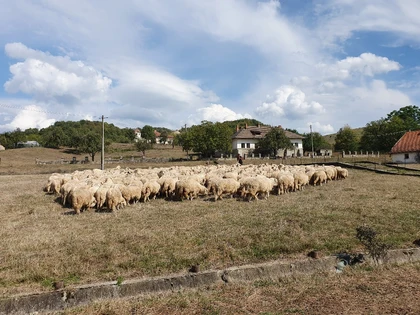
Optimisation of Crude Protein Intake in Sheep – a measure ensuring both increased efficiency as well as the reduction of the GHG emission of the milk production

Romania
Continental Temperate Zone
Benefits of the practice
- Increase the feeding efficiency
- Increase the overall farm profitability
- Reduce the carbon footprint / kg of milk
Production system(s)
Thematic Area(s)
The objective of implementing this measure was, among other things, to demonstrate that reducing the carbon footprint of milk production can also be achieved without affecting the profitability of sheep farms, especially within less intensive sheep milk production systems. Within these systems, particularly where the livestock load per hectare is low, farmers often do not focus on ration optimization, especially in ensuring the dietary protein supply needed to support high milk yields or to reach the potential milk production of the animals.
Frequently, in such systems, milk production is less than 100 kg/head/lactation, although the genetic potential of sheep may exceed 120 kg (while the animals are still undergoing genetic improvement).
In this context, one of the implemented measures consists of aligning the protein intake of consumed diets with the nutritional requirements of the animals throughout the year, by providing complementary concentrated feeds. There are several such periods when the nutritional value of pastures is dramatically reduced or when sheep require higher nutritional intake (e.g., peak lactation or preparation for mating).
This measure can be implemented at several levels — from simply following basic nutritional recommendations (e.g., feeding a one-size-fits-all compound feed specific to sheep at certain times of the year), to checking the diets using ruminant feeding tables, and even up to applying precision feeding.
The advantage of the method lies in the fact that, for lactating animals, the effects are quickly noticeable, typically through increased daily milk production. On the other hand, the additional costs related to complementary feeding are offset by the increased income from the higher milk yields.
The main beneficiaries are farmers, but also nutrition consultants, feed producers, and others involved in livestock nutrition and management.
Obiectivul implementării acestei măsuri a fost, printre altele, de a demonstra că reducerea amprentei de carbon a producției de lapte poate fi obținută și fără a afecta profitabilitatea fermelor de ovine, mai ales în cadrul unor sisteme de producție a laptelui de ovine mai puțin intensive. În cadrul acestor sisteme de producție, mai ales în cazurile în care încărcătura de animale / hectar este redusă, fermierii nu acordă atenție optimizării rațiilor, în particular atingerii necesarului de proteină care să susțină producții ridicate de lapte / atingerii potențialului productiv al animalelor. În mod frecvent, în astfel de sisteme, producția de lapte este mai mică de 100 kg / cap / lactație, deși potențialul productiv al animalelor poate depăși 120 kg (populațiile respective fiind încă în curs de ameliorare genetică).
În acest context, una dintre măsurile implementate constă în alinierea aportului de proteină al rațiilor consumate la cerințele nutriționale ale animalelor, pe toată perioada anului, prin asigurarea de nutrețuri concentrate complementare. Există câteva astfel de perioade, când valoarea nutritivă a pajiștilor scade foarte mult sau când animalele necesită aporturi nutriționale mai ridicate (ex. vârful de lactație / pregătirea pentru montă).
Această măsură poate avea mai multe niveluri de implementare – de la simpla urmare a unor recomandări nutriționale (de a administra, în anumite perioade din an, un nutreț combinat generic specific ovinelor), la verificarea rațiilor consultând tabelele de valori nutritive pentru rumeg[toare, mergând până la aplicarea nutriției de precizie. Avantajul constă în faptul că în cazul animalelor în lactație efectele se văd destul de rapid în creșterea producției zilnice de lapte. Pe de altă parte, costurile suplimentare (cu furajarea complementară) sunt acoperite de veniturile obținute de pe urma creșterii producției de lapte.
Principalii beneficiari sunt fermierii, dar și consultanții în nutriție, producătorii de furaje, etc.
Nest Boxes for Vole Control in Agricultural Crops
Spain
Mediterranean
Benefits of the practice
- Natural pest control through nest boxes for Barn Owls and Kestrels
- Medium- and long-term effectiveness in reducing vole populations
- Cost-effective and eco-friendly alternative to chemical rodenticides
Production system(s)
Thematic Area(s)
Rodents are one of the pests with the greatest economic impact on agriculture worldwide, and the Iberian Peninsula is no exception. The rodent species that has unleashed the greatest conflict has been the vole (Microtus arvalis), although there are several species causing agricultural losses. It can affect practically any crop without exception. In our region (Navarra) the vole has increased both in abundance and distribution.
The use of plastic in horticultural crops and the direct sowing of extensive crops have favoured the increase of this species. Voles also increase their numbers in either permanent and multi-year crops, such as alfalfa, and where no-tillage techniques are used. In addition, the modernisation of agricultural and livestock infrastructures has limited the nesting areas for birds that prey on these rodents.
In order to deal with this problem, the burning of stubble and boundaries and the use of rodenticides have traditionally been used. Those are measures with a very high environmental impact and a highly questionable effectiveness.
Artificial nest boxes for predators (kestrels, owls) prevent the overgrowth of vole populations and minimise crop damage. Hedges also have a positive effect.
The nest boxes are placed at a minimum height of 3 metres in buildings such as restored farmyards or agricultural warehouses. In the case of the kestrel they can also be placed on poles. As the breeding area of a pair of barn owls or kestrels is around 30 ha, these boxes should be placed at least 300 m apart to optimise their effectiveness.
This strategy aims to control these rodents in the most effective way in the medium and long term and also has the advantage of being economically and environmentally more sustainable than the usual application of pesticides.
Los roedores son una de las plagas con mayor repercusión económica en la agricultura de todo el mundo y la Península Ibérica no es una excepción. La especie de roedor que mayor conflicto ha desatado ha sido el Topillo Campesino (Microtus arvalis), aunque se encuentran varias especies que causan daños agrícolas. Puede afectar prácticamente a cualquier cultivo sin excepción. En nuestra región (Navarra) el topillo campesino ha aumentado tanto en abundancia como en distribución.
El uso de plástico en los cultivos hortícolas y la siembra directa de cultivos extensivos han favorecido el incremento de esta especie. Los topillos aumentan sus poblaciones en cultivos permanentes y/o plurianuales, como es el caso de la alfalfa entre otros y en parcelas donde se realizan técnicas de lo laboreo. Además, la modernización de las infraestructuras agrícolas y ganaderas ha limitado los espacios de anidación de aves depredadoras de estos roedores.
Con el fin de hacerle frente, tradicionalmente se ha recurrido a la quema de rastrojos y linderos y al uso de rodenticidas. Medidas con un impacto medioambiental muy elevado y una eficacia muy cuestionada.
La colocación de nidales artificiales para depredadores (cernícalos, lechuzas) evitan el crecimiento excesivo de las poblaciones de topillos minimizando los daños en los cultivos. El mantenimiento de setos también tiene implicaciones positivas.
Los nidales se colocan a una altura mínima de 3 metros en edificios tales como corrales restaurados o almacenes agrícolas. En el caso del cernícalo se pueden colocar también en postes. Dado que el área de campeo de una pareja de lechuzas o cernícalos está en torno a las 30 ha, estas cajas deben colocarse separadas un mínimo de 300 m para optimizar la eficacia de las mismas.
Esta estrategia persigue el control de estos roedores de la manera más eficaz a medio y largo plazo, teniendo además la ventaja de ser económica y ambientalmente más sostenible que la habitual aplicación de fitosanitarios.
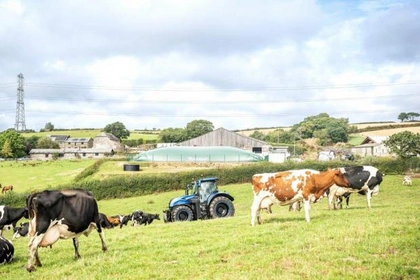
Modular Anaerobic Digestion Systems for Circular Agriculture

UK
NW Europe Maritime Climate
Benefits of the practice
- Methane capture and biogas production for renewable energy
- Improved nutrient recycling and organic fertiliser production
- Compliant manure management and storage
Production system(s)
Thematic Area(s)
Anaerobic digestion (AD) provides a sustainable solution for agricultural waste by capturing methane from slurry, reducing greenhouse gas emissions, and producing renewable energy. Farms benefit from biogas generation for electricity and heat, while modular systems allow accessibility across sectors. AD also creates organic fertilisers rich in nitrogen, phosphorus, potassium, and sulphur, reducing dependence on synthetic inputs.
Biogas production efficiency ranges from 60% to 98%, with gases used in the green gas grid, transport, or on-site in methane-powered machinery. Combined heat and power generators maximise energy self-sufficiency. The byproduct, digestate, can be processed into organic fertilisers, typically containing 0.12–1.5% nitrogen, 0.04–0.26% phosphorus, and 0.12–1.15% potassium, with dry matter content from 1.5% to 45.8%. Processing can concentrate these nutrients to around 30% nitrogen, 15% phosphorus, and 15% potassium.
Scalable and adaptable, AD integrates one-stage, two-stage, or three-stage digestion to improve gas extraction and waste processing. Modular systems focus on single-phase digestion, achieving up to 95% methane extraction. While initial investment is higher than traditional slurry storage, AD is becoming more cost-effective through modular innovations and financial incentives. Economic viability is enhanced through energy sales, carbon credits, and rising green finance interest.
AD improves farm sustainability, reduces costs, and generates revenue. Customisable modular systems fit different herd sizes, infrastructure, and energy demands. Advisors support adoption through feasibility studies and carbon audits. Policymakers should expand incentives for AD adoption, supporting carbon sequestration and renewable energy. ROI is expected within four to ten years, potentially accelerated by carbon market opportunities. By adopting AD, farms cut methane emissions, enhance nutrient management, and contribute to a circular agricultural economy.
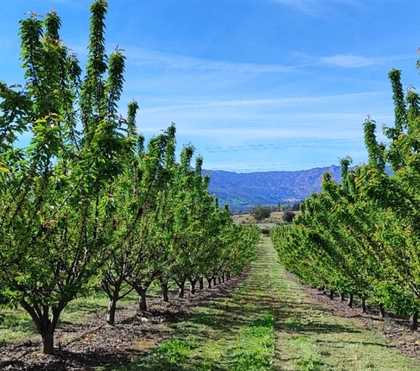
Integrated Pest Management in the Fruit and Vegetable Sector
Portugal
Mediterranean zone
Benefits of the practice
- Costs reduction
- Productivity increase
- Product quality increase
Production system(s)
Thematic Area(s)
Pest and disease management in Portugal’s fruit and vegetable sector is an increasing challenge. The high incidence of these issues may compromise crop productivity and quality, leading to significant economic losses for producers. When a crop is affected by pests or diseases, costs can be substantial—not only in controlling the outbreak but also in potentially lost production. In response, producers recognize the need of adopting preventive measures that enhance pest and disease management.
The primary objectives of these practices are to increase crop productivity and enhance fruit quality, ensuring a more competitive final product, by preventing and closely monitoring pest and disease occurrence. Additionally, they aim to reduce dependence on plant protection products, fostering a more balanced and cost-effective production model.
To achieve these goals, several measures have been implemented:
⦁ Pruning and preventative treatments help mitigate the risk of pest infestations and disease outbreaks. Ensuring the temperatures and relative humidity in the orchard are not optimal for pest and disease development is a preventive measure that has a high impact.
⦁ Promoting biodiversity is another effective approach, achieved through the creation of ecological strips, the sowing of biodiverse plant mixtures between orchard rows and the installation of artificial habitats for beneficial insects and auxiliary organisms. These actions support ecosystem balance and enhance natural biological pest control.
⦁ Regular crop monitoring is also essential for timely and effective intervention. Systematic observation and the counting of pests and beneficial organisms enable more precise and efficient responses, reducing waste and optimizing resource use.
By adopting these best practices, the fruit and vegetable sector can enhance sustainability while strengthening the competitiveness of Portuguese producers ensuring high-quality and environmentally responsible products.
A gestão de pragas e doenças no setor hortofrutícola em Portugal é um desafio crescente. A elevada incidência desses problemas pode comprometer a produtividade e a qualidade das culturas, resultando em perdas económicas significativas para os produtores. Quando uma cultura é afetada por pragas ou doenças, os custos podem ser substanciais — não apenas no controlo da praga ou doença, mas também na possível perda de produção. Em resposta, os produtores reconhecem a necessidade de adotar medidas preventivas que melhorem a gestão de pragas e doenças.
Os principais objetivos das práticas são aumentar a produtividade das culturas e melhorar a qualidade dos frutos, garantindo um produto final mais competitivo, através da prevenção e do acompanhamento rigoroso da ocorrência de pragas e doenças. Além disso, pretendem reduzir a dependência de produtos fitofarmacêuticos, promovendo um sistema de produção mais equilibrado e economicamente eficiente.
Para alcançar esses objetivos, foram implementadas diversas medidas:
⦁ Poda e tratamentos preventivos, que ajudam a mitigar o risco de infeções por pragas e aparecimentos de doenças. Garantir que as temperaturas e a humidade relativa no pomar não sejam favoráveis ao desenvolvimento de pragas e doenças é uma medida preventiva de alto impacto.
⦁ Promoção da biodiversidade, uma abordagem eficaz que inclui a criação de faixas ecológicas, a sementeira de misturas biodiversas entre as linhas do pomar e a instalação de habitats artificiais para insetos benéficos e organismos auxiliares. Estas ações contribuem para o equilíbrio do ecossistema e reforçam o controlo biológico natural de pragas.
⦁ Monitorização regular das culturas, essencial para intervenções atempadas e eficazes. A observação regular e a contagem de pragas e organismos benéficos permitem respostas mais precisas e eficientes, reduzindo desperdícios e otimizando o uso de recursos.
Ao adotar estas boas práticas, o setor hortofrutícola pode melhorar a sustentabilidade, enquanto reforça a competitividade dos produtores portugueses, garantindo produtos de alta qualidade e ambientalmente responsáveis.
Implementing Rotational Grazing Within a Low-input Sheep Milk Production System
Romania
Continental Temperate
Benefits of the practice
- Increase the overall biomass production & better control on the feeding strategies
- Increase the overall farm profitability and resilience
- Climate-friendly technique
Production system(s)
Thematic Area(s)
The objective of implementing this measure was, among other things, to demonstrate that rotational grazing using electric fencing offers multiple advantages for the sheep farming sector, particularly in a low-input system for sheep milk production.
In addition to being a climate-friendly measure that reduces the net carbon footprint, rotational grazing also provides economic benefits and enhances farm resilience. While it requires an initial investment (e.g., purchasing electric fencing) and the assimilation of new knowledge regarding grazing management, the advantages are numerous.
These benefits include increased biomass production per hectare, better control of animal feeding (e.g., by category), and the prevention of overgrazing—factors directly linked to farm efficiency. In the long term, rotational grazing also improves pasture resistance to drought, enhances soil quality, and positively influences biodiversity.
As farmers gain experience, this measure can be implemented at different levels, ranging from simple, empirical applications—such as copying models from other farmers or visually assessing pastures—to rigorous planning that includes biomass production estimations and biochemical analyses to determine nutritional value.
The primary beneficiaries are farmers, as well as agricultural consultants specializing in nutrition, grassland management, and related fields.
Obiectivul implementării acestei măsuri a fost, printre altele, de a demonstra că pășunatul prin rotație, folosind gardul electric, are multiple avantaje și în sectorul creșterii ovinelor, într-un sistem low-input de producere a laptelui de oaie.
Pe lângă faptul că aplicarea pășunatului prin rotație este o măsură prietenoasă cu clima, conducând la reducerea amprentei nete de carbon, aduce și avantaje din punct de vedere economic și al creșterii rezilienței fermei. Evident, măsura presupune o investiție inițială (achiziția gardului electric), asimilarea de noi cunoștințe privind managementul pășunatului, etc.
Avantajele sunt însă multiple: de la creșterea producției de biomasă / hectar, un mai bun control al furajării animalelor (ex. pe categorii), evitarea supra-pășunatului, etc. – elemente direct legate de eficiența fermei, la avantaje pe termen lung.
Printre acestea se enumeră o mai bună rezistență a pășunii la factorii secetă, o îmbunătățire a calității solului, o influență pozitivă asupra biodiversității, etc.
Pe măsură ce fermierii dobândesc experiență, această măsură poate avea mai multe niveluri de implementare – de la simpla aplicare, empirică, bazate pe copierea unor modele (de exemplu, de la alți fermieri) sau pe examinarea vizuală a pășunilor, la planificarea riguroasă însoțită de estimări ale producției de biomasă și/sau analize biochimice ale acesteia în vederea estimării valorii nutritive.
Principalii beneficiari sunt fermierii, dar și consultanții agricoli (specializați în nutriție, managementul pajiștilor, etc.)
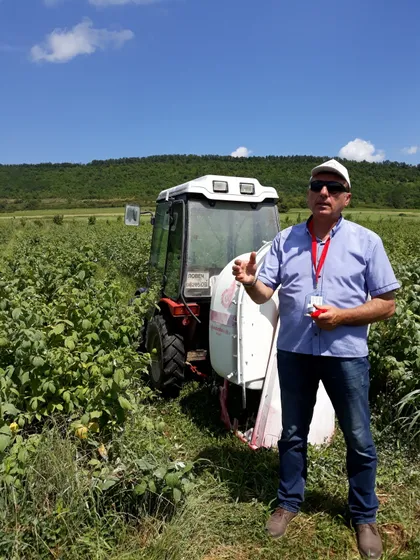
Good Practices for Soil Carbon Retention in Perennial Crops (berry)

Bulgaria
Continental Climate
Benefits of the practice
- Retention of carbon in the soil and promotion of a sustainable agricultural ecosystem.
- Improved soil health.
- Enhanced crop yield combines with healthier plant growth.
Production system(s)
Thematic Area(s)
Soil carbon sequestration is an important aspect of the management of perennial crops such as berry crops. Among the most effective methods for sequestration are the use of mineral products based on calcium hydroxide (e.g. fruit lime) and specific mulching technologies.
Fruit lime is a product characterized by a high content of calcium, magnesium and silica. It is widely used in orchards to regulate soil pH, which is essential for the absorption of nutrients by plants. In addition, lime helps retain carbon in the soil by stabilizing organic matter.
Benefits of using fruit lime:
⦁ Regulate soil pH: Maintaining an optimal pH improves microbiological activity and carbon sequestration.
⦁ Improve soil structure: Calcium promotes the aggregation of soil particles, which increases the soil’s ability to retain carbon.
⦁ Increase mineral content: High levels of calcium, magnesium and silica are essential for plant health and resistance to stress factors.
Mulching is a technique in which the soil around plants is covered with organic or inorganic materials. This not only helps retain moisture, but also significantly reduces erosion and increases the organic matter content of the soil.
Specific mulching technologies for berries:
⦁ Organic mulches: The use of mulches made from plant materials such as straw, sawdust, and compost helps retain carbon in the soil. They decompose slowly, enriching the soil with organic matter.
⦁ Inorganic mulches: Mulches made from plastic films or geotextiles can also be effective, as they prevent moisture loss and reduce weed growth, which in turn reduces the need for frequent tillage.
Задържането на въглерода в почвата е важен аспект от управлението на трайни насаждения като ягодоплодни култури. Сред най-ефективните методи за задържане на въглерода са използването на минерални продукти на базата на калциев хидрооксид (например овощарска вар) и специфични технологии на мулчиране.
Овощарската вар е продукт, който се отличава с високо съдържание на калций, магнезий и силициев диоксид. Тя се използва широко в овощарството за регулиране на pH на почвата, което е от съществено значение за усвояването на хранителни вещества от растенията. Освен това, варта подпомага задържането на въглерод в почвата чрез стабилизирането на органичната материя.
Ползи от използването на овощарска вар:
⦁ Регулиране на pH на почвата: Поддържането на оптимално pH подобрява микробиологичната активност и задържането на въглерод.
⦁ Подобряване на структурата на почвата: Калцият подпомага агрегацията на почвените частици, което увеличава способността на почвата да задържа въглерод.
⦁ Увеличаване на минералното съдържание: Високото съдържание на калций, магнезий и силициев диоксид е от съществено значение за здравето на растенията и тяхната устойчивост към стресови фактори.
Мулчирането е техника, при която почвата около растенията се покрива с органични или неорганични материали. Това не само подпомага задържането на влага, но и съществено намалява ерозията и увеличава съдържанието на органични вещества в почвата.
Специфични технологии на мулчиране за ягодоплодни:
⦁ Органични мулчове: Използването на мулчи от растителни материали като слама, дървени стърготини, и компост подпомага задържането на въглерод в почвата. Те се разграждат бавно, обогатявайки почвата с органична материя.
⦁ Неорганични мулчове: Мулчи от пластмасови фолиа или геотекстили също могат да бъдат ефективни, като те предотвратяват загубата на влага и намаляват растежа на плевели, което от своя страна намалява необходимостта от често обработване на почвата
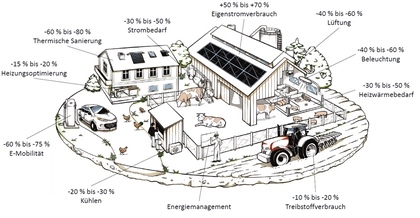
Energy Efficiency in Agriculture - A guide to Reducing Energy Costs on the Farm
Austria
All zones
Benefits of the practice
- Reducing emissions
- Energy saving
- Energy independence
Thematic Area(s)
In many aspects, Austrian agriculture and forestry provide the right answers to the pressing climate problems of our time. It stands for safe food production, short transport routes and the provision of renewable energy. For more than three decades, farmers have been working on innovative energy solutions.
Countless prototypes have been developed on farms into internationally marketable energy technologies.
With persistent enthusiasm and genuine manual labour, the first self-built solar systems were created in the early 1980s, which still generate free heat today. Another milestone in the regional heat supply was the technical development of biomass chipping plants. Thanks to many a pioneering agricultural spirit, oil, gas and coal have been replaced over the years by climate-friendly and local wood chips.
The utilisation of regional resources and the efficient use of energy are as important success factors for agriculture and forestry today as they were then. Austria’s agricultural sector requires more than six billion kilowatt hours of energy every year. The cost of energy supply is around 550 million euros. The implementation of simple measures alone can save over 100 million euros per year.
With increasing electrification and digitalisation, energy as a production factor is taking on a new significance. Today, agricultural and forestry operations are using completely new technologies to reduce energy costs, such as photovoltaic systems, electric vehicles, heat pumps, energy storage systems and satellite-controlled driving assistants. The technologies are digitally networked and constantly communicate with each other with the aim of ensuring the most efficient energy supply possible.
By implementing efficiency measures on your farm, you are taking a step towards energy independence, climate protection and a farm worth living on.
Die österreichische Land- und Forstwirtschaft gibt in mehrfacher Hinsicht die richtigen Antworten auf die drängenden Klimaprobleme unserer Zeit. Sie steht für eine sichere Lebensmittelproduktion, kurze Transportwege sowie die Bereitstellung von erneuerbaren Energien. Seit mehr als drei Jahrzehnten tüfteln die Landwirtinnen und Landwirte an innovativen Energielösungen. Unzählige Prototypen sind auf den landwirtschaftlichen Höfen zu international marktfähigen Energietechnologien weiterentwickelt worden.
Mit ausdauernder Begeisterung und echter Handarbeit entstanden in den Anfangsjahren der 1980er die ersten selbstgebauten Solaranlagen, die noch heute kostenlose Wärme erzeugen. Ein weiterer Meilenstein in der regionalen Wärmeversorgung war die technische Entwicklung der Biomasse-Hackgutanlagen. Durch so manchen landwirtschaftlichen Pioniergeist wurden Öl, Gas und Kohle über die Jahre durch klimafreundliches und heimisches Waldhackgut ersetzt.
Die Nutzung regionaler Ressourcen sowie der effiziente Energieeinsatz sind heute wie damals wichtige Erfolgsfaktoren für die Land- und Forstwirtschaft. Österreichs Landwirtschaft benötigt jährlich mehr als sechs Milliarden Kilowattstunden an Energie. Die Kosten für die Energieversorgung liegen bei rund 550 Millionen Euro. Allein durch die Umsetzung von einfachen Maßnahmen lassen sich über 100 Millionen Euro pro Jahr einsparen.
Mit zunehmender Elektrifizierung und Digitalisierung kommt dem Produktionsfaktor Energie eine neue Bedeutung zu. Heute finden wir auf den land- und forstwirtschaftlichen Betrieben völlig neue Technologien zur Senkung der Energiekosten, wie Photovoltaikanlagen, Elektrofahrzeuge, Wärmepumpen, Stromspeicher sowie von Satelliten gesteuerte Fahrassistenten. Die Technologien sind digital vernetzt und kommunizieren ständig miteinander, mit dem Ziel, eine möglichst effiziente Eigenenergieversorgung sicherzustellen.
Durch die Umsetzung von Effizienzmaßnahmen auf Ihrem Betrieb setzten Sie einen Schritt in Richtung Energieunabhängigkeit, Klimaschutz und lebenswerten Bauernhof.
Effect of Water Stress on Alfalfa Yield
France
Temperate
Benefits of the practice
- Maintaining forage production
- Anticipating possible yield loss
- Adapting hydric stress due to climate change
Production system(s)
Thematic Area(s)
Due to recent climate change and episodes of high temperatures linked to a lack of rain, the practice of fodder irrigation has gradually become more widespread in France. In 2010, meadows and fodder represented 4% of the irrigated area in France and 6% in 2020. To best support farmers and quantify the added value of irrigation on fodder, Arvalis has set up water response trials on several fodder crops, including alfalfa. Three trials were set up (La Jaillière – department 44, Le Magneraud – department 17, Pusignan – department 69) over 3 years (2022-2023-2024) with 3 irrigation levels as well as dry management.
Part of the trial was irrigated to cover the theoretical needs of the crop; another part was deliberately stressed by covering only half of the theoretical irrigation needs. The third approach consisted of putting in more water than the theoretical irrigation need to properly manage the crop’s needs.
The irrigation water use efficiency measured in these trials vary between 17 kg of dry matter/ha/mm and 30 kg of dry matter/ha/mm with a median around 20-22 kg DM/ha/mm. This means that for 30 mm irrigation, the farmer can expect a forage gain of around 650 kg/ha. These references can allow the farmer to better reason his water distribution on his irrigable land and see if it is interesting for him to prioritize his irrigation on alfalfa to feed his animals.
En raison de l’évolution récente du climat et des épisodes de fortes températures liées à du manque de pluie, la pratique d’irrigation des fourrages s’est peu à peu démocratisée en France. En 2010, les prairies et fourrages représentaient 4% de la sole irriguée française et 6% en 2020. Afin de pouvoir accompagner au mieux les agriculteurs et quantifier la plus-value de l’irrigation sur les fourrages, Arvalis a mis en place des essais de réponse à l’eau sur plusieurs cultures fourragères, dont la luzerne. Trois essais ont été mis en place (La Jaillière – département 44, Le Magneraud – département 17, Pusignan – département 69) sur 3 ans (2022-2023-2024) avec 3 niveaux d’irrigation ainsi qu’une conduite en sec. Une partie de l’essai a été irriguée pour couvrir les besoins théoriques de la culture, une autre partie a été volontairement stressée en couvrant seulement la moitié des besoins d’irrigation théorique. La troisième conduite a consisté à mettre plus d’eau que le besoin théorique d’irrigation afin de bien encadrer le besoin de la culture. Les efficiences de l’eau d’irrigation qui ont été mesurées dans ces essais sont très disparates et varient entre 17 kg de matière sèche/ha/mm et 30 kg de matière sèche/ha/mm avec une médiane autour de 20-22 kg MS/ha/mm. Cela signifie que pour une irrigation de 30 mm, l’agriculteur peut espérer un gain de fourrage de l’ordre de 650 kg/ha. Ces références peuvent permettre à l’agriculteur de mieux raisonner sa répartition de l’eau sur sa sole irrigable et voir si c’est intéressant pour lui de prioriser son irrigation sur la luzerne afin de nourrir ses animaux.
Control Traffic Farming

Slovakia
Mild Continental Climate
Benefits of the practice
- Increase in the yields of cultivated crops
- Restore land degradation
- Effectiveness of machine operations
Production system(s)
Thematic Area(s)
The University Farm of the Slovak University of Agriculture in Nitra uses Controlled Traffic Farming (CTF) technology on about 20 hectares, based on a system for controlling the movement of agricultural machinery in the field. Its aim is to concentrate and minimise the compacted area resulting from machinery movement and to eliminate technogenic soil compaction, thereby promoting soil infiltration, increasing soil retention capacity, and reducing the risk of water erosion. The created system of conveyor/transport tracks is then maintained throughout the year.
The application of the above technologies results in an average yield increases of 3–10% for the crops grown, especially in the case of cereals, maize, and legumes. This effect is particularly pronounced in drier years. The correct design and organisation of machinery movement optimise individual work operations, reduce fuel costs, and increase the efficiency of machinery use. An additional benefit is the increased technological precision of parallel machinery passes and clear identification of chemically treated versus untreated areas. In addition to the ecological benefits, it is also possible to reduce the consumption of production inputs such as seeds and fertilisers, which can be lowered by up to 10% when optimally applied.
Increased comfort during machine operation reduces operator fatigue and stress, allowing work even in conditions of reduced visibility.
For implementation, the acquisition of a navigation system (optimally with RTK- real time kinematic accuracy) and its installation on the tractor and self-propelled machines is essential. The machines are then optimised in terms of their range. The use of telematics software is to be defined and the navigation lines on the respective plots are optimised. The individual machines are gradually adapted to the established navigation lines and their operators are trained. It is also necessary to provide a GNSS correction signal.
Vysokoškolský poľnohospodársky podnik Slovenskej poľnohospodárskej univerzity v Nitre využíva na cca 20 hektároch CTF (control traffic farming) technológiu, založenú na systéme riadenia pohybu poľnohospodárskych strojov po poli. Jej úlohou je koncentrovať a zmenšiť na najmenšiu mieru utlačenú plochu po prejazde strojov a eliminovať technogénne zhutnenie pôdy vyvolané pohybom strojov, čím sa podporí infiltračná schopnosť pôdy, zvýši jej retenčná schopnosť a zároveň sa znižuje riziko vodnej erózie. Vytvorený system prepravných/ dopravných dráh je následne udržiavaný počas celého roka.
Pri aplikácii uvedených technológií dosahuje navýšenie úrod pestovaných plodín v priemere 3-10%, a to predovšetkým v prípade pestovania obilnín, kukurice a strukovín. Uvedený efekt sa prejavuje najmä v suchších rokoch. Pri správnom návrhu organizácie pohybu stroja sa optimalizujú jednotlivé pracovné operácie, znižujú sa náklady na pohonné hmoty a zvyšuje sa efektivita prevádzky strojov. Benefitom je tiež zvýšenie technologickej presnosti paralelných prejazdov strojov a jasná identifikácia chemicky ošetrených – neošetrených plôch. Okrem ekologického efektu je možné aj zníženie spotreby výrobných vstupov vo forme osív a hnojív, ktoré môže pri ich optimálnom využití dosiahnuť až 10%-ný pokles.
Zvýšenie komfortu ovládania stroja znižuje únavu a stres obsluhy, čo umožňuje prácu aj za zníženej viditeľnosti.
Pre implementáciu je podstatným zaobstaranie navigačného systému (optimálne s presnosťou RTK- real time kinematic) a jeho inštalácia na traktor a samohybné stroje.
Následne sa stroje optimalizujú z hľadiska šírky záberu. Zadefinuje sa využitie telematického softvéru a optimalizujú navigačné línie na príslušných pozemkoch. Jednotlivé stroje sa postupne adaptujú na stanovené navigačné línie a zaškoľuje sa ich obsluha. Je tiež potrebné zabezpečiť korekčný signál.
Climate and Soil Benefits of Cover Crops: Carbon Sequestration, Nitrogen Management, and Weed Control
Sweden
Subarctic & Humid Continental
Benefits of the practice
- Soil carbon sequestration
- Efficient nitrogen use
- Reduce Environmental impact
Production system(s)
Thematic Area(s)
Cover crops play a vital role in carbon sequestration by utilising the period between main crops. They contribute to stable carbon storage, particularly through roots, which have a higher sequestration potential than aboveground biomass. Grass species generally have a greater root proportion compared to brassicas, and soil properties influence sequestration efficiency. Microorganisms stabilise carbon after decomposition, and farming techniques as well as climate change can affect both sequestration and decomposition rates.
Cover crops reduce nitrogen leaching, especially in light soils, and can lower leaching by up to 43%. For optimal efficiency, nitrogen must be released at the right time for the subsequent crop. Grasses can deplete soil nitrogen in spring, whereas legumes can contribute nitrogen. A mixture of grasses and clover balances nitrogen uptake and residual effects. The timing of incorporation affects both nitrogen availability and leaching risks, particularly in sandy soils.
The impact on nitrous oxide emissions varies depending on management and crop selection. The decomposition of cover crops in wet soils can lead to high emissions, especially from brassicas such as radish and mustard. Removing biomass in autumn for biogas production or fodder can reduce emissions. Overwintering cover crops can also lower nitrous oxide emissions by retaining nitrogen.
Cover crops also compete with weeds and can reduce weed occurrence by up to 90%. Plants such as oil radish and phacelia are particularly effective. Combining cover crops with mechanical tillage can help manage perennial weeds, and strategies such as inter-row hoeing between cover crops can control weeds without increasing nitrogen leaching.
Mellangrödor spelar en viktig roll i kolinlagring genom att utnyttja tiden mellan huvudgrödor. De bidrar till stabil kolinlagring, särskilt genom rötter, som har högre lagringspotential än ovanjordisk biomassa. Gräsarter har generellt en större andel rötter än korsblommiga växter, och jordens egenskaper påverkar inlagringens effektivitet. Mikroorganismer stabiliserar kolet efter nedbrytning, och odlingstekniker samt klimatförändringar kan påverka både kolinlagring och nedbrytningstakt.
Mellangrödor minskar kväveläckage, särskilt på lätta jordar, och kan reducera läckaget med upp till 43 %. För att vara effektiva måste kvävet frigöras i rätt tid för efterföljande gröda. Gräs kan tömma marken på kväve på våren, medan baljväxter kan bidra med kväve. Blandningar av gräs och klöver kan kombinera kväveupptag och förfruktseffekt. Tidpunkten för nedbrukning påverkar både kvävetillgång och läckagerisk, särskilt på sandjordar.
Effekten på lustgasutsläpp varierar beroende på skötsel och grödval. Nedbrytning av mellangrödor på blöt mark kan leda till höga utsläpp, särskilt från korsblommiga växter som rättika och senap. Att föra bort biomassa på hösten för biogasproduktion eller foder kan minska emissionerna. Övervintrande mellangrödor kan också sänka lustgasutsläpp genom att hålla kvar kväve.
Mellangrödor kan också konkurrera med ogräs och minska förekomsten med upp till 90 %. Växter som oljerättika och honungsört är särskilt effektiva. Kombination med mekanisk bearbetning kan hantera fleråriga ogräs, och strategier som ogräshackning medan mellangrödor kan minska ogräs utan att öka kväveläckage.
Carbon Audits and Adaptation and Mitigation Plans (AMPs) to Support Farms in Improving their Environmental Performance
Europe
All Zones
Benefits of the practice
- AMPs support efficient resource use (economic, human, time)
- AMPs define clear and feasible environmental objectives
- AMPs help identify and mitigate risks and obstacles
Production system(s)
Thematic Area(s)
The improvement of farms’ environmental sustainability is both a priority and a challenge for farmers. They must develop ways to become more productive and sustainable while adapting to climate change and contributing to its mitigation. To succeed in this objective, it is relevant to develop a “Plan”. A plan is a set of actions designed to achieve something, an idea or method of doing something.
Planning applies to various areas, including farms. Writing a plan provides a clear vision of the goals, actions, resources (economic, human), and time needed to reach those objectives. Planning also helps identify weaknesses and obstacles that might occur during implementation and find possible solutions in advance to increase the chances of success.
The adaptation and mitigation plan (AMP) is a tool that helps farmers minimise the impacts of climate change on farms while reducing greenhouse gas (GHG) emissions. There are no strict rules regarding the format of an AMP, but to be effective, it should include: a description of the current situation, the objectives, necessary actions, and the timeline.
A carbon audit measures the farm’s efficiency in terms of emissions and removals (carbon stored through sequestration). It requires an analysis of the entire production system and provides a baseline for emissions and sequestration. While the AMP can be created without the audit, the audit offers in-depth insights for better management of production inputs like energy, water, fertilisers, feed, and labour.
Carrying out the audit enables farmers and advisors to assess the actual success of the plan by comparing net emissions before and after implementation. During implementation, monitoring ensures that adaptation and mitigation measures (AMMs) are carried out as planned.
It helps farmers identify challenges, make adjustments, and improve strategies to meet AMP objectives. In Climate Farm Demo, a common AMP template was developed for use on 1,500 farms across Europe.
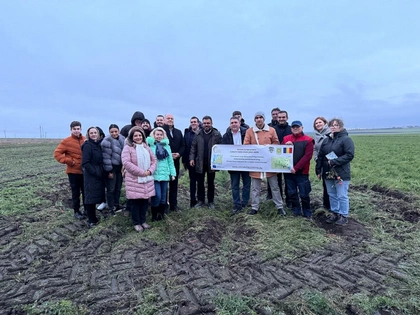
Adopting Agroforestry by Planting Trees in Open-field Vegetal Farms
Romania
Continental Temperate
Benefits of the practice
- Biodiversity & Pest Control: beneficial insects, birds, wildlife, natural pest control, reduce chemical pesticides
- Soil Health: tree roots, soil stabilization, erosion prevention, water retention, drought resilience, organic matter, fertile soil, crop productivity
- Carbon Footprint Reduction & Climate Resilience: carbon storage, climate change mitigation, extreme-weather resilience, sustainable farming, agroforestry
Production system(s)
Thematic Area(s)
Agroforestry has emerged as a viable solution for enhancing sustainable land use while promoting environmental conservation and economic resilience.
By integrating trees and crops, farmers can optimize land productivity, improve soil health, and contribute to climate change mitigation.
Agroforestry improves soil health and water retention by stabilizing the soil with tree roots, reducing erosion, and increasing water infiltration. Organic matter from leaf litter enriches the soil, enhancing fertility and crop yields. It also enhances biodiversity and pest control by providing habitat for beneficial insects, birds, and pollinators, reducing reliance on chemical pesticides due to natural pest control.
As a key element in defining the significance of this measure, and due to the farmer’s desire to reduce carbon emissions, a certificate of sustainability was awarded to the farmer (the farmer’s company), issued by FEPRA (attached to this report).
With that said, the winners of this measure are the farmer, the environment, and the future itself. Agroforestry is a strong strategy for sustainable agriculture, as it perfectly balances productivity, innovation, and environmental conservation.
Using the Farm Carbon Calculator and simulating the estimated CO₂ release after implementing this measure, the result was halved!
Agroforestry a aparut ca o solutie viabila pentru imbunatatirea utilizarii durabile a terenurilor, promovand in acelasi timp conservarea mediului si rezilienta economica.
Prin integrarea arborilor si a culturilor, fermierii pot optimiza productivitatea terenurilor, imbunatati sanatatea solului si contribui la atenuarea schimbarilor climatice.
Agroforestry imbunatateste sanatatea solului si retentia apei prin stabilizarea terenului cu ajutorul radacinilor arborilor, reducerea eroziunii si cresterea infiltrarii apei. Materia organica din frunzele cazute imbogateste solul, sporind fertilitatea si productivitatea culturilor. De asemenea, sustine biodiversitatea si controlul natural al daunatorilor, oferind habitat pentru insecte benefice, pasari si polenizatori, reducand astfel dependenta de pesticide chimice.
Ca element-cheie in definirea importantei acestei masuri, si datorita dorintei infocate a fermierului de a-si reduce emisiile de carbon, i-a fost acordat acestuia (companiei fermierului) un certificat de sustenabilitate emis de FEPRA (atasat la acest raport).
Astfel, castigatorii acestei masuri sunt fermierul, mediul inconjurator si viitorul in sine. Agroforestry este o strategie puternica pentru agricultura durabila, echilibrand perfect productivitatea, inovatia si conservarea mediului.
Folosind „Farm Carbon Calculator” si simuland care ar fi emisia estimata de CO2 dupa implementarea masurii in cauza, rezultatul initial a fost redus la jumatate!
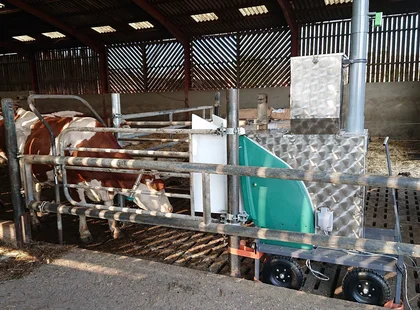
Additives for Reducing Enteric Methane Emissions from Cattle
Europe
All zones
Benefits of the practice
2. Improvement of feed efficiency
3. Contribution to decrease carbon footprint of bovine production
Production system(s)
Thematic Area(s)
The use of dietary supplements can significantly reduce methane emissions in cattle (see the CFD webinar for scientific references, included in additional dissemination material). There is a wide variety of supplements: tannins, essential oils, nitrates, and other chemical compounds. These additives act by modifying ruminal fermentation, limiting methane production while generally maintaining animal performance. Within the Climate Farm Demo project, the goal is to share current scientific knowledge, ongoing trials, and testimonies from the milk and meat sectors on practical implementation. Expected results show up to 20% reduction in emissions, with limited economic impact for farmers, often supported by other actors. These solutions offer an opportunity to improve the sustainability of European beef production.
Integrating feed additives into cattle diets is an innovative way to reduce methane emissions. Farm trials show that some additives, especially condensed tannins and seaweed extracts, can cut methane production by 10–20%. They improve digestion by altering ruminal fermentation without affecting performance.
These additives offer farmers a way to reduce their environmental footprint while maintaining profitability. They are compatible with current systems and can be integrated without major feeding changes.
However, several challenges limit large-scale adoption. Availability and costs vary by region and supply chain. Effectiveness depends on feed rations and farm conditions, requiring tailored advice. While some additives are approved and sold in Europe, others need more research to confirm long-term safety and impact.
Support from research and policy will be key. Awareness campaigns, training, and real-farm demonstrations are essential to encourage adoption and share best practices.
L’utilisation de compléments alimentaires permet de réduire significativement les émissions de méthane chez les bovins (voir le replay du webinaire organisé par CFD pour les références bibliographiques). Il en existe une grande diversité : tanins, huiles essentielles, nitrates, composés issus de la chimie. Ces additifs agissent en modifiant la fermentation ruminale, ce qui limite la production de méthane tout en maintenant les performances zootechniques des animaux la plupart du temps. Dans le cadre du projet Climate Farm Demo, l’ambition est de partager des connaissances scientifiques à jour, des essais en cours permettant d’améliorer la connaissance, de témoigner avec des acteurs des filières lait et viande sur la mise en œuvre pratique de ces solutions en ferme. Les résultats espérés sont une réduction des émissions pouvant atteindre 20 %, avec un impact économique limité pour les éleveurs ou pris en charge par un autre acteur. Ces solutions représentent une opportunité intéressante pour améliorer la durabilité de la production bovine en Europe.
L’intégration de compléments alimentaires dans l’alimentation des bovins est une approche innovante pour réduire les émissions de méthane. Des travaux scientifiques ont montré que la majorité de ces compléments permettent de réduire la production de méthane de 10 à 20 %. Ils influencent la digestion des animaux en modifiant le processus de fermentation ruminale, sans compromettre leurs performances productives la plupart du temps. (voir le replay du webinaire organisé par CFD pour les références bibliographiques)
L’utilisation de ces compléments constitue une opportunité pour les éleveurs souhaitant réduire leur empreinte environnementale tout en maintenant une rentabilité économique. L’intérêt de ces solutions réside également dans leur compatibilité avec les systèmes d’élevage existants et leur potentiel à être intégrées sans nécessiter de modifications majeures des pratiques alimentaires actuelles.
Cependant, plusieurs défis demeurent quant à leur adoption à grande échelle. Tout d’abord, la disponibilité et le coût de ces additifs varient selon les régions et les filières d’approvisionnement. Leur efficacité peut également dépendre du type de ration et des conditions d’élevage spécifiques. Il est donc essentiel d’adapter les recommandations d’utilisation en fonction des contextes locaux.
Par ailleurs, bien que certains compléments bénéficient déjà d’une reconnaissance réglementaire et d’une commercialisation à l’échelle européenne, d’autres nécessitent encore des études complémentaires pour garantir leur innocuité et leur efficacité sur le long terme. Le soutien de la recherche et des politiques publiques sera déterminant pour favoriser leur adoption généralisée.
Des initiatives de sensibilisation et de formation des éleveurs sont également indispensables pour accélérer l’adoption de ces solutions. En complément, le partage d’expériences entre agriculteurs et la démonstration de résultats concrets sur le terrain contribueront à lever les freins à leur mise en œuvre.
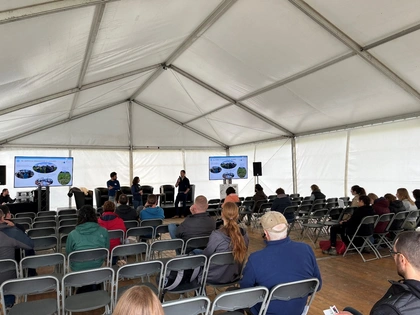
Adapting to a Loss of 20 to 30% of Grassland Production in Brittany: The Levers Put in Place by “SCEA de l'Ellé”
France
Atlantic area
Benefits of the practice
2. Climate resilience
3. Optimising the dairy system
Production system(s)
Thematic Area(s)
To address climate change challenges, SCEA de l’Ellé has implemented several adaptation measures. Using the ClimAléas-Diag tool, created in both Fermadapt and Climatveg programs, a vulnerability diagnosis showed 31% reduction in grass production in dry years. To secure livestock feed, the farm has made changes to its system, increasing temporary grassland areas and forage crops, diversifying its resources (silage maize, mixed cereals, beet), and optimising the management of fodder stocks. In the short term, a cattle underpass will significantly increase the grazing area from 24 to 40 hectares.
Despite notable challenges in adopting these practices—such as:
⦁ Increased energy and economic costs due to higher mechanization expenses.
⦁ Investments in infrastructure, including cattle underpasses and additional fodder storage.
⦁ The necessity to test adaptation strategies tailored to the farm’s specific conditions.
The anticipated benefits—enhanced resilience to climatic hazards, improved food self-sufficiency, and reduced reliance on external inputs—have motivated the farmer to proceed.
SCEA de l’Ellé in Brittany faces increasingly variable climatic conditions, impacting forage production and dairy herd management. To mitigate risks from dry summers and slow-growing springs, they conducted a diagnosis using the ClimAléas-Diag tool, revealing a potential forage deficit of 236 tonnes of dry matter—20% of annual needs. In response, they implemented several strategies:
⦁ Diversifying forage resources: Introducing mixed cereals, beets, and legumes like alfalfa.
⦁ Enhancing feed autonomy: Expanding grazing and forage crop areas.
⦁ Optimizing the herd: Reducing the replacement rate, grouping autumn calvings, and extending grazing periods for heifers.
⦁ Managing stocks: Prioritizing silage and wrapped forage to ensure year-round feed availability.
In the medium term, increasing legume cultivation and improving herd management will further secure the system against climate variability.
Face aux défis du changement climatique, la SCEA de l’Ellé a mis en place plusieurs leviers d’adaptation. Grâce à l’outil ClimAléas-Diag, issu des projets Fermadapt et Climatveg, un diagnostic de vulnérabilité a été réalisé, révélant une baisse de production herbagère de 31 % en cas d’année sèche. Pour sécuriser l’alimentation du troupeau, l’exploitation s’est engagée dans des modifications conséquentes de son système : augmentation des surfaces de prairies temporaires et de cultures fourragères, diversification de ses ressources (maïs ensilage, méteil, betteraves), et optimisation de la gestion des stocks fourragers. À court terme, l’installation d’un boviduc permettra d’agrandir très significativement les surfaces de pâturage de 24 à 40 hectares.
Malgré des freins à l’adoption de ces pratiques importants : (1) de nouveaux coûts énergétiques et économiques liés à la hausse des charges de mécanisation ; (2) des investissements dans des infrastructures (boviduc, stockage des fourrages) et (3) la nécessité de tester les stratégies d’adaptation dans les conditions spécifiques de son exploitation, les bénéfices attendus sont une plus grande résilience face aux aléas climatiques, une amélioration de l’autonomie alimentaire, et une réduction de la dépendance aux intrants extérieurs. Cette analyse « coûts / bénéfices » a motivé l’éleveur à se lancer !
La SCEA de l’Ellé, située en Bretagne, fait face à des conditions climatiques de plus en plus variables, impactant directement la production de fourrage et la gestion du troupeau laitier. Afin de limiter les risques liés aux sécheresses estivales et aux printemps peu poussants, un diagnostic a été réalisé avec l’outil ClimAléas-Diag (programmes Fermadapt et Climatveg). Les résultats ont montré un déficit fourrager potentiel de 236 tonnes de matière sèche, soit 20 % des besoins annuels. Pour y faire face, plusieurs stratégies ont été mises en œuvre :
⦁ Diversification des ressources fourragères : introduction de méteil, betteraves et légumineuses (luzerne).
⦁ Amélioration de l’autonomie alimentaire : augmentation des surfaces de pâturage et cultures fourragères.
⦁ Optimisation du troupeau : baisse du taux de renouvellement, vêlages groupés en automne, et sortie prolongée des génisses au pâturage.
⦁ Gestion des stocks : ensilage et enrubannage priorisés pour garantir une alimentation suffisante toute l’année.
À moyen terme, l’implantation accrue de légumineuses et une meilleure gestion des effectifs permettront de sécuriser davantage le système face aux aléas climatiques