



Select one or more regions of interest
by clicking on the filter elements
Drag the filter elements horizontally,
and select one or multiple
thematic areas of interest.

Co-Constructing a Step-by-Step Design Approach in a Multi-Skill Group on Adapting to Climate Change in the Dairy Sector in the North of the Nouvelle-Aquitaine Region!

France
Atlantic region subject to summer drought
Benefits of the practice
- Step by step design
- Reduced age at calving
- Multi-stakeholder co-innovation
Production system(s)
Thematic Area(s)
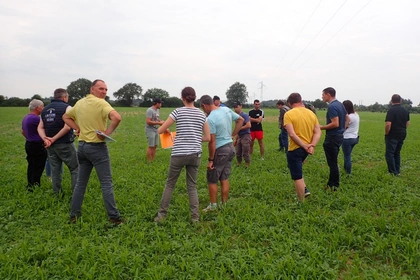
The French Living Lab (LL) is working on adapting to climate change in the dairy sector in the north of the Nouvelle-Aquitaine region. At the end of 2024, the participants wanted to focus the LL’s activities on a case study. We therefore initiated a step-by-step design approach. The principle is to carry out a diagnosis of one of the farms taking part in the LL, and then to propose measures for improvement. The farmer then chooses to implement one or more changes in his practices. A few months later, the group meets again for a progress review and a collective analysis of the results. The group then suggests new measures for improvement.
One of the farmers in the group agreed to take part. The workshop took place over one day. The morning session began with a presentation by the farmer of his farm, followed by work in three sub-groups, who were asked to complete an ‘astonishment report’ on the situation presented, and then to list possible adaptations. Following these proposals, the farmer identified several relevant levers to be explored, but for which he was encountering technical obstacles: reducing turnover, reducing the age at first calving, and integrating a greater diversity of forages. We therefore chose to focus the afternoon farm visit on these themes.
At the end of the day, we debriefed all the observations. The group’s comments led the farmer to refine his strategy, but the need for technical support and reassurance to be able to implement new practices became apparent. LL’s technical partners undertook to work with him on these points between now and the next meeting.
At the end of the meeting, the participants expressed great satisfaction with the way the workshop had gone and were keen to meet up again for ‘the next episode’ to continue to support this process over the long term.
Le Living Lab (LL) français travaille sur l’adaptation au changement climatique de la filière laitière du Nord de la Nouvelle-Aquitaine. Fin 2024, les participants ont souhaité orienter les travaux du LL sur une étude de cas. Nous avons donc initié une démarche de conception pas-à-pas. Le principe est de réaliser un diagnostic de l’un des élevages participant au LL, puis de proposer des leviers d’amélioration. L’éleveur choisit alors de mettre en place un ou plusieurs changements de pratique. Quelques mois plus tard, le groupe se réunit à nouveau pour un point d’étape et une analyse collective des résultats. Le groupe propose alors de nouveaux leviers d’amélioration.
L’un des éleveurs du groupe a accepté de se prêter au jeu. L’atelier s’est déroulé sur une journée. La matinée en salle a démarré par une présentation par l’éleveur de son exploitation, suivi d’un travail en trois sous-groupes, qui devaient compléter un “rapport d’étonnement” sur la situation présentée, puis lister des pistes d’adaptation. Suite à ces propositions, l’éleveur a identifié plusieurs leviers pertinents à creuser mais pour lesquels il rencontre des freins techniques : réduction du renouvellement, diminution de l’âge au 1er vêlage, et l’intégration d’une plus grande diversité de fourrages. Nous avons donc choisi d’axer la visite d’exploitation organisée l’après-midi sur ces thèmes.
A la fin de la journée, nous avons débriefé de l’ensemble des observations. Les remarques du groupe ont amené l’éleveur à affiner sa stratégie, mais est apparu le besoin d’être accompagné et rassuré techniquement pour pouvoir mettre en place de nouvelles pratiques. Les partenaires techniques du LL se sont engagés à travailler ces points avec lui d’ici la prochaine réunion.
Lors du bilan, les participants ont exprimé une grande satisfaction sur le déroulement de l’atelier, et sont pressés de se revoir pour “le prochain épisode” pour continuer à accompagner cette réflexion dans la durée.
In the French Climate Farm Demo Living Lab, we are working on climate change adaptation of dairy sector in the North of Nouvelle-Aquitaine.Our LL represents all types of stakeholders in the dairy sector: farmers, advisors, researchers, dairy represents.
After two meeting dedicated to initiate the group’s dynamic (with an agenda balanced between a technical focus, discussion about climate adaptation and the works to start in the living lab), the group decided to focus on a concrete case study.
So, we initiated a step-by-step design workshop. The principle is to choose a voluntary member in a group, and to carry out a joint diagnosis in relation to an issue, and then to propose some levers to improve. The farmer can then implement one or more changes in his practices. A few months later, another workshop is dedicated to analyse the changes in practice. Does the lever meet the issue or not? Does it create new problem(s)? The group can then suggest news changes in practice.
The step-by-step design takes a long time (5 or 6 years), which makes it compatible with the Climate Farm Demo project.
A farmer of the LL has agreed to implement the process in his farm. This farm is representative of the farms in the area for several reasons. First, one of the two partners will be retiring in the next year or two. Secondly, the forage system is highly vulnerable to climatic hazards, with fragmented and very clayey land parcels and no irrigation. But the herd is managed very intensively to meet high financial expectations. Finally, the partners have a very heavy workload, and every task must be optimised.
The workshop took place over one day, in the morning in the meeting room and in the afternoon on the farm. A great deal of preparatory work was carried out, including a meeting with the farmer to define his expectations and the problem, and then in the office to prepare the elements of the diagnosis (crop rotation, land parcels, forage system, rations, etc.). We chose to focus the day on adapting the forage system to climatic hazards.
The morning session began with the farmer presenting his farm, with the support of the facilitators. Before this, we took care to set out the framework for the group’s operation, as diagnosis by peers can be destabilising for the host farmer, so it’s essential that it takes place in an atmosphere of listening and caring. We made sure that the presentation was as factual as possible on the part of the farmer, so as not to lead the discussion.
We then divided the participants into three sub-groups. Each group had to complete an ‘astonishment report’ on the situation presented and then list ideas for adaptations.
After the sub-groups feed backs, the farmer was able to provide additional information to explain some of the ‘astonishments’ and to rule out some ideas that were too far removed from the current reality of his farm.
He then identified several measures that he felt should be explored, but for which he was encountering technical obstacles: reducing the age at calving of heifers and integrating a greater diversity of forages. We therefore chose to focus the farm visit on these two themes to discuss these obstacles.
In the afternoon, part of the group went on a tour of the plots to see the constraints linked to the plot structure, which limit forage diversification. The other group stayed at the dairy barn to look at the constraints linked to fodder storage, and the herd in relation to calving age.
At the end of the day, we debriefed all the observations.
The age at calving seems inconsistent as it is over 30 months in an intensive system where the heifers do not go out to pasture at all. In addition, the turnover rate is high. The farmer explained this for two reasons. Firstly, he has a large surface of permanent grassland, which means he has hay that cannot be used in the ration of lactating cows. So the rearing phase, even if it’s a long one, isn’t very costly because it allows him to make use of fodder that would otherwise be surplus. In addition, late calving allows the farmer to obtain sufficient size for the animals. He has noticed that ‘small cows’ find it difficult to get through the milking robot, and that this penalises attendance, especially in the case of a very saturated milking robot as his. As for the renewal rate, it helps to secure milk production in the event of health problems.The farm suffered from gingival haemorrhagic disease a few years ago and was only able to maintain its herd thanks to the large number of heifers present.The farmer wants to maintain this security.
In the general opinion, forage diversification is complicated to implement now because the farmer does not have a silage storage platform with alley silos. The farmer needs to improve his financial capacity before implementing this lever.
The group’s comments led the farmer to question the relevance of his renewal strategy (age at calving and number of heifers). He therefore is now thinking of trying to reduce the age at calving but needs technical support to ensure that the animals’ size at calving does not deteriorate.
The farmer also questioned the high level of security at all levels of his system. He was afraid that a drop in the level of security would lead to a drop in production, and therefore financial difficulties. It was suggested that, between now and the next meeting, one or more simulations would be carried out to assess the impact of a more far-reaching system change (e.g. ‘can I reduce the production of my cows, what is the threshold below which the fall in income will be greater than the fall in costs?)
At the end of the workshop, the participants expressed great satisfaction with the way the workshop had gone and were keen to participate in ‘the next episode’ so that they could continue to support this process over the long term.
Monitoring and Evaluation of Living Labs

Europe
All Zones
Benefits of the practice
2. Stimulate reflexivity and collective learning
3. Support decision making in the Living Lab
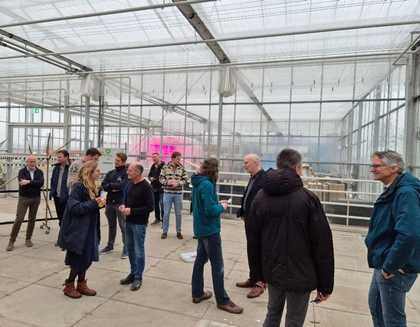
Within Climate Farm Demo, 10 Living Labs (LLs) are established. These LLs are creative multi-actor spaces for co-designing innovative climate-smart solutions in real-life settings. Multiple actors—such as farmers, researchers, advisors, suppliers, and policymakers—are involved in developing climate-smart solutions based on climate-related challenges in the region.
To strengthen the co-creation process in the LLs, a specifically designed Monitoring & Evaluation (M&E) approach has been developed. The objectives of M&E for the LLs are:
⦁ to support transparency and facilitate peer-to-peer learning between LLs,
⦁ to add reflexivity to strengthen the co-design process within the LL, and
⦁ to improve LL responsiveness to changes and developments in and around the LL.
Literature provides many tools and approaches for M&E of LLs. Some tools focus on organizational aspects of the LL, others on the co-creation process or on the impact of the LL. Different indicators and approaches can be used, largely depending on the objective of M&E—there is no one-size-fits-all M&E framework for LLs.
In Climate Farm Demo, the M&E framework developed is based on a harmonized approach to allow for comparison between LLs. Monitoring of the LL includes continuously tracking activities by completing an LL diary. This is the responsibility of the LL monitor, a role specifically created in each LL. At regular intervals—twice a year—the LL monitor and facilitator evaluate the LL. The evaluation uses a template assessing the overall performance of the LL (efficiency, efficacy, and stakeholder engagement).
Additionally, the monitor and facilitator complete a self-assessment survey by scoring the LL on several Key Performance Indicators (KPIs). This helps them reflect on the resources, capabilities, collaborations, and innovations within the living lab. The list of KPIs was developed based on literature related to Living Labs.
Living Lab - Method for Interactive Generation and Prioritization of Ideas
Europe
All Zones
Benefits of the practice
- Collection of ideas of all participants
- Everyone involved in prioritization
- Energetic approach useful for large groups from 8-80 persons
You are a facilitator of a Living Lab and want to brainstorm and prioritize ideas. How do you do this with all the participants, but without falling into endless discussions? All you need is an open space where people can mingle, a card (A6 size) and a pen for each participant. Follow the steps below:
⦁ Ask a question of the group to which you want individual answers. For example: what is the most interesting opportunity for our Living Lab? or…what we should discuss next time is…. Write this question on a board for everyone to see.
⦁ Give everyone 3 minutes to come up with an answer. Everyone may only give 1 idea. Ask to write this in 3 to 5 words on the card. Only 1 side of the card may be written on.
⦁ Ask everyone to stand up with their card and pen in hand. Let everyone crisscross for 1 minute and have them continuously exchange cards without looking at the card. Encourage a fast pace.
⦁ Clap your hands and ask everyone to stand still. Everyone has a random card in their hand. Ask to form pairs with the nearest person and ask to discuss both cards and make a judgment. For each pair, divide 7 points between the 2 cards. The best idea gets 4 or more points. The inferior idea 3 or less. Write this score on the back of the corresponding card.
⦁ The 2nd round begins again with walking and exchanging cards simultaneously. After 1 minute, 7 points are again distributed in pairs and written on the back of the card. Ditto for rounds 3 and 4.
⦁ Ask everyone to add up the 4 scores written on the back of the card they have in their hand. The result is between 0 and 28.
⦁ Plenary select answers with the highest score, as in an auction: who has 28 points? Who has 27, 26, etc. Write on the flip chart the 3-6 ideas with the highest scores and therefore with a lot of commitment.
Je bent begeleider van een Living Lab en wilt ideeën brainstormen en prioriteren. Hoe doe je dit met alle deelnemers, maar zonder te vervallen in eindeloze discussies? Je hebt alleen een open ruimte nodig waarin mensen door elkaar kunnen lopen, een kaartje (A6 formaat) en een pen voor elke deelnemer. Volg de onderstaande stappen.
⦁ Stel een vraag aan de groep waarop je individuele antwoorden wilt. Bijvoorbeeld: wat is de meest interessante kans voor ons Living Lab? ..of.. wat we de volgende keer moeten bespreken is.. Schrijf deze vraag op een bord zodat iedereen het kan zien.
⦁ Geef iedereen 3 minuten om een antwoord te bedenken. Iedereen mag maar 1 idee gegeven. Vraag om dit in 3 tot 5 woorden op het kaartje te schrijven. Er mag maar op 1 kant van de kaart geschreven worden.
⦁ Vraag iedereen om op te staan met hun kaart en pen in de hand. Laat iedereen 1 minuut lang kriskras door elkaar lopen en laat ze continu de kaarten uitwisselen zonder naar de kaart te kijken. Moedig een hoog tempo aan.
⦁ Klap in je handen en vraag iedereen stil te staan. Iedereen heeft een willekeurige kaart in de hand. Vraag om duo’s te vormen met de dichtstbijzijnde persoon en vraag om beide kaarten te bespreken en een oordeel te vellen. Verdeel per duo 7 punten over de 2 kaarten. Het beste idee krijgt 4 of meer punten. Het mindere idee 3 of minder. Schrijf deze score op de achterkant van de betreffende kaart.
⦁ De 2de ronde begint weer met door elkaar lopen en gelijktijdig uitwisselen van de kaartjes. Na 1 minuut worden in duo’s weer 7 punten verdeeld en opgeschreven op de achterkant van het kaartje. Idem voor ronde 3 en 4.
⦁ Vraag iedereen om de 4 scores op te tellen die op de achterkant staan van de kaart die ze in hun hand hebben. Het resultaat ligt tussen 0 en 28.
⦁ Plenair selecteer je antwoorden met de hoogste score, zoals bij een veiling: wie heeft 28 punten? Wie 27, 26 enz. Schrijf op de flip-over de 3-6 ideeën met de hoogste scores en dus met draagvlak van de deelnemers.
You are the facilitator of a Living Lab with a large group of farmers and stakeholders.
You want to collect ideas, opportunities, bottlenecks or agenda items for the next meeting.
How do you do this with all the participants, but without falling into endless discussions?
All you need is an open space where people can mingle, a card (A6 size) and a pen for each participant.
Follow the steps below.
1. Ask a question of the group to which you want individual answers.
For example: the most relevant challenge for our Living Lab is …
or … the most interesting market opportunity I see is …
or … what we should discuss next time is ….
Write this question on a board or paper for everyone to see.
2. Give everyone 3 minutes to think of his/her answer.
Ask for their best idea.
Emphasize that everyone may only give 1 idea.
Ask them to write it in 3 to 5 words on the card.
Only 1 side of the card may be written on.
3. Then invite everyone to stand up with their card in one hand and their pen in the other.
Let everyone crisscross for 1 minute and have them continuously exchange cards without looking at the card.
Encourage a fast pace.
4. Clap your hands and ask everyone to stand still.
Everyone has a random card in his/her hand.
Ask to form pairs with the nearest person and ask to discuss both cards and make a judgment.
For each pair, divide 7 points between the 2 cards.
The best idea gets 4 or more points.
The inferior idea 3 or less.
Write this score on the back of the corresponding card.
5. The 2nd round begins by getting everyone mixed up again and continuously changing cards.
Repeat step 4.
6. Ditto (round 3).
7. Ditto (round 4).
8. Ask everyone to add up the 4 scores shown on the back of the card they have in their hand.
The result is between 0 and 28.
9. Plenary select answers with the highest score, as in an auction: who has 28 points?
Who has 27, 26, etc.
Write 3-6 ideas with the highest scores on the flip chart.
Points of attention: It is helpful to have an even number of participants.
Decide whether to participate yourself.
Remember that these are initial ideas which could be worked out in detail later.
Enthuse and encourage speed and quick decision-making, otherwise the energy dissipates in the 3rd and 4th rounds.
A statistician may have questions about the approach, but the ideas that emerge have strong support from the whole group.
Living Laboratory on Living and Healthy Soil, Capable of Producing Healthy Food

Slovakia
Mild Continental Climate
Benefits of the practice
- Improved Water Retention – reduces impact of rainfall fluctuations; water remains in porous soils.
- Enhanced Nutrient Availability – balanced mineralization; organic nutrients more accessible to plants.
- Stronger Plant Health & Quality – increased disease resistance; fewer harmful substances; higher nutritional value.
Production system(s)
Thematic Area(s)
A healthy, structurally aerobic soil must maintain a proper water/air ratio to retain moisture without displacing air. Key to this is enabling water infiltration, leaving plant residues on the surface, and avoiding disturbance to soil layers and organisms—thus respecting natural principles and the soil microbiome. Plants and fungi play vital roles in nutrient and moisture transfer over long distances. On this farm, mechanical loosening and ploughing have been replaced by biological soil processing— a symbiosis of plant roots and fungi. Soil organic matter and fungi help stabilise soil aggregates.
The farm Agricultural Cooperative Krakovany – Stráže follows a holistic approach, implementing practices gradually:
⦁ In 2011, minimisation technologies were introduced, and ploughing was stopped.
⦁ From 2013, cover crops were used.
⦁ Between 2016–2018, they transitioned to full no-till farming.
⦁ From 2020/2021, they eliminated fungicides, insecticides, and artificial fertilisers.
Monitoring began in 2014, in partnership with the University of Agriculture, focusing on organic carbon soil. Since 2020/2021, mineral nitrogen is assessed during different crop stages. From 2020, microbial life, particularly soil fungi and bacteria—is also monitored. In 2023, collaboration with the Slovak Academy of Sciences began, using DNA metabarcoding to assess soil fungal diversity.
Additionally, soil compaction is being measured after machinery passes, comparing conventional fields to those under no-till for 8–10 years. These studies are part of various academic theses (bachelor, master’s, PhD, and Habilitation), including assessments of the economic benefits of switching from conventional to regenerative practices.
Zdravá štruktúrna aeróbna pôda musí mať správny pomer vody a vzduchu, ktorý umožňuje zadržiavanie a presakovanie vody tak, aby sa vzduch nevytláčal. Presakovanie vody, ponechávanie rastlinných zvyškov na povrchu, nenarúšanie jednotlivých pôdnych vrstiev a života v pôde, teda rešpektovanie prírodných princípov a prírodného mikrobiómu, je predpokladom zdravej pôdy; rastliny a huby si totiž dokážu preposielať živiny a vlahu na veľké vzdialenosti. Mechanické kyprenie, oranie pôdy, bolo preto na farme nahradené biologickým spracovaním pôdy, symbiózou koreňov zelených rastlín a hubami. Pôdne organické hmoty, včítane pôdnych húb tak dokážu zabezpečiť stabilizáciu pôdnych agregátov. Farma uplatňuje holistický prístup, neuplatňuje iba jeden vybraný parameter, ale využíva kombináciu viacerých, pričom jednotlivé kroky boli zavádzané postupne:
⦁ Od roku 2011 začali s minimalizačnými technológiami a prestali s orbou,
⦁ od roku 2013 zaradili krycie plodiny,
⦁ v rokoch 2016 až 2018 postupne prešli úplne na bezorbové hospodárenie,
⦁ od sezóny 2020/2021 úplne prestali používať fungicídy, insekticídy a umelé hnojivá.
V roku 2014 sa začal uplatňovať systém monitorovania: merania prínosu regeneračných postupov začali meraním organického uhlíka v pôde, v spolupráci so Slovenskou poľnohospodárskou univerzitou v Nitre. Od rokov 2020-2021, kedy prešla farma na hospodárenie bez hnojív, sa hodnotí minerálny dusík v pôde v rôznych fázach vegetácie. Od roku 2020 je sledovaná úroveň mikrobiálneho života v pôde s dôrazom na pôdne huby a baktérie. V roku 2023 začala spolupráca so Slovenskou akadémiou vied na hodnotení diverzity pôdnych húb v pôdnych vzorkách metódou DNA metabarcoding.
Okrem toho, prebiehajú druhý rok merania zhutnenia pôdy po prejazde kolies (rôzne kvalitné pneumatiky – flotácia) poľnohospodárskych strojov a porovnanie prejazdu po konvenčne obrábanej pôde (pri orbe) a prejazdu po pôde, ktorá bola 8-10 rokov v bezorbovom režime. Všetky merania a výskumy boli a sú realizované v rámci vedeckých (bakalárskych, diplomových, doktorandských, habilitačných) prác. Vrátane prác hodnotiacich ekonomický prínos zmeny hospodárenia z konvenčného na regeneračné.
A healthy, structurally aerobic soil must have the correct water/air ratio to allow water to be retained and infiltrated so that air is not displaced.
Water infiltration, leaving plant residues on the surface, and not disturbing the different soil layers and soil life—i.e., respecting natural principles and the natural microbiome—is a prerequisite for healthy soil, as plants and fungi are able to transfer nutrients and moisture over long distances.
Mechanical loosening and ploughing have therefore been replaced on the farm by biological soil processing—a symbiosis of green plant roots and fungi.
Soil organic matter, including soil fungi, can ensure the stabilisation of soil aggregates.
The farm Agricultural Cooperative Krakovany – Stráže adopts a holistic approach, not applying only one selected parameter, but using a combination of several, with the individual steps introduced gradually: • Since 2011, they started with minimisation technologies and stopped ploughing.
• From 2013 onwards, cover crops were introduced.
• Between 2016 and 2018, they gradually switched completely to no-till farming.
• From the 2020/2021 season onwards, they completely stopped using fungicides, insecticides, and artificial fertilisers.
In 2014, a monitoring system was established: measurement of the benefits of regenerative practices began with the assessment of soil organic carbon, in cooperation with the University of Agriculture.
From 2020–2021, when the farm switched to fertiliser-free management, mineral nitrogen in the soil has been assessed at different vegetation stages.
From 2020, the level of microbial life in the soil has been monitored, with an emphasis on soil fungi and bacteria.
In 2023, collaboration with the Slovak Academy of Sciences began to assess the diversity of soil fungi in soil samples via DNA metabarcoding.
In addition, measurements of soil compaction after wheel passage of agricultural machinery, and comparisons between conventionally cultivated soil and soil in a no-till regime for 8–10 years, have been underway for the second year.
All measurements and investigations have been and continue to be carried out as part of scientific (bachelor, diploma, doctoral, and habilitation) theses, including works evaluating the economic benefits of transitioning from conventional to regenerative management.
The farm has drawn up an internal regulation document, including a code of ethics, which explains the application of 10 principles it strives for and promotes to unify the regeneration movement in Europe:
- No ploughing
- Permanent coverage
- Cover crops
- No chemicals
- Regenerative grazing
- Biodiversity support
- Bee friendliness
- No GMOs
- Direct sales
- Honest and fair approach
Consumers are the main reason for adopting these approaches. They need to be convinced that restoring the soil is vital for the future of coming generations: only healthy soil produces healthy, wholesome, and real food.
That is why the farm sells produce directly to customers.
Krakovany Stráže is the first agricultural cooperative in Slovakia to sell CO₂ credits.
It is now in its third year in the CO₂ sequestration measurement program with the certified Czech company Carboneg.
The funds raised through this help finance educational, research, and promotional activities.
Enriching Agricultural Landscapes with Hedges and Shrub Strips

Estonia
Mixed Forest Sub-region of the Atlantic Continental region of the Temperate zone
Benefits of the practice
- Diverse Habitats: Supports various species, boosting biodiversity.
- Enhanced Forage Base: Provides food for birds, animals, and insects, promoting pollination.
- Natural Pest Management: Encourages ecological balance, reducing pests.
- Carbon Storage: Increases carbon sequestration, mitigating climate change.
- Microclimate Stability: Regulates temperature and moisture levels.
- Wind Protection & Erosion Control: Shields crops, birds, and wildlife.
- Aesthetic Value: Creates visually appealing agricultural landscape
Production system(s)
Thematic Area(s)
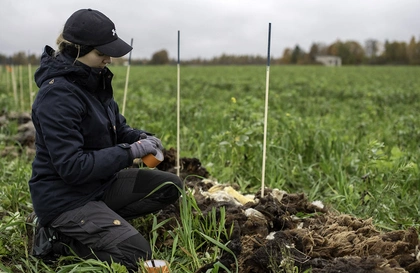
The University of Tartu is collaborating with farmers to enrich agricultural landscapes by planting diverse hedgerows. As part of the Climate Farm Demo project, OÜ Mäemõisa established the first trial, planting a 130-meter hedgerow with various trees and shrubs suitable for hedging, including buckthorn, viburnum, blackcurrant, gooseberry, hawthorn, hazel, and elm. Over the next few years, they plan to establish approximately 4 kilometers of hedgerows.
For the first trial, they focused mainly on native plants, some bearing edible fruits. In subsequent stages, they will create different types of hedgerows and tree lines—some designed for harvestable fruits, others to support biodiversity, and some for aesthetic appeal.
The planting area also includes experiments with different mulches and trunk protection methods. One key reason for establishing hedgerows was to create green corridors that connect forest masses separated by fields. The project also includes observations on planting tools and techniques, offering insights for both the farmers and other hedgerow enthusiasts.
Researchers recommend establishing both pruned and free-form hedgerows. The location choice should consider local conditions, expectations, and possibilities. Hedgerows with a mix of species, including natural ones from the surrounding area, are more likely to survive. It is advised to select species of different heights, with flowering and fruiting occurring at different times.
In areas where maintaining herbaceous vegetation is difficult, wider strips are recommended. Hedgerows and shrub strips are best established in early spring or autumn. Taller shrubs should be grouped toward the center, while smaller shrubs should be placed around them.
During the first few years, hedgerows require more care, including mulching. A 6-meter mown grass strip around the hedgerows is recommended, which can also be seeded with natural seed mixes to support biodiversity.
Tartu Ülikool katsetab koos talunikega põllumajandusmaastike rikastamist liigirikaste hekkidega. Climate Farm Demo projektis osalev OÜ Mäemõisa rajas oma põllule esimese katsena 130-meetrise, mitmesugustest hekitaimedeks sobivatest puudest ja põõsastest koosneva heki (türnpuu, lodjapuu, magesõstar, mustsõstar, tikker, viirpuu, sarapuu, jalakas jmt). Järgnevatel aastatel on plaan rajada umbes 4 kilomeetrit erinevaid elurikkaid hekke. Esimese katseriba hekitaimede valikul sooviti lisada eelkõige kodumaiseid taimi, millest osad on ka söödavate viljadega. Järgmistes etappides luuakse eriilmelisi hekke/puuderibasid, milledest mõnede eesmärk on pakkuda ka saagiks sobivaid vilju, teised keskenduvad rohkem elurikkuse toetamisele ning mõnede puhul on oluline ka esteetiline mulje.
Hekitaimede istutusalal katsetati erinevaid multše ja tüvekaitsemeetodeid. Tootja üheks hekkide rajamise põhjuseks oli soov luua rohekoridore, mis ühendaksid metsamassiive, mida eraldavad mitmed põllud. Heki osas tehakse projektis tähelepanekuid erinevate istutusvahendite ning -protsessi kohta, mis omakorda võiks aidata järgmiste hekkide istutamise puhul nii tootjaid endid kui ka teisi hekihuvilisi. Teadlased soovitavad rajada nii pügamist vajavaid kui ka vabakujulisi hekke.
Asukoha valikul tuleks kindlasti arvestada kohalike olude, ootuste ja võimalustega. Mitmeliigilistel ja ümbruskonna looduslikest liikidest koosnevatel hekkidel on kahjustajaid vähem. Istutamiseks on hea valida erineva kõrgusega, aga ka erinevatel aegadel õitsevaid ja viljuvaid liike. Nutikas on rajada ka kohati laiemaid ribasid kohtadesse, kus on rohttaimestiku hooldus raskendatud. Hekid või põõsasribad rajatakse üldjuhul varakevadel või sügisel. Kõrgema kasvuga põõsad võiks paigutada väiksemate rühmadena põõsasriba keskele, väikesekasvulisemad suuremate rühmadena riba servadesse. Esimestel aastatel vajavad põõsasribad ja hekid rohkem hoolt, sh ka multšimist. Hekkide ja põõsasribade ümber peaks olema niidetav rohumaariba, millesse võib külvata looduslikke seemnesegusid.
The University of Tartu is testing the enrichment of agricultural landscapes with species-rich hedgerows as part of the “Loodusrikas Eesti” project.
The goal is to enhance biodiversity in agricultural landscapes while also improving the area’s visual appeal.
The 1,000-hectare Climate Farm Demo farm, OÜ Mäemõisa, is also involved in the project.
The producer established a 130-meter trial hedgerow with various trees and shrubs suitable for hedging, including viburnum, blackcurrant, gooseberry, buckthorn, hawthorn, hazel, elm, and others.
The area is carefully designed, and the plant selection is well thought out.
The hedgerow plant selection focused primarily on edible species, ensuring a future harvest, landscape diversification, and aesthetic value.
The planting area was covered with different mulches and trunk protection methods.
A key goal was to create green corridors connecting forest masses separated by fields.
The project also includes observations on planting tools and processes, providing insights for both producers and other hedgerow enthusiasts.
Scientists recommend that agricultural producers establish both pruned and free-form hedgerows and shrub strips.
Hedgerows with varying characteristics (low and high, sparse and dense, pruned and unpruned) provide habitats for various species.
When selecting a location, the suitability of the hedgerow or shrub strip to the landscape should be considered.
Since hedgerows are permanent structures, they should be placed as boundary fences where possible, ensuring they do not obstruct scenic views or water bodies.
If placed in the middle of fields, care must be taken not to hinder fieldwork.
Hedgerows should ideally be planted in a north-south direction to prevent shading crops.
If placed along field edges in an east-west direction, their height should be considered.
In some cases, shade may be beneficial, such as for livestock sun protection.
Hedgerows and shrub strips also act as erosion barriers when placed perpendicular to water flow and prevailing winds.
Drainage systems should also be considered.
When planting a hedgerow or shrub strip, it is recommended to use multispecies compositions, as they are more resistant to biological pests.
Native species from the surrounding area should be preferred, particularly deciduous shrubs and lower deciduous trees, interspersed with longer-lived trees.
Selecting species that flower and bear fruit at different times ensures food for pollinators and berries for birds.
For hedgerows along major roads, species should be resistant to environmental pollutants (e.
g.
, exhaust gases, dust).
Some species produce abundant root suckers, requiring annual mowing around them.
Shrub strips with different heights create denser and more visually appealing landscapes.
Their width can vary, allowing for expansion in areas where maintaining herbaceous vegetation is difficult.
The best time to plant hedgerows or shrub strips is early spring or autumn after leaves have fallen.
Autumn planting requires less maintenance due to higher soil moisture, whereas spring planting may require additional watering.
Planning a shrub strip begins with placing larger trees approximately 25 meters apart.
In multi-row hedgerows, taller and more light-demanding species should be planted in the center, while lower species should be positioned at the edges.
Grouping different plant species together prevents pest spread.
Taller shrubs should be placed in smaller groups, while shorter shrubs should be arranged in larger clusters.
Early Maintenance and Biodiversity Support In the first few years, newly planted shrub strips and hedgerows require extra care, such as mowing around seedlings, pruning shrubs, and replacing dead plants.
To prevent herbaceous plants from smothering hedgerow plants, the area under the hedgerow should be adequately mulched.
Spring pruning encourages the formation of lateral branches.
A mowable grass strip should surround hedgerows and shrub strips, with permanent vegetation that is not plowed, sown, or fertilized.
To enhance biodiversity, these grass strips can be sown with natural seed mixes, providing food for pollinators like flowering plants, legumes, and other species.
Impact of Minimized Tillage on Soil Properties, Biota, and Environmental Conditions
Estonia
Mixed Forest Sub-region of the Atlantic Continental region of the Temperate zone
Benefits of the practice
- Lower carbon footprint
- More profitable production
- Longer/optimized sawing time
- Higher organic carbon in upper soil layers
- Increased microbiological activity
- More individuals and species of earthworms
Production system(s)
Thematic Area(s)
The organic carbon content is vertically stratified in direct cropping fields. In the upper 0-5 cm soil layers, its content is increased, in the lower layers decreased. In traditionally ploughed soils the crop content is more uniform. Soluble phosphorus and potassium are also vertically stratified in direct cropped fields. Such fields may acidify more rapidly and require liming. There were no major problems with excessive trampling of soils. Soil microbiological activity was higher in direct seeding fields. Earthworm abundance tended to be higher in ploughed fields, but the number of earthworm species tended to be higher in direct-sown fields. The use of plant protection products of direct-sowed fields was significantly higher compared to the ploughed fields. More pesticide residues were detected in the soil and mulch of direct broadcast fields than in plough-based fields.
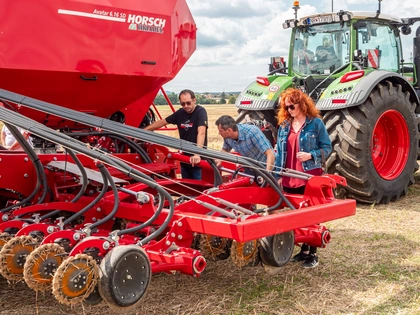
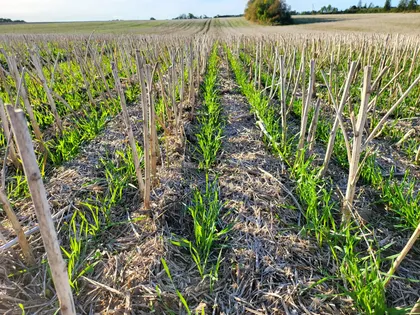
The aim of direct sowing is to maximize soil protection, reduce emissions and create a larger window for optimal sowing at minimum cost to the producer. Direct sowing has been tested for example in winter wheat, peas, beans, barley, winter oilseed rape, catch crops and grasslands in Estonia. With direct sowing, the tractor hours and labour costs can be reduced. We can also save soil, increase soil carbon and significantly reduce CO2 emissions. Indeed, ploughing should only be used when it is absolutely necessary (e.g. after extensive land preparation).
Orgaanilise süsiniku sisaldus on otsekülvipõldudel vertikaalselt kihistunud. Ülemises 0-5 cm mullakihis on selle sisaldus suurenenud, alumistes vähenenud. Traditsiooniliselt kündes on aga Crog sisaldus mullaprofiilis ühtlane. Liikuva fosfori ja kaaliumi sisaldus on samuti otsekülvipõldudel vertikaalselt kihistunud. Otsekülvi põllud võivad hapestuda kiiremini ning vajada lupjamist. Muldade liigse tallamisega suuri probleeme ei esinenud. Mulla mikrobioloogiline aktiivsus olid kõrgemad otsekülviga põldudel. Vihmausside arvukus oli pigem suurem künnipõhistel põldudel, kuid vihmausside liikide arv oli suurem pigem otsekülviga põldudel. Taimekaitsevahendeid kasutavad otsekülvi rakendajad oluliselt rohkem kui künnipõhise tehnoloogia kasutajad. Otsekülvi põldude mullas ja multšis tuvastati rohkem taimekaitsevahendite jääke kui künnipõhistel põldudel. Otsekülvi praktiseerimisel on tootja eesmärk kaitsta minimaalsete kuludega maksimaalselt mulda, vähendada heitmeid ja tekitada suurem ajaaken optimaalseks külviajaks. Otsekülvi on katsetatud talinisu, herne, oa, odra, talirapsi, vahekultuuride, aga ka rohumaade rajamisel. Otsekülviga saab ta vähendada traktorite töötunde ja tööjõukulu, säästa mulda, kasvatada süsiniku hulka mullas ja vähendada oluliselt CO2 heidet. Künda tuleks tõesti ainult siis, kui see on hädavajalik (nt peale ulatuslikke maaparandustöid).
A direct seeding survey conducted in 2022 on three fields in South Estonia found that organic carbon content in direct seeding fields is vertically stratified, with an increase in the upper 0–5 cm layer and a decrease in lower layers over the years.
In traditionally ploughed soils, however, organic carbon content remains uniform.
Soluble phosphorus and potassium concentrations are also vertically stratified in direct-cropped fields, while soil reaction and trace element content showed no significant differences between different technologies.
Some direct-drilled fields have become more acidic over time, requiring liming.
Soil trampling was found to be generally low, and no major problems were encountered with direct seeding.
Soil microbiological activity (biomass and respiration) was higher in direct-drilled fields.
Earthworm abundance tended to be higher in ploughed fields, but species diversity was greater in direct-sown fields.
In the 0–5 cm layer of direct-sown fields, earthworm abundance and species richness were higher compared to plough-based fields, particularly in comparison to the 5–10 cm layer.
However, herbicide use in direct-sown fields is significantly higher than in plough-based systems, as mechanical weed control is not possible with direct sowing.
More pesticide residues were found in the mulch of directsown fields than in the soil, mainly herbicide and fungicide residues.
Additionally, more residues were found in the soil of direct-sown fields compared to ploughed fields.
A demo-producer also experimented with strip-tillage and strip-tillage with liquid fertilizer application.
In direct drilling, the producer aims to maximize soil protection at minimum cost, reduce emissions, and create a larger window for optimal sowing.
The producer applies direct drilling for winter wheat, peas, beans, barley, and catch crops, as well as for winter oilseed rape and grassland establishment.
Row widths of 19 cm and 25 cm are used.
In direct sowing, even straw spreading across the field is crucial, and pretreatment of the soil surface may be necessary.
The producer emphasizes that direct drilling can reduce tractor hours and labor, conserve soil, increase soil carbon, and significantly lower CO₂ emissions.
He also stresses that ploughing should be the last resort when no other options are available.
Ploughing is generally used only after land melioration, when soil leveling is required.