




Select one or more regions of interest
by clicking on the filter elements
Drag the filter elements horizontally,
and select one or multiple
thematic areas of interest.

The Carbon Removals and Carbon Farming (CRCF) Regulation

Europe
Pan-European
Benefits of the practice
- Cost-effective monitoring
- Regulatory alignment
- Market opportunities
Thematic Area(s)
The Carbon Removals and Carbon Farming (CRCF) Regulation (EU/2024/3012) is a voluntary certification framework introduced by the EU to support climate efforts by offering farmers an additional income source. Aligned with the EU Commission’s Vision for Sustainable Agriculture, CRCF provides more incentives (carrots) and fewer rules (sticks). It enhances transparency and reduces greenwashing by establishing EU-wide quality criteria and monitoring processes. The regulation categorizes certificates into permanent carbon removals, carbon storage in products, carbon farming removals, and soil emission reductions, with standardized procedures for third-party verification, certification, and registration.
Carbon farming practices include agroforestry, peatland restoration, use of cover crops, reduced fertilizer use, and biodiversity-focused reforestation. Methodologies describing MRV (Monitoring, Reporting, Verification) will be drafted by the EU Commission and published via delegated acts. The certification process builds on the Renewable Energy Directive, enabling compliance through audits, registries, and standardized baselines. Copernicus satellite data and remote sensing will make monitoring cost-effective and ensure data accuracy.
The CRCF introduces group certification for small-scale farmers and foresters, enabling verified carbon credits through sustainable practices and innovation. It aims to reduce the admin burden by using group certification and bioenergy certification models. While it currently covers only soil-related emissions, methane reductions from livestock could be included from 2027.
Though use-cases are not specified, CRCF is expected to benefit farmers, foresters, agri-food businesses, policymakers, and advisors by incentivizing sustainable practices and shaping climate policy. It supports a scalable, transparent carbon removal market in the EU, rewarding nature-inclusive land management.
The Carbon Removals and Carbon Farming (CRCF) Regulation (EU/2024/3012) aims to support the European Union’s efforts to tackleclimate change by introducing a voluntary certification framework forcarbon removals, carbon storage in products and carbon farming. Alignedwith the EU’s evolving Vision for Sustainable Agriculture, the Regulationreflects a shift towards prioritizing incentives (“carrots”) over regulatorymandates (“sticks”), emphasizing economic opportunities as key drivers ofsustainability It tries to address challenges in carbon market credibility bysetting out EU-wide quality criteria and monitoring processes that seek toenhance transparency and reduce the risks of greenwashing. The Regulation encourages investment in innovative carbon removal technologies and sustainable carbon farming, aiming to create economicopportunities for farmers, foresters, and businesses while maintainingenvironmental integrity.
The CRCF Regulation attempts to organize carbon removals into distinctcategories, including permanent carbon removals, carbon storage inproducts, carbon farming, and soil emission reductions. It proposesstandardized procedures for third-party verification, certification, andregistration to improve reliability and consistency across the EU. Some of theapproaches it highlights include permanent carbon removals throughtechnologies like Direct Air Carbon Capture with Storage (DACCS),Bioenergy with Carbon Capture and Storage (BECCS), and chemicallybinding CO2 into products to secure long-term carbon storage. Carbonfarming encompasses practices that seek to increase carbon sequestrationin soil and forests or to cut emissions, such as agroforestry, peatlandrestoration, use of cover crops, reducing fertilizer application, andbiodiversity-conscious reforestation. The certification process builds on the Renewable Energy Directive, looking to streamline compliance throughaudits, registries, and standardized baselines. Monitoring is expected tobecome more cost-effective with the use of Copernicus satellite technologyand remote sensing, helping to lower reporting costs while ensuring dataaccuracy. The Regulation also introduces group certification to easeparticipation for small-scale farmers and foresters.
The CRCF Regulation seeks to create new financial opportunities forfarmers, foresters, and businesses by allowing them to generate verifiedcarbon credits through sustainable land management and technologicalinnovations. Carbon farming has the potential to offer an additional incomestream, while certification scheme owners involved in permanent carbonremovals could attract sustainability-focused investors. The Regulation triesto reduce the administrative burden by enabling group certification anddrawing on existing bioenergy certification models, making compliancemore feasible for smaller landowners. Ensuring alignment with EU climatepolicies, the certification process aims to integrate smoothly withagricultural and environmental frameworks. Additionally, climate-friendlypractices in the agri-food sector could enhance resilience and competitiveness. To build on these developments, the Directorate-Generalfor Climate Action has commissioned a study to further assess policyoptions for encouraging climate action within the agri-food value chain,particularly with a view toward the post-2030 period.
The CRCF Regulation is expected to benefit farmers and foresters byproviding financial incentives for adopting sustainable land managementand emission reduction techniques. Agri-food businesses may use marketbased climate policies to reinforce sustainability across their supply chains. Investors and carbon market stakeholders could find a more credibleframework for supporting certified carbon removal initiatives. Policymakersand advisory services may use the Regulation as a foundation for informeddecision-making on climate and agricultural policy, e.g. nature credits. By working toward a transparent, science-based framework, the CRCF Regulation hopes to establish a reliable and scalable carbon removal marketin Europe, contributing to the EU’s broader climate goals while offeringpractical advantages to land managers and industry stakeholders.
Agroforestry Systems: Introduction and Funding Opportunities in Germany

Germany
Warm-temperate Mid-latitude Climate Zone
Benefits of the practice
2. Financial support through funding programs at federal and state levels
3. Long-term improvement in soil quality and biodiversity
Production system(s)
Thematic Area(s)
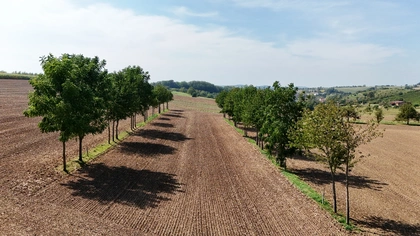
Agroforestry systems combine agriculture with woody plants and offer farmers both ecological and economic benefits. They contribute to climate adaptation by cushioning weather extremes such as drought and heavy rainfall, binding CO₂ and improving soil quality through erosion protection, humus formation and better water retention capacity.
Agroforestry systems have been officially eligible for funding in Germany since 2023. Farmers receive €200 per hectare of woodland via the Common Agricultural Policy (CAP). In addition, federal states such as Bavaria, Mecklenburg-Western Pomerania, Lower Saxony and Saxony offer investment subsidies. External programs such as SilvoCultura also support the planting of fruit and timber trees with up to €50 per tree (for at least 70 trees).
In addition to the financial incentives, agroforestry systems are also economically attractive. They generate additional income through the production of nuts, fruit, energy or timber and can add value to agricultural products through sustainable cultivation methods and storytelling potential.
Targeted care is crucial for successful establishment. Especially in the first few years after planting, measures such as weed control by hoeing or mulching are important to minimise competition from weeds. Slow-growing woody plants require up to three years of intensive care before they grow stably and offer long-term benefits.
Agroforstsysteme verbinden Landwirtschaft mit Gehölzen und bieten Landwirten sowohl ökologische als auch wirtschaftliche Vorteile. Sie tragen zur Klimaanpassung bei, indem sie Wetterextreme wie Trockenheit und Starkregen abfedern, CO₂ binden und die Bodenqualität durch Erosionsschutz, Humusbildung und bessere Wasserhaltefähigkeit verbessern.
Seit 2023 sind Agroforstsysteme in Deutschland offiziell förderfähig. Über die Gemeinsame Agrarpolitik (GAP) erhalten Landwirte 200 € pro Hektar Gehölzfläche. Zusätzlich bieten Bundesländer wie Bayern, Mecklenburg-Vorpommern, Niedersachsen und Sachsen Investitionsförderungen. Externe Programme wie SilvoCultura unterstützen zudem die Pflanzung von Frucht- und Wertholzbäumen mit bis zu 50 € pro Baum (bei mindestens 70 Bäumen).
Neben den finanziellen Anreizen sind Agroforstsysteme auch wirtschaftlich attraktiv. Sie ermöglichen zusätzliche Einnahmen durch die Produktion von Nüssen, Früchten, Energie- oder Wertholz und können landwirtschaftliche Produkte durch nachhaltige Anbaumethoden und Storytelling-Potenziale aufwerten.
Für eine erfolgreiche Etablierung ist eine gezielte Pflege entscheidend. Besonders in den ersten Jahren nach der Pflanzung sind Maßnahmen wie Beikrautregulierung durch Hacken oder Mulchen wichtig, um Konkurrenz durch Unkraut zu minimieren. Langsam wachsende Gehölze benötigen bis zu drei Jahre intensive Pflege, bevor sie stabil wachsen und langfristige Vorteile bieten.
Agroforestry systems, a combination of agriculture and woody plants, opennumerous ecological and economic opportunities for farmers. These systems not only offer a sustainable response to climate change, but also awide range of opportunities for farm diversification. By integrating trees intoagricultural areas, weather extremes such as dry spells or heavy rainfall canbe buffered. At the same time, CO₂ sequestration is promoted, whichcontributes to climate protection. Agroforestry also improves soil quality:trees prevent erosion, promote humus formation and support the soil’sability to retain water.
In Germany, agroforestry has been officially recognized as an eligiblepractice since 2023. Through the Common Agricultural Policy (CAP), farmerscan receive €200 per hectare of wood per year via the organic regulations.
In addition, federal states such as Bavaria, Mecklenburg-Western Pomerania, Lower Saxony and Saxony offer specific investment subsidies toimplement agroforestry systems. External programs such as SilvoCulturaalso support the planting of fruit or timber trees, with funding of up to €50per tree (if at least 70 trees are planted). These funding instruments make iteasier to get started and reduce financial hurdles.
In addition to financial support, agroforestry systems are also economicallyattractive. Tree strips offer income opportunities through fruit and nutproduction, energy wood or high-quality timber yields. At the same time,they increase the attractiveness of agricultural products as they provideenvironmental services and storytelling potential that can have a positiveimpact on marketing.
However, long-term profitability depends on targeted maintenance. Weedcontrol is particularly important to minimize competition between thewoody plants and weeds. In the first year after planting, the soil should bekept black to create optimal growing conditions. Mechanical methods suchas hoeing or mulching facilitate this care. Slow-growing woody plants alsorequire up to three years of intensive care before they can grow stably anddevelop their full potential.
Rewarding Mechanisms – The example of Label-Bas Carbone

France
European Climate
Benefits of the practice
- Result-based rewards
- Credible and Transparent Carbon Certification
- Flexibility and Market Opportunities
Thematic Area(s)
The Label Bas-Carbone is a voluntary climate certification framework established by the French government to support projects that contribute to greenhouse gas emission reductions and carbon sequestration in France. It provides a structured approach to monitoring, reporting, and verifying carbon reductions or removals, ensuring transparency and credibility in the national voluntary carbon market. Farmers, farm advisors, and other agricultural operators can utilize this mechanism to adopt sustainable practices while securing financial rewards from private, public, or mixed funding sources.
The Label Bas-Carbone framework operates on a result-based rewarding method, meaning that financial compensation is tied to measurable environmental outcomes. Farmers implementing low-carbon practices must conduct a carbon audit at the start of the project and another at the end to assess progress. These practices fall under six approved farming methodologies and include actions such as reducing mineral fertilizer use in field crops, optimizing herd management in livestock farming, decreasing reliance on imported soybean feed, using cover crops, and planting hedges. Project proposals must be approved by the French Ministry of Ecological Transition, and independent auditors assess progress throughout the project cycle. Once the certification is obtained, project developers and their partners can contract with financiers to pay for the change of practices. Contracts are negotiated over the counter, but it has been observed that funding for agricultural projects is around €40-60/tCO2.
The governance of the Label Bas-Carbone is managed by the French Ministry of the Environment, which oversees the approval of methodologies, ensures compliance with regulatory standards, and supervises the work of third-party auditors. By leveraging this framework, farmers can contribute to climate mitigation efforts, enhance farm sustainability, and access new revenue streams within the carbon market.
The Label Bas-Carbone is a voluntary climate certification framework established by the French government to support projects that contribute to greenhouse gas emission reductions and carbon sequestration in France.
It provides a structured approach to monitoring, reporting, and verifying carbon reductions or removals, ensuring transparency and credibility in the national voluntary carbon market. Farmers, farm advisors, and other agricultural operators can utilize this mechanism to adopt sustainable practices while securing financial rewards from private, public, or mixed funding sources.
The Label Bas-Carbone framework operates on a result-based rewarding method, meaning that financial compensation is tied to measurable environmental outcomes. Farmers implementing low-carbon practices must conduct a carbon audit at the start of the project and another at the end to assess progress. These practices fall under six approved farming methodologies and include actions such as reducing mineral fertilizer use in field crops, optimizing herd management in livestock farming, decreasing reliance on imported soybean feed, using cover crops, and planting hedges. Project proposals must be approved by the French Ministry of Ecological Transition, and independent auditors assess progress throughout the project cycle.
The financial arrangements between farmers and funders are not regulated by the Label Bas-Carbone itself, allowing flexibility in contractual agreements. Typically, these initiatives are collective efforts involving multiple farmers and intermediaries, which enhances collaboration and improves project success rates.
The financial rewards under the Label Bas-Carbone system follow a multiyear payment structure, with contracts typically lasting five years, renewable upon review. Farmers can receive payments annually or at the end of the five-year period, depending on the agreed contract with funders and intermediaries. It has been observed that funding for agricultural projects is around €40-60/tCO2. Importantly, project validation under the Label BasCarbone does not guarantee financing; once a project is approved, intermediaries must secure funding, predominantly from private entities seeking to contribute to climate mitigation efforts.
The governance of the Label Bas-Carbone is managed by the French Ministry of the Environment, which oversees the approval of methodologies, ensures compliance with regulatory standards, and supervises the work of third-party auditors. The financial resources for the projects primarily come from companies and institutions looking to fulfill sustainability commitments through voluntary carbon contribution. The Label BasCarbone initiative aligns with France’s National Low-Carbon Strategy, reinforcing the country’s commitment to achieving carbon neutrality and fostering sustainable agricultural transitions.
For farmers, the Label Bas-Carbone offers an opportunity to integrate climate-smart practices into their operations while securing financial incentives. However, challenges remain, including the complexity of administrative procedures, the need for initial financial investments, and the uncertainty of securing funding. Advisors play a crucial role in supporting farmers through these processes by providing guidance on methodologies, assisting with carbon audits, and facilitating connections with potential funders. By leveraging this framework, farmers can contribute to climate mitigation efforts, enhance farm sustainability, and access new revenue streams within the carbon market.
Overall, the Label Bas-Carbone serves as a promising model for voluntary carbon markets, offering a structured and credible approach to rewarding climate-positive agricultural practices. Its emphasis on transparency, thirdparty validation, and performance-based incentives makes it an effective tool for encouraging sustainable farming while addressing climate challenges. As the framework continues to evolve, improvements in accessibility, strengthening environmental integrity and increased financial guarantees could further enhance its impact and attractiveness to farmers and agricultural stakeholders.
Definitions and Categorization of Rewarding Mechanisms for Climate Smart Farming
Europe
Pan-European Scope
Benefits of the practice
- Knowledge Sharing
- Awareness
Thematic Area(s)
Farmers need rewarding mechanisms in the pursuit of the green transition in agriculture. These rewarding mechanisms can be sourced from public or private entities, and can take the form of regulatory responsibilities, voluntary public money, R&D, voluntary carbon markets, and price premiums/labelling.
On EU agricultural land, there are various climate action systems, including emission reduction, carbon sequestration, and climate adaptation. There are two types of rewarding sources: public and private. Public rewarding refers to financing from the international community, EU, State, or regional level, while private rewarding includes funding from companies, private groups, and consumers through carbon markets or price premiums.
There are several ways to reward land users and farmers for their environmental activity, with two main types: result-based and action-based results. Action-based rewarding provides farmers with compensation or incentives for carrying out specific agricultural methods, while result-based rewarding is linked to a confirmed outcome. The timing of rewarding can be either ex-ante, a financial prelude to climate action, or ex-post, following the farmer’s climate action. Combinations of timing are also possible.
Farmer face numerous positive and negative effects on the climate and adaptiveness to climate change. Using two sorts of policy approaches— those of “carrots,” or “sticks”—broadly speaking, legislators and the private sector can inspire farmers to adopt measures regarding climate change effects mitigation (i.e., lower emissions or enhance carbon removals) and adaptability to climate change. “Sticks” comprise taxes, regulatory restrictions or prohibitions, quotas or quantitative limitations, and taxes—all of which penalise or make it unlawful to carry out negative activities, therefore changing behaviour. On the other hand, legislators or the private sector might pay farmers for doing good deeds, therefore encouraging positive change – “carrots”.
We focus on these so-called “carrots,” which we see as rewarding mechanisms, in this Practice Abstract. Rewards for agricultural activities that lower or avoid emissions, remove carbon from the atmosphere, adapt to climate change are defined as mechanisms that reward farmers in return for implementing a desired action or delivering a desired outcome and can be sourced from public or private entity or even a mix of both. Aiming to promote a behavioural change, using positive incentives, and their voluntary character define rewarding systems. Among other things, these motivating systems can take the following format: regulatory
responsibilities (that are rewarded), voluntary public money, R&D, voluntary carbon markets and price premiums/labelling.
Furthermore, on EU agricultural land, there is a wide spectrum of climate action on plot, field, and landscape level which are captured to different degrees in the several present or proposed rewarding systems. One can classify them as follows:
1. emission reduction which is mainly methane (CH4) from enteric fermentation and N2O emissions from managed agricultural soils, which together represent over 80% of agricultural emission in the EU.
2. the removal of CO2 from the atmosphere by converting between land cover types and managing the agricultural soils to increase carbon sequestration and
3. the response to climate change by increasing the adaptive capacity of the agricultural sector.
Moreover, two basic types define rewarding sources: public and private ones. While most of the current systems rely on monetary financing, both might entail both financial and non-financial benefits. With public rewarding we refer to financing or help from the international community, EU, State or regional level e.g. Common Agricultural Policy (CAP), R&D initiatives, etc. Any kind of funding from the private sector—companies, private groups, and consumers—through carbon markets or price premiums and labelling qualifies as private rewarding. Public/private funding sources include market-based strategies whereby the Government plays a major role either supplying or distributing the funds also exist.
There are several ways to reward land users and farmers for their environmental activity. They can be generally divided between the delivery of result-based or action-based results. Action-based rewarding gives the farmer in line with generally quite particular agricultural methods satisfying results. Independent of the outcome of those designated management activities, farmer or landowner gets a compensation or incentive for carrying out such activities. Result-based rewarding is linked to a confirmed outcome and calls for a direct, explicit relationship between the result delivered—e.g., emission decreased or avoided, carbon sequestered—and the incentive the farmer gets.
Lastly, there are several design choices about the timing of the rewarding, that is, when and how often the rewarding is occurring. Ex-ante rewarding is the (typically financial) prelude to climate action. While the real result of climate change might take years, long-term initiatives requiring significant upfront expenditures may find relevance for this payment mechanism. Expost rewarding is done following the farmer’s generated climate action.
Over the course of the project, the rewarding might be one-off or continuous, multi-year. Also, combinations of the timing of rewarding are feasible.
Farmers and Advisors' Needs from Rewarding Mechanisms
Europe
Pan-European Scope
Benefits of the practice
- Needs identification
- Needs understanding
- Information exchange
Thematic Area(s)
Farmers and farm advisors play a crucial role in implementing climate-smart farming practices, but they often face challenges in accessing and benefiting from reward mechanisms. This practice abstract aims to identify the key needs of farmers and advisors to engage more effectively with these mechanisms.
Farmers need straightforward, organized, and easy-to-understand information about the available mechanisms, including policy contexts, eligibility criteria, benefits, and potential risks. Organizations like farmer groups are essential for sharing this information.
Easy-to-use carbon calculation tools should help farmers determine their potential earnings from carbon credits. Clear policies with consistent rules, less red tape, and proven methods are crucial for building farmers’ trust in mechanisms. Reliable advisors can help farmers through application processes, compliance tracking, and economic feasibility evaluation. Offering fair and motivating prices for carbon credits and other sustainable production outputs is essential.
Advisors need ongoing training, especially on carbon market tools, updates on national and EU policies, and incentive programs. They need accessible tools to help farmers navigate the complexities of rewarding mechanisms, offering risk assessments and evaluations of long-term economic impacts. Access to trustworthy validation and certification schemes ensures that incentives offered to farmers are credible and financially sound.
To make the most of rewarding mechanisms, it is important to create a user-friendly information platform, strengthen advisory networks by training advisors in climate-smart agriculture and reward systems, equip them with decision-making tools, establish consistent rules, simplify processes, provide stable policies to motivate farmers’ participation, boost market opportunities through fair pricing for carbon credits and sustainable products, and encourage knowledge sharing.
Rewarding Climate Action: Recognizing the Contributions of Organic Farmers
Europe
All Zones
Benefits of the practice
- Climate & Biodiversity Gains - Organic farming cuts emissions, builds soil health, and protects biodiversity.
- Holistic Approach - Supports whole-farm sustainability beyond just carbon.
- Rewarding Mechanisms Needed - Organic farmers must be recognized and compensated for ongoing climate efforts.
Production system(s)
Thematic Area(s)
Organic farming offers a systemic approach for climate mitigation and adaptation while sustaining healthy soils and protecting biodiversity. Organic agriculture reduces greenhouse gas emissions by refraining from the use of synthetic fertilizer and pesticides and using less energy. Common organic practices like crop rotations including legumes, cover crops or reduced tillage help to improve soil quality and fertility while also contributing to higher soil organic carbon stocks. These practices also support species protection and increase biodiversity as well as support ecosystem functions. Overall, the holistic approach of organic leads to more resilient farming systems.
However, organic farmers face some limitations under existing rewarding mechanisms for their climate action.
Carbon farming schemes typically only reward “additional” efforts. This is a barrier for first movers, like organic farmers, as they often have already built up soil organic carbon stocks. Their past efforts are not recognized and the maintenance of soil carbon is not incentivized.
In many cases, existing carbon farming schemes have a narrow approach. They do not take a whole farm approach and a carbon balance at farm level. Instead, they focus on efficiency and only on specific aspects like soil organic carbon. Externalities of the farming system, including biodiversity and ecosystem services, are often neglected.
Current rewarding mechanisms often do not remunerate farmers proportionally to the environmental benefits they provide. For example, in some EU Member States organic farmers have restricted access to environmental payments of the CAP due to the alleged issue of double funding.
To ensure organic farmers are rewarded appropriately, mechanisms should:
take a systemic, whole farm approach to rewarding climate action.
compensate proportionally for providing environmental benefits.
recognize the efforts of first movers and support the maintenance of carbon soil.
AgroImpact - a Multi-stakeholder Association to Promote and Support Decarbonization Efforts by Swiss Farmers

Switzerland
All Zones
Benefits of the practice
- Market valuation and recognition of farmers' efforts
- Inter-cantonal dynamics between public and private players
- Pooling human and financial resources
Production system(s)
Thematic Area(s)
AgroImpact is a young association created in December 2023 to accelerate the climate transition of agriculture. It proposes an approach aimed at supporting farmers in the adoption of resilient practices to climate change.
Farmers participate in the AgroImpact program on a voluntary basis. Depending on the canton, they receive additional financial support for the assessment of a carbon footprint and the adoption of adaptation and mitigation measures. The AgroImpact approach allows synergies with other ongoing regional projects. The farmer also receives a climate premium paid by the buyer. It should be noted that the AgroImpact approach does not generate any sales of carbon certificates.
The association is unique in that it has a shared governance structure involving representatives of agricultural organizations (producers, chambers of agriculture, advisory), research organizations, NGOs and buyers (industrialists, cooperatives and distributors) of raw materials. A wide range of collaborations in AgroImpact are being established and coordinated between the public and private sectors.
Farmers commit to the AgroImpact program for 6 years:
- An advisor carries out a full carbon assessment of the farm.
- A specific action plan is adopted to reduce the climate footprint.
- The ClimaCert certification process is implemented, which includes:
– Measuring the farm’s carbon footprint.
– Identification of specific measures for improvement.
– Obtaining the ClimaCert certificate (the results of the farm’s climate footprint and its carbon storage are certified).
– Registration in a public register. - At the end of the process, the certified farmer can receive annual climate premiums to produce low carbon raw materials. The premiums are granted by buyers/industrialists who are members of the association.
AgroImpact est une jeune association créée en décembre 2023 pour accélérer la transition climatique de l’agriculture. Elle propose une démarche visant à soutenir les agriculteurs dans l’adoption de pratiques résilientes face au changement climatique.
Les agriculteurs s’engagent sur une base volontaire dans le programme AgroImpact. Ils bénéficient, en fonction du canton, de soutien financier supplémentaire pour la réalisation d’un bilan carbone et l’adoption de mesures d’adaptation au changement climatique. La démarche AgroImpact permet des synergies avec d’autres projets régionaux en cours. L’agriculteur perçoit également une prime climatique versée par l’acheteur. Il est à préciser que la démarche AgroImpact ne génère pas de vente de certificats carbone.
La spécificité de l’association réside dans une gouvernance partagée regroupant des représentants d’organisations agricoles (producteurs, chambres d’agriculture, conseil), de la recherche, d’association (ONG), et des acheteurs (industriels, coopérative et distributeurs) de matières premières. Des collaborations multiples se mettent en place et se coordonnent entre public et privé.
Les agriculteurs s’engagent pour 6 ans dans le dispositif AgroImpact :
Réalisation par un conseiller d’un bilan carbone complet de l’exploitation ;
Adoption d’un plan d’action personnalisé pour réduire son empreinte climatique ;
Mise en place de la démarche de certification ClimaCert qui comprend :
Mesure du bilan carbone de l’exploitation.
Identification de leviers d’amélioration spécifiques.
Obtention de l’attestation ClimaCert (les résultats de l’empreinte climatique de l’exploitation ainsi que son stockage carbone sont attestés).
Inscription sur un registre public.
A l’issue du processus, l’agriculteur certifié peut percevoir annuellement des primes climatiques pour la production de matières premières bas carbone. Les primes sont octroyées par les acheteurs/industriels membres de l’association.