



Contact/s:
Elena Bortolazzo
e.bortolazzo@crpa.it
Lorena Giglio
From Planning to Action: Mapping of Adaptation and Mitigation Measures (AMM) within the AMPs in CFD Project.

Europe
All
1. Adaptation and Mitigation measures
2. Production systems
Thematic Areas
Production System/s
Summary for Practicioners on the Main Finding(s)/Innovative solution(s)
Across 26 countries, 1,417 farms in the Climate Farm Demo (CFD) project are taking direct action to reduce their environmental impact. Each farm is implementing a tailored Adaptation and Mitigation Plan (AMP) selecting adaptation and mitigation measures (AMMs) based on the farm’s GHG emissions baseline situation, specific needs, long-term vision and budget.
The goal of CFD is to observe these measures in action on farms and to obtain feedback on their impact across different parts of Europe and in various production sectors, helping us to understand the current interests and needs of the farms.
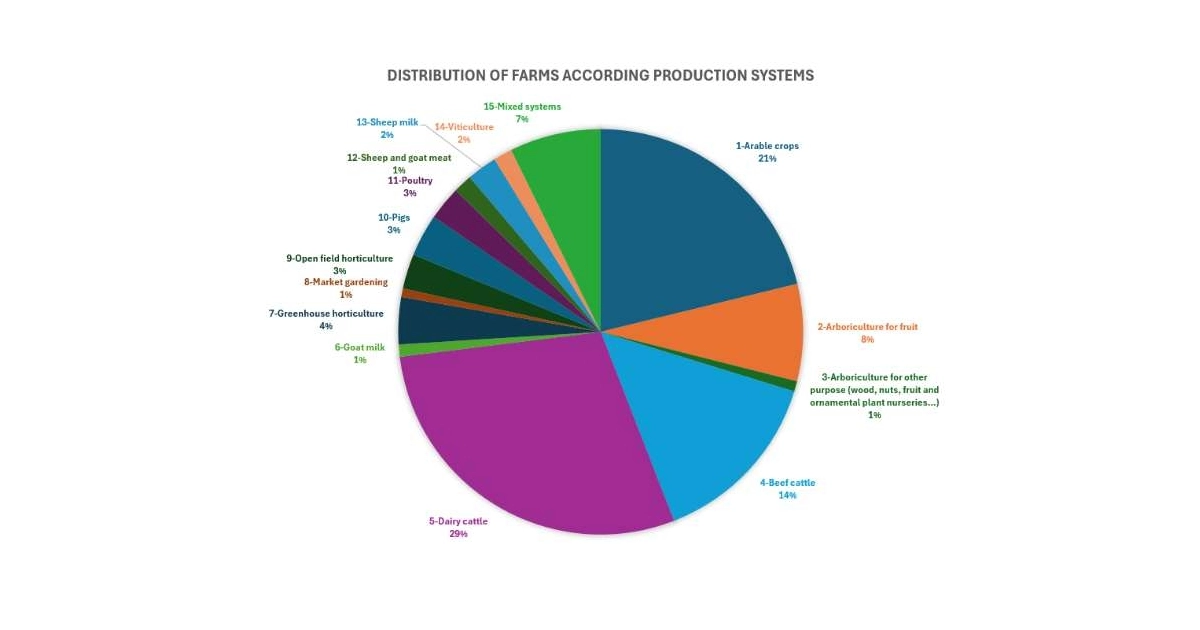
A total of 1,339 farms were included in the analysis. In the sample, dairy cattle farms account for the largest share (29%), followed by arable crops (21%), beef cattle (14%), and fruit arboriculture (8%). Mixed farms represent a further 7% of the sample.
Farmers selected 167 of the 193 available measures, showing a wide diversity of adaptation and mitigation strategies, with both types – adaptation and mitigation – well represented.
The most widely adopted measure was renewable (solar) energy production, implemented by 12% of farms across the network and present in 22 of the 26 countries.
Soil management and animal husbandry and feeding stand out as the two most important categories for farmers. The soil management category covers three measures – adding organic matter to the soil, cultivating legume crops, and no-till. Within animal husbandry and feeding, the most selected measures are optimizing rotational grazing management, reducing the number of unproductive animals, and improving animal health status.
For farmers, seeing which practices their peers plan to adopt offers practical inspiration. For advisers, these selections provide a concrete baseline to guide consultations and design farm-specific strategies. At the policy level, these measures help decision-makers to align regional governance, advisory services and support schemes with producers’ priorities.
Summary for Practicioners in Native Language
Nell’ambito del progetto Climate Farm Demo (CFD), 1.417 aziende agricole distribuite in 26 Paesi stanno attuando interventi volti a ridurre il proprio impatto ambientale. Ciascuna realtà aziendale ha preparato un Piano di Adattamento e Mitigazione (Adaptation and Mitigation Plan – AMP) personalizzato, selezionando specifiche misure di adattamento e mitigazione (AMMs) definite sulla base delle proprie emissioni (GHG), delle esigenze dell’azienda, della visione strategica a lungo termine e delle risorse finanziarie disponibili.
Il presente practice abstract si propone di mappare le diverse soluzioni adottate nei 26 Paesi coinvolti. L’analisi ha preso in esame un campione complessivo di 1.339 aziende. Gli allevamenti di bovini da latte costituiscono la quota maggioritaria (29%), seguiti dalle colture seminative (21%), dagli allevamenti di bovini da carne (14%) e dalla frutticoltura (8%). Le aziende ad indirizzo produttivo misto — caratterizzate dalla combinazione di più sistemi di produzione — rappresentano un ulteriore 7% del campione.
Gli agricoltori hanno adottato 167 delle 193 misure disponibili nella raccolta di misure proposte dal progetto, evidenziando una notevole varietà di strategie di adattamento e mitigazione, con entrambe le tipologie – adattamento e mitigazione – ben rappresentate. La misura maggiormente adottata è stata la produzione di energia da fonti rinnovabili (solare), attuata dal 12% delle aziende agricole dell’intera rete e presente in 22 dei 26 Paesi.
La gestione del suolo e l’allevamento e l’alimentazione degli animali emergono come le due categorie più importanti per gli agricoltori. La gestione del suolo comprende tre misure: l’apporto di materia organica al suolo, la coltivazione di leguminose e la semina su sodo. Nell’ambito dell’allevamento e dell’alimentazione degli animali, le misure emergenti sono l’ottimizzazione della gestione del pascolo a rotazione, la riduzione del numero di animali improduttivi e il miglioramento dello stato di salute degli animali.
Per gli agricoltori, vedere quali pratiche i loro colleghi intendono adottare offre uno spunto pratico. Per i consulenti, queste scelte forniscono un punto di riferimento concreto per orientare le consulenze e definire strategie specifiche per ogni azienda agricola. A livello politico, queste misure aiutano i decisori ad allineare la governance regionale, i servizi di consulenza e i programmi di sostegno alle priorità dei produttori.
Additional Information
Beyond its descriptive value, this analysis captures what is actually taking place on the farms – reflecting the interests and needs of the farmers themselves – and serves as a key guiding tool, helping stakeholders identify priorities for attention, resource allocation, and future research. Grouping measures into categories, such as soil management, animal husbandry, and energy, further highlights the thematic priorities farmers are focusing on.
This summary aggregates all production systems combined; results may vary when examined by individual system.
Further details on the implementation of these measures will be provided at the end of the project, following the collection of monitoring data for each farm. This monitoring will generate real-world evidence on technical and economic performance, resource use, and implementation of feasibility across the different farms, and will be complemented by a cost-benefit analysis once the implementation phase concludes.