



Contact/s:
Karme Petrutis
karme.petrutis@metk.agri.ee
Enriching Agricultural Landscapes with Hedges and Shrub Strips

Estonia
Mixed Forest Sub-region of the Atlantic Continental region of the Temperate zone
- Diverse Habitats: Supports various species, boosting biodiversity.
- Enhanced Forage Base: Provides food for birds, animals, and insects, promoting pollination.
- Natural Pest Management: Encourages ecological balance, reducing pests.
- Carbon Storage: Increases carbon sequestration, mitigating climate change.
- Microclimate Stability: Regulates temperature and moisture levels.
- Wind Protection & Erosion Control: Shields crops, birds, and wildlife.
- Aesthetic Value: Creates visually appealing agricultural landscape
Thematic Areas
Production System/s
Summary for Practicioners on the Main Finding(s)/Innovative solution(s)
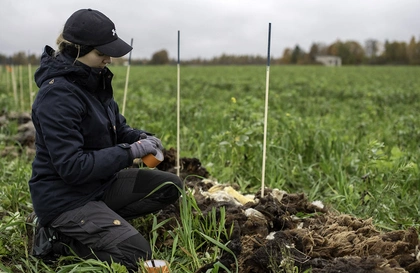
The University of Tartu is collaborating with farmers to enrich agricultural landscapes by planting diverse hedgerows. As part of the Climate Farm Demo project, OÜ Mäemõisa established the first trial, planting a 130-meter hedgerow with various trees and shrubs suitable for hedging, including buckthorn, viburnum, blackcurrant, gooseberry, hawthorn, hazel, and elm. Over the next few years, they plan to establish approximately 4 kilometers of hedgerows.
For the first trial, they focused mainly on native plants, some bearing edible fruits. In subsequent stages, they will create different types of hedgerows and tree lines—some designed for harvestable fruits, others to support biodiversity, and some for aesthetic appeal.
The planting area also includes experiments with different mulches and trunk protection methods. One key reason for establishing hedgerows was to create green corridors that connect forest masses separated by fields. The project also includes observations on planting tools and techniques, offering insights for both the farmers and other hedgerow enthusiasts.
Researchers recommend establishing both pruned and free-form hedgerows. The location choice should consider local conditions, expectations, and possibilities. Hedgerows with a mix of species, including natural ones from the surrounding area, are more likely to survive. It is advised to select species of different heights, with flowering and fruiting occurring at different times.
In areas where maintaining herbaceous vegetation is difficult, wider strips are recommended. Hedgerows and shrub strips are best established in early spring or autumn. Taller shrubs should be grouped toward the center, while smaller shrubs should be placed around them.
During the first few years, hedgerows require more care, including mulching. A 6-meter mown grass strip around the hedgerows is recommended, which can also be seeded with natural seed mixes to support biodiversity.
Summary for Practicioners in Native Language
Tartu Ülikool katsetab koos talunikega põllumajandusmaastike rikastamist liigirikaste hekkidega. Climate Farm Demo projektis osalev OÜ Mäemõisa rajas oma põllule esimese katsena 130-meetrise, mitmesugustest hekitaimedeks sobivatest puudest ja põõsastest koosneva heki (türnpuu, lodjapuu, magesõstar, mustsõstar, tikker, viirpuu, sarapuu, jalakas jmt). Järgnevatel aastatel on plaan rajada umbes 4 kilomeetrit erinevaid elurikkaid hekke. Esimese katseriba hekitaimede valikul sooviti lisada eelkõige kodumaiseid taimi, millest osad on ka söödavate viljadega. Järgmistes etappides luuakse eriilmelisi hekke/puuderibasid, milledest mõnede eesmärk on pakkuda ka saagiks sobivaid vilju, teised keskenduvad rohkem elurikkuse toetamisele ning mõnede puhul on oluline ka esteetiline mulje.
Hekitaimede istutusalal katsetati erinevaid multše ja tüvekaitsemeetodeid. Tootja üheks hekkide rajamise põhjuseks oli soov luua rohekoridore, mis ühendaksid metsamassiive, mida eraldavad mitmed põllud. Heki osas tehakse projektis tähelepanekuid erinevate istutusvahendite ning -protsessi kohta, mis omakorda võiks aidata järgmiste hekkide istutamise puhul nii tootjaid endid kui ka teisi hekihuvilisi. Teadlased soovitavad rajada nii pügamist vajavaid kui ka vabakujulisi hekke.
Asukoha valikul tuleks kindlasti arvestada kohalike olude, ootuste ja võimalustega. Mitmeliigilistel ja ümbruskonna looduslikest liikidest koosnevatel hekkidel on kahjustajaid vähem. Istutamiseks on hea valida erineva kõrgusega, aga ka erinevatel aegadel õitsevaid ja viljuvaid liike. Nutikas on rajada ka kohati laiemaid ribasid kohtadesse, kus on rohttaimestiku hooldus raskendatud. Hekid või põõsasribad rajatakse üldjuhul varakevadel või sügisel. Kõrgema kasvuga põõsad võiks paigutada väiksemate rühmadena põõsasriba keskele, väikesekasvulisemad suuremate rühmadena riba servadesse. Esimestel aastatel vajavad põõsasribad ja hekid rohkem hoolt, sh ka multšimist. Hekkide ja põõsasribade ümber peaks olema niidetav rohumaariba, millesse võib külvata looduslikke seemnesegusid.
Additional Information
The University of Tartu is testing the enrichment of agricultural landscapes with species-rich hedgerows as part of the “Loodusrikas Eesti” project.
The goal is to enhance biodiversity in agricultural landscapes while also improving the area’s visual appeal.
The 1,000-hectare Climate Farm Demo farm, OÜ Mäemõisa, is also involved in the project.
The producer established a 130-meter trial hedgerow with various trees and shrubs suitable for hedging, including viburnum, blackcurrant, gooseberry, buckthorn, hawthorn, hazel, elm, and others.
The area is carefully designed, and the plant selection is well thought out.
The hedgerow plant selection focused primarily on edible species, ensuring a future harvest, landscape diversification, and aesthetic value.
The planting area was covered with different mulches and trunk protection methods.
A key goal was to create green corridors connecting forest masses separated by fields.
The project also includes observations on planting tools and processes, providing insights for both producers and other hedgerow enthusiasts.
Scientists recommend that agricultural producers establish both pruned and free-form hedgerows and shrub strips.
Hedgerows with varying characteristics (low and high, sparse and dense, pruned and unpruned) provide habitats for various species.
When selecting a location, the suitability of the hedgerow or shrub strip to the landscape should be considered.
Since hedgerows are permanent structures, they should be placed as boundary fences where possible, ensuring they do not obstruct scenic views or water bodies.
If placed in the middle of fields, care must be taken not to hinder fieldwork.
Hedgerows should ideally be planted in a north-south direction to prevent shading crops.
If placed along field edges in an east-west direction, their height should be considered.
In some cases, shade may be beneficial, such as for livestock sun protection.
Hedgerows and shrub strips also act as erosion barriers when placed perpendicular to water flow and prevailing winds.
Drainage systems should also be considered.
When planting a hedgerow or shrub strip, it is recommended to use multispecies compositions, as they are more resistant to biological pests.
Native species from the surrounding area should be preferred, particularly deciduous shrubs and lower deciduous trees, interspersed with longer-lived trees.
Selecting species that flower and bear fruit at different times ensures food for pollinators and berries for birds.
For hedgerows along major roads, species should be resistant to environmental pollutants (e.
g.
, exhaust gases, dust).
Some species produce abundant root suckers, requiring annual mowing around them.
Shrub strips with different heights create denser and more visually appealing landscapes.
Their width can vary, allowing for expansion in areas where maintaining herbaceous vegetation is difficult.
The best time to plant hedgerows or shrub strips is early spring or autumn after leaves have fallen.
Autumn planting requires less maintenance due to higher soil moisture, whereas spring planting may require additional watering.
Planning a shrub strip begins with placing larger trees approximately 25 meters apart.
In multi-row hedgerows, taller and more light-demanding species should be planted in the center, while lower species should be positioned at the edges.
Grouping different plant species together prevents pest spread.
Taller shrubs should be placed in smaller groups, while shorter shrubs should be arranged in larger clusters.
Early Maintenance and Biodiversity Support In the first few years, newly planted shrub strips and hedgerows require extra care, such as mowing around seedlings, pruning shrubs, and replacing dead plants.
To prevent herbaceous plants from smothering hedgerow plants, the area under the hedgerow should be adequately mulched.
Spring pruning encourages the formation of lateral branches.
A mowable grass strip should surround hedgerows and shrub strips, with permanent vegetation that is not plowed, sown, or fertilized.
To enhance biodiversity, these grass strips can be sown with natural seed mixes, providing food for pollinators like flowering plants, legumes, and other species.