



Contact/s:
Christine Berger
christine.berger@idele.fr
Helping Future French “Bordeaux” Winegrowers to Invent the Agriculture of Tomorrow

France
Atlantic area
- Education
- Multi-actor capacity building
- Adaptation to climate change
Thematic Areas
Production System/s
Summary for Practicioners on the Main Finding(s)/Innovative solution(s)
Château Dillon, 40 ha in « AOC Haut Médoc – Crus Bourgeois Supérieur », is located North of Bordeaux and is one of the three Agro Campus Bordeaux Gironde wine farms. It is also one of the ‘Pilot Demo Farms’ in the Climate Farm Demo project.
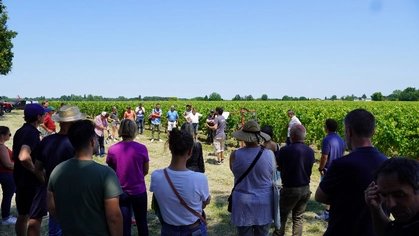
They strongly believe that knowledge exchange, capacity building and training should increasingly be based on peer-to-peer sharing and designed based on ‘working together’. The school’s motto — “collective intelligence, knowledge transfer and sharing” — guides students along a radically new path. They are working hard to maintain access to operational knowledge for those working in the field. And they rely on the strength of the collective and multi-stakeholder approach. They are strongly committed to transferring knowledge through numerous events in the field — very much aligned with Climate Farm Demo main objective!
Château Dillon is also involved in developing innovative teaching tools, such as simulators (for pruning, plot management, sprayer adjustment, etc.), ensuring that training is not dependent on the plant cycle and the seasons. Another of their major missions is to serve as a showcase site and a site for experimentation and innovation in the sector.
Therefore, in 2024, they created a 5-hectare experimental vineyard for assessing innovative practices that are both compatible with society’s expectations and economically viable. The primary aim is to create a reservoir of genetic diversity. This vineyard houses vine conservatories designed to safeguard the genetic diversity of grape varieties in the Nouvelle-Aquitaine region. The second objective is to test breakthrough scenarios. There is a long list of innovative techniques, including pruning, planting density, shading, soil conservation, robotisation, etc. And in the future, other parameters will be tested, such as energy and technical sobriety, diversification of production, agroforestry, reduction in the use of phytosanitary products, etc.
Summary for Practicioners in Native Language
Château Dillon, 40 ha en AOC Haut Médoc – Crus Bourgeois Supérieur, situé au nord de Bordeaux, est l’une des 3 fermes viticoles de l’Agro Campus Bordeaux Gironde. C’est également l’une des fermes pilotes du projet Climate Farm Demo.
Le lycée agricole est convaincu que la montée en compétences et la formation doivent de plus en plus être basés sur les échanges entre pairs et être conçus sur la base d’un « travail en commun ». Sa devise est : « intelligence collective, transfert et partage des connaissances », afin de guider les étudiants sur une voie radicalement nouvelle. Il s’efforce de maintenir l’accès aux connaissances opérationnelles pour les acteurs de terrain et s’appuie sur la force de l’approche collective et multipartite. Il est également fortement engagé dans le transfert de connaissances par le biais de nombreux événements sur le terrain. Cela correspond tout à fait à l’objectif principal de Climate Farm Demo !
Il participe également au développement d’outils pédagogiques innovants, tels que des simulateurs (pour la taille, la gestion des parcelles, le réglage des pulvérisateurs, etc.), afin que la formation ne soit pas dépendante du cycle de la plante et des saisons. Une autre de leurs grandes missions est d’être un site vitrine et un site d’expérimentation et d’innovation pour la filière. Ainsi, en 2024, ils ont créé un vignoble expérimental de 5 hectares pour évaluer des pratiques innovantes, compatibles avec les attentes de la société et économiquement viables. L’objectif premier est de créer une banque de biodiversité génétique des cépages. Le deuxième objectif est de tester des scénarios de rupture. La liste des techniques innovantes est longue : taille, densité de plantation, ombrage, conservation des sols, robotisation, etc. Et à l’avenir, d’autres paramètres seront testés, comme la sobriété énergétique et technique, la diversification des productions, l’agroforesterie, la réduction de l’utilisation des produits phytosanitaires, etc.