


Contact/s:
Karme Petrutis
karme.petrutis@metk.agri.ee
Impact of Minimized Tillage on Soil Properties, Biota, and Environmental Conditions

Estonia
Mixed Forest Sub-region of the Atlantic Continental region of the Temperate zone
- Lower carbon footprint
- More profitable production
- Longer/optimized sawing time
- Higher organic carbon in upper soil layers
- Increased microbiological activity
- More individuals and species of earthworms
Thematic Areas
Production System/s
Summary for Practicioners on the Main Finding(s)/Innovative solution(s)
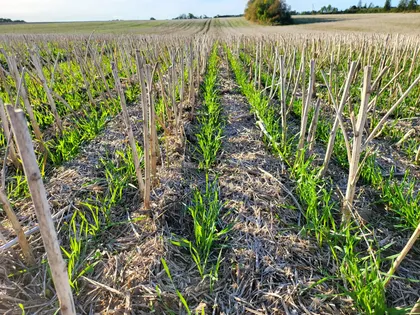
The organic carbon content is vertically stratified in direct cropping fields. In the upper 0-5 cm soil layers, its content is increased, in the lower layers decreased. In traditionally ploughed soils the crop content is more uniform. Soluble phosphorus and potassium are also vertically stratified in direct cropped fields. Such fields may acidify more rapidly and require liming. There were no major problems with excessive trampling of soils. Soil microbiological activity was higher in direct seeding fields. Earthworm abundance tended to be higher in ploughed fields, but the number of earthworm species tended to be higher in direct-sown fields. The use of plant protection products of direct-sowed fields was significantly higher compared to the ploughed fields. More pesticide residues were detected in the soil and mulch of direct broadcast fields than in plough-based fields.
The aim of direct sowing is to maximize soil protection, reduce emissions and create a larger window for optimal sowing at minimum cost to the producer. Direct sowing has been tested for example in winter wheat, peas, beans, barley, winter oilseed rape, catch crops and grasslands in Estonia. With direct sowing, the tractor hours and labour costs can be reduced. We can also save soil, increase soil carbon and significantly reduce CO2 emissions. Indeed, ploughing should only be used when it is absolutely necessary (e.g. after extensive land preparation).
Summary for Practicioners in Native Language
Orgaanilise süsiniku sisaldus on otsekülvipõldudel vertikaalselt kihistunud. Ülemises 0-5 cm mullakihis on selle sisaldus suurenenud, alumistes vähenenud. Traditsiooniliselt kündes on aga Crog sisaldus mullaprofiilis ühtlane. Liikuva fosfori ja kaaliumi sisaldus on samuti otsekülvipõldudel vertikaalselt kihistunud. Otsekülvi põllud võivad hapestuda kiiremini ning vajada lupjamist. Muldade liigse tallamisega suuri probleeme ei esinenud. Mulla mikrobioloogiline aktiivsus olid kõrgemad otsekülviga põldudel. Vihmausside arvukus oli pigem suurem künnipõhistel põldudel, kuid vihmausside liikide arv oli suurem pigem otsekülviga põldudel. Taimekaitsevahendeid kasutavad otsekülvi rakendajad oluliselt rohkem kui künnipõhise tehnoloogia kasutajad. Otsekülvi põldude mullas ja multšis tuvastati rohkem taimekaitsevahendite jääke kui künnipõhistel põldudel. Otsekülvi praktiseerimisel on tootja eesmärk kaitsta minimaalsete kuludega maksimaalselt mulda, vähendada heitmeid ja tekitada suurem ajaaken optimaalseks külviajaks. Otsekülvi on katsetatud talinisu, herne, oa, odra, talirapsi, vahekultuuride, aga ka rohumaade rajamisel. Otsekülviga saab ta vähendada traktorite töötunde ja tööjõukulu, säästa mulda, kasvatada süsiniku hulka mullas ja vähendada oluliselt CO2 heidet. Künda tuleks tõesti ainult siis, kui see on hädavajalik (nt peale ulatuslikke maaparandustöid).
Additional Information
A direct seeding survey conducted in 2022 on three fields in South Estonia found that organic carbon content in direct seeding fields is vertically stratified, with an increase in the upper 0–5 cm layer and a decrease in lower layers over the years.
In traditionally ploughed soils, however, organic carbon content remains uniform.
Soluble phosphorus and potassium concentrations are also vertically stratified in direct-cropped fields, while soil reaction and trace element content showed no significant differences between different technologies.
Some direct-drilled fields have become more acidic over time, requiring liming.
Soil trampling was found to be generally low, and no major problems were encountered with direct seeding.
Soil microbiological activity (biomass and respiration) was higher in direct-drilled fields.
Earthworm abundance tended to be higher in ploughed fields, but species diversity was greater in direct-sown fields.
In the 0–5 cm layer of direct-sown fields, earthworm abundance and species richness were higher compared to plough-based fields, particularly in comparison to the 5–10 cm layer.
However, herbicide use in direct-sown fields is significantly higher than in plough-based systems, as mechanical weed control is not possible with direct sowing.
More pesticide residues were found in the mulch of directsown fields than in the soil, mainly herbicide and fungicide residues.
Additionally, more residues were found in the soil of direct-sown fields compared to ploughed fields.
A demo-producer also experimented with strip-tillage and strip-tillage with liquid fertilizer application.
In direct drilling, the producer aims to maximize soil protection at minimum cost, reduce emissions, and create a larger window for optimal sowing.
The producer applies direct drilling for winter wheat, peas, beans, barley, and catch crops, as well as for winter oilseed rape and grassland establishment.
Row widths of 19 cm and 25 cm are used.
In direct sowing, even straw spreading across the field is crucial, and pretreatment of the soil surface may be necessary.
The producer emphasizes that direct drilling can reduce tractor hours and labor, conserve soil, increase soil carbon, and significantly lower CO₂ emissions.
He also stresses that ploughing should be the last resort when no other options are available.
Ploughing is generally used only after land melioration, when soil leveling is required.