


Contact/s:
Dr. Dimitar Vanev
dimitar.vanev@naas.government.bg
Rooftop Photovoltaics: Renewable Energy Without Taking Agricultural Land out of Production
Bulgaria
Bulgaria – Unconstrained zone

1. No loss of and competition for agricultural land – photovoltaic panels are installed on existing barn roofs rather than on fields or pastures thus agricultural land remains available for crops, forage and livestock production.
2. Renewable energy close to the point of consumption – electricity can be used directly for dairy and farm operations.
3. Reduced dependence on conventional energy sources and potential reduction of the farm’s energy-related carbon footprint.
Thematic Areas
Production System/s
Summary for Practicioners on the Main Finding(s)/Innovative solution(s)
Asenitza 96 Ltd., a Climate Farm Demo Pilot Demo Farm in Bulgaria, is a mixed dairy and crop farm with high energy demand. With 566.5 ha of utilised agricultural area, around 591 livestock units, and reported total energy consumption of approximately 18.26 million MJ, on-farm electricity production and reducing dependence on conventional energy are therefore important elements of this farm’s climate strategy.
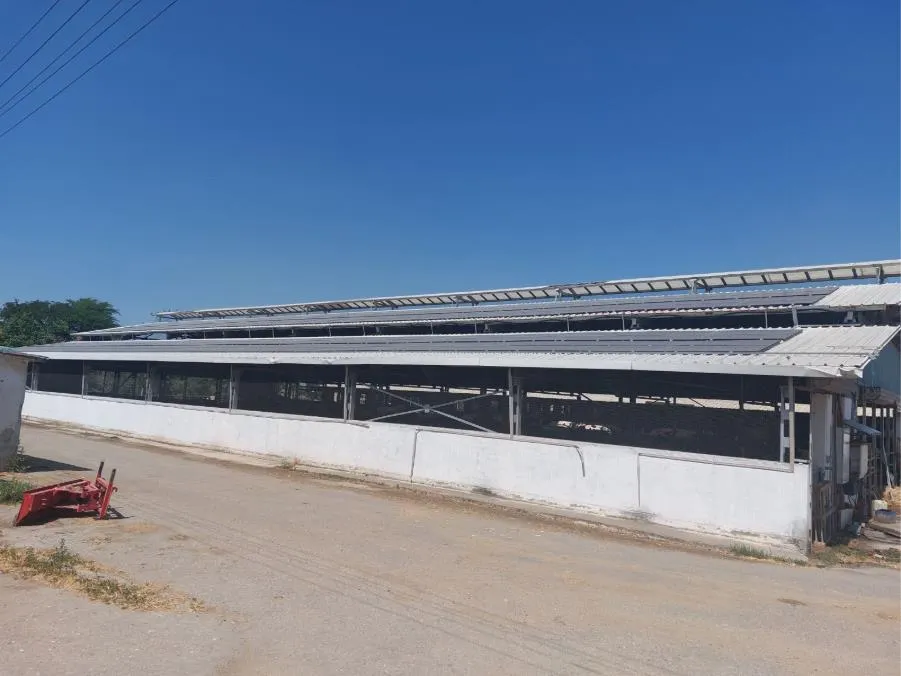
A key practice is the production of renewable electricity through photovoltaic panels installed on the roofs of the livestock barns. Using existing barn roofs allows the farm to generate solar energy without using pasture or productive agricultural land, which remains available for food and feed production.
The approach therefore avoids competition between renewable energy generation and agriculture while limiting additional pressure on agricultural soils and grasslands.
The electricity produced on the farm is used for farm operations including lighting, ventilation, cooling, milking equipment, water pumping and other electrical systems. Generating renewable energy close to the point of consumption reduces dependence on conventional electricity and improve energy efficiency.
The main value of this approach is therefore not only the use of solar energy, but the choice to place the photovoltaic system on existing livestock-barn roofs rather than on agricultural land. This provides renewable energy while preserving productive land and pasture for farming, making the approach particularly relevant for other livestock farms seeking to combine climate action with efficient land use. The approach is particularly suitable for livestock farms with large existing roof surfaces and high on-farm electricity demand.
Summary for Practicioners in Native Language
Ферма „Асеница 96“ (пилотно по проект Climate Farm Demo демонстрационно стопанство) е модернизирано смесено стопанство за млечно говедовъдство и растениевъдство с високо потребление на енергия. Предвид използваната земеделска площ от 566,5 ха, наличието на около 591 животински единици и отчетеното общо потребление на енергия от приблизително 18,26 милиона MJ, производството на електроенергия в стопанството и намаляването на зависимостта от конвенционални енергийни източници са важни елементи от стратегията на стопанството по отношение на климата.
Ключова практика е производството на възобновяема електроенергия чрез фотоволтаични панели, разположени върху покривите на оборите. Използването на съществуващите покривни площи е особено важно, тъй като не се заемат пасища или продуктивни земеделски земи. По този начин се избягва конкуренцията между производството на храна и производство на енергия и същевременно се ограничава допълнителния натиск върху земеделските почви и пасищата
Електроенергията, произведена на място се използва за нуждите на фермата – осветление, вентилация, охлаждане, доилно оборудване, помпи и други електрически системи. Производството на енергия близо до мястото на потребление намаля зависимостта от конвенционална електроенергия и подобрява енергийната ефективност.
Основната стойност на този подход се състои не само в използването на слънчева енергия, но и в избора фотоволтаичната система да се разположи върху съществуващи покриви на обори, вместо върху земеделски земи. Това осигурява възобновяема енергия, като същевременно запазва продуктивните земи и пасищата за земеделски нужди, което прави подхода особено подходящ за други животновъдни стопанства, стремящи се да съчетаят действията за опазване на климата с ефективното използване на земята. Подходът е особено удачен за животновъдни
ферми, разполагащи с големи съществуващи покривни площи и високи нужди от електроенергия в рамките на стопанството.
Additional Information
Producing electricity on-farm, reducing electricity consumption and lowering fuel use are important action levers for Asenitza 96. The farm owners are open to innovations aimed at optimising production and adapting to climate change. In 2025, a project was developed for a new barn for 324 animals, equipped with six milking robots. The main objectives of the investment are to improve feeding precision, provide climate control within the barn and optimise milk yield. The rooftop photovoltaic solution is part of a broader climate strategy. The farm has a 90% soil cover rate, a significant share of grassland, and identified opportunities for improved nitrogen management and carbon storage. The CAP’2ER® assessment estimates carbon storage of approximately 270 tonnes CO2 equivalent. For future development, the farm will monitor renewable electricity production, the share of farm electricity demand covered by photovoltaics, changes in purchased electricity consumption, and the resulting energy and climate performance. The rooftop approach can serve as a practical example for other livestock farms with suitable existing buildings. An important advantage of rooftop photovoltaic production is that no additional productive agricultural land or pasture needs to be converted to energy production. Facilitating elements include the availability of large existing barn-roof surfaces, the high energy demand of dairy operations and the opportunity to produce electricity close to where it is consumed.
Additional Dissemination and Communication Materal(s)
Climate Farm Demo – Calendar of Demo Events