



Contact/s:
Rocco Lioy
rocco.lioy@convis.lu
The Challenge of Reducing Both Ammonia and Nitrous Oxide Emissions

Luxembourg
Luxembourg, temperate climate
1. Nitrogen Emission Mitigation
2. Working Procedures
3. Effective Measures"
Thematic Areas
Production System/s
Summary for Practicioners on the Main Finding(s)/Innovative solution(s)
The following text summarizes the key findings from a thematic event held in February 2026 at the intersection of the Climate Farm Demo and Climate Smart Advisors projects. The event covered the topics of “Herd Management” and “Storage and Spreading of Manure.”
Many measures to reduce ammonia emissions lead to increased nitrous oxide emissions, and vice versa. To avoid having to resort to costly reduction techniques at a later stage, reducing excess nitrogen entering the farm system should be considered first. There are several ways of achieving this.
An important lever in the areas of feeding and herd management is adjusting crude protein intake to the animals’ actual requirements. Cutting nitrogen at the source avoids this problem entirely. Feeding animals closer to their actual protein needs lowers emissions without the trade-off risk, and it doesn’t require expensive equipment.
Increasing productivity, on the other hand, does not reliably reduce ammonia and nitrous oxide emissions. The same applies to slurry storage: covering the slurry tank reduces NH₃ but may actually increase N₂O emissions. The same is true of the immediate separation of urine and regular cleaning. Other measures, such as solid–liquid separation and slurry fermentation, have only a minor effect on emissions.
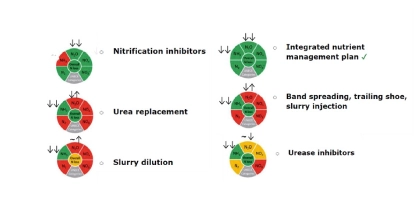
When applying fertilizer to a field, fertilizer planning offers advantages over other tools or techniques. For example, application techniques, urea substitution, nitrification inhibitors, and other methods are either ineffective or reduce emissions of only one of the two nitrogen gases, while emissions of the other increase.
The exact scale of ammonia and nitrous oxide savings or emissions resulting from the various measures to reduce emissions has not yet been reliably determined. It is therefore difficult to say which is the best method for retroactive reduction. What is certain, however, is that reducing the input of nitrogen into the system is the most effective way to cut emissions.
Summary for Practicioners in Native Language
Der folgende Text fasst die wesentlichen Erkenntnisse zusammen, die im Rahmen eines Thematic Event an der Schnittstelle der Projekte Climate Farm Demo und Climate Smart Advisors im Februar 2026 stattgefunden hat. Das Event deckt die thematischen Felder “Herd Management” sowie Storage and Spreading of manure”.
Viele Maßnahmen zur Reduzierung der Ammoniak-Emissionen fördern die Emission von Lachgas, und viceversa. Um späte kostspielige Reduzierungstechniken zu vermeiden, sollten vor allem die Stickstoffeinbringungen gedrosselt werden. Dazu existieren mehrere Möglichkeiten.
Ein wichtiger Hebel im Bereich der Fütterung und des Herdenmanagements ist die Anpassung der Rohproteinaufnahme an den tatsächlichen Bedarf der Tiere. Die Erhöhung der Produktivität hingegen reduziert nicht zuverlässig die Emissionen beider Stickstoffgase. Dasselbe gilt für die Güllelagerung: Eine Abdeckung des Gülletanks reduziert NH3, kann N2O-Emissionen jedoch sogar erhöhen. Gleiches gilt für die sofortige Abtrennung des Urins und die reguläre Reinigung. Andere Maßnahmen wie die Fest-/Flüssig-Separierung und die Güllevergärung wirken sich nur schwach auf die Emissionen aus.
Bei der Ausbringung von Dünger auf das Feld zeigt die Düngeplanung Vorteile gegenüber anderen Tools bzw. Techniken. So sind zum Beispiel Ausbringungstechnik, Harnstoffsubstitution, Nitrifikationshemmer, u.a. entweder wirkungslos oder senken nur die Emission eines der beiden Stickstoffgase, während die des anderen steigt.
In welcher Größenordnung Ammoniak und Lachgas bei den einzelnen Maßnahmen zur Reduktion der Emissionen eingespart oder freigesetzt werden, ist noch nicht zuverlässig bestimmt. Es ist daher schwierig zu sagen, was nun die beste Methode zur nachträglichen Reduktion ist. Sicher ist jedoch, dass eine Drosselung der Einbringung von Stickstoff in das System die effektivste Methode ist, um Emissionen zu verringern.