



Contact/s:
Federico Dragoni
eranet@atb-potsdam.de
Sebastian Voß
svoss@atb-potsdam.de
From Climate-smart Technologies to Better Farm Decisions: Lessons from the InnoHof® Living Lab
Germany
Germany, Continental climate

1. Improved farm decision-making
2. More efficient resource use
3. Better targeted investments
Thematic Areas
Production System/s
Summary for Practicioners on the Main Finding(s)/Innovative solution(s)
Livestock farms face pressure to improve nutrient use, reduce emissions and increase sustainability. Many climate-smart technologies are available, but farmers often face difficulties assessing their practical relevance.
As German Living Lab of the Climate Farm Demo project, the Leibniz Innovation Farm (InnoHof®) co-develops solutions for mixed farming, where crop production, livestock, renewable energy, nutrient flows, digital technologies and data-driven decision support are connected.
A key lesson from stakeholder meetings and demonstrations within German Living Lab is that technology adoption depends not only on performance, but also on how well tools fit existing workflows. The usefulness of digital tools decreases when interoperability between software and machinery is lacking, and data cannot easily lead to management decisions.
In precision nutrient management, the Living Lab explored how remote sensing and farm data can support site-specific nitrogen management with DigiMix-PA project. The objective is not simply to produce variable-rate application maps, but to support farmers in deciding whether site-specific fertilisation provides advantages over conventional approaches.
The InnoHof LL demonstrates that climate-smart technologies are most useful when they support better decisions rather than generating more data. Combining digital data with local knowledge and field experience can enable farmers to apply input more efficiently while reducing costs and impacts.
Summary for Practicioners in Native Language
Tierhaltungsbetriebe stehen zunehmend unter Druck, Nährstoffe effizienter zu nutzen, Emissionen zu senken und nachhaltiger zu wirtschaften. Viele klimaschonende Technologien sind verfügbar, doch ihre praktische Relevanz und ihr Nutzen im Betrieb sind oft schwer einzuschätzen.
Das Living Lab des Leibniz-Innovationshofs (InnoHof®) entwickelt mit Landwirten, landwirtschaftlichen Beratern, Forschungseinrichtungen und Technologieanbietern Lösungen für einen Gemischtbetrieb, in dem Pflanzenbau, Tierhaltung, Nährstoffflüsse, digitale Technologien und datenbasierte Entscheidungsunterstützung als Teile eines Gesamtsystems betrachtet werden.
Additional Information
Facilitating elements
Living Lab demonstrations under real farm conditions.
Exchange between farmers, advisors, researchers and technology providers.
Availability of farm data collected over multiple years.
Digital tools that integrate different data sources into practical decision support.
Main obstacles
Investment costs for precision farming technologies.
Time needed to learn new workflows and data processing.
Limited interoperability between software, machinery and digital platforms.
Farm-specific variability, requiring local validation before implementation.
Future needs
Continue involving farmers in co-designing and validating digital decision-support approaches.
Evaluate the long-term stability of management zones across years and crops.
Further integrate agronomic, environmental and economic information into decision-support tools and test them with stakeholders.
Improve interoperability between digital technologies and farm management systems.
Message to end-users
Site-specific management is not about applying more technology, but about making better decisions. Start with a clearly identified management objective, validate digital recommendations with field observations, and introduce new approaches gradually under your own farm conditions.
Additional Dissemination and Communication Materal(s)
Photos
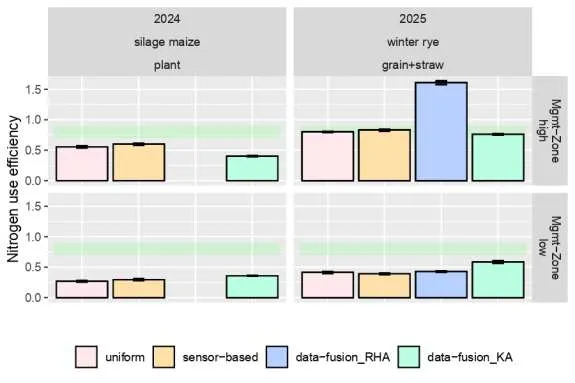
zones under different fertilization strategies. NUE was generally low in the
low-yield zone, with the highest efficiency under the King’s approach, which applies less fertilizer in zones with low yield potential. In the high-yield zone, the Robin Hood approach resulted in NUE >100%, indicating depletion of soil N reserves. Overall, reducing N inputs in low-yield zones while maintaining standard fertilization in high-yield zones appears most favorable, for the field and time under investigation. The greenish horizontal bar indicates the ideal nitrogen use efficiency range of 70–90%.