


Contact/s:
Delphine Breton
delphine.breton@pl.chambagri.fr
The Pays de la Loire “Low-Carbon Pathway”: Studying the Carbon Footprint and the Production’s Costs Simultaneously

France
Atlantic Area
- Competitiveness
- Carbon sequestration
- Global approach
Thematic Areas
Production System/s
Summary for Practicioners on the Main Finding(s)/Innovative solution(s)
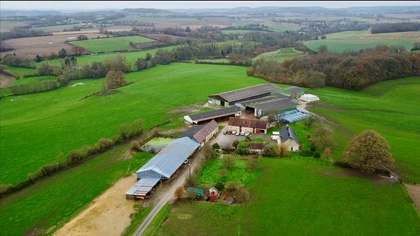
During the DEMO organised in 2024 at Florent’s, one of the ‘Pilot Demo Farmers’ involved in the Climate Farm Demo project and supported by the Chamber of Agriculture, we experienced the benefits of combining the environment (CAP2ER®) and the economy (COUPROD®). This breeder of Limousin cows is an ‘animal farmer’ at heart, but that doesn’t prevent him from paying close attention to his environmental and economic performance! The CAP’2ER® audit enabled Florent to rationalise his crop rotation and refine his mechanisation strategy. As a result, he has reduced his stocking rate by increasing the amount of permanent grassland and has reduced his mineral nitrogen inputs by 25% in 5 years. His aim is to develop his protein autonomy through wet harvesting, to continue growing legumes (clover) and cover crops (fodder rye), and to increase the grazing period. Thanks to the genetic management of the herd, Florent can sort his animals quickly and adjust the mating schedule. COUPROD® has enabled him to improve the productivity of his livestock units. He aims at reaching an age at 1st calving of 30 months, to reduce the number of livestock units (LU) per calving to less than 1.6 and to maintain the Calving-Calving Interval at 365-370 days. Finally, Florent has invested in decarbonising energy on his farm, by equipping the roof of a storage building with photovoltaic panels, enabling him to be self-sufficient in electricity for the farm and the home (saving €1,000 a year on the electricity bill) and selling 145,000 kWh under contract per year (933 tonnes of CO2 emissions avoided over 25 years).
This combined approach (CAP’2ER® + COUPROD®) has enabled Florent to achieve a number of important objectives: 1/ a carbon footprint that is better than the average for comparable farms; 2/ an improvement in the productivity of livestock (+34kg/livestock unit in 4 years); 3/ the introduction of a more extensive grazing and grassland system; 4/ self-sufficiency in electricity thanks to the photovoltaic panels.
Summary for Practicioners in Native Language
Lors de la DEMO organisée fin 2024 chez Florent, l’un des « Pilot Demo Farmer », engagé dans Climate Farm Demo et accompagné par la Chambre d’Agriculture, nous avons pu mesurer l’intérêt de coupler environnement (CAP2ER®) et économie (COUPROD®). Cet éleveur sélectionneur de vaches Limousines est un animalier dans l’âme, ce qui ne l’empêche pas de porter une attention fine et attentive à ses performances environnementales et économiques ! Le CAP’2ER® a permis à Florent de réduire son chargement, en augmentant les surfaces à pâturer de prairies permanentes et a réduit de 25% ses apports en azote minéral en 5 ans. Son objectif est de développer l’autonomie protéique par un mode de récolte humide, de continuer la culture de légumineuses (trèfle) et de dérobées (seigle fourrager) ; enfin d’augmenter la durée de pâturage. Grâce au pilotage génétique du troupeau, Florent est réactif pour trier ses animaux et ajuster le planning d’accouplement. Le COUPROD® lui a permis d’améliorer la productivité des unités de gros bétail (UGB). Son objectif est d’arriver à un âge au 1er vêlage de 30 mois, de réduire le nombre d’UGB par vêlage à moins de 1,6 et de maintenir l’Intervalle Vêlage-Vêlage à 365-370 jours. Enfin, Florent a investi dans la décarbonation de l’énergie sur son exploitation. Il a équipé la toiture d’un bâtiment de stockage de panneaux photovoltaïques lui permettant d’atteindre l’autonomie en électricité sur l’exploitation et l’habitation (économies de 1 000 €/an sur la facture d’électricité) et réalisant des ventes de 145 000 kWh sous contrat/an. Cela correspond à 933 tonnes d’émissions de CO2 évitées sur 25 ans.
Cette démarche combinée (CAP’2ER® + COUPROD®) lui a permis d’atteindre plusieurs objectifs importants : 1/ une empreinte carbone meilleure que la moyenne des élevages comparables ; 2/ une amélioration de la productivité des UGB (+34kg/UGB en 4 ans) ; 3/ la mise en place d’un système pâturant plus extensif et herbager : 4/ une autonomie électrique avec les panneaux photovoltaïques. SUMMARY FOR PRACTICIONERS ON TH
Additional Information
Launched in 2020 by the Pays de la Loire Region, the ‘low-carbon pathway’ enables cattle farmers to evaluate and improve their environmental and economic performance simultaneously. By combining a CAP2ER®
diagnosis with a COUPROD® assessment, farmers have a very precise overall view of their potential room for manoeuvre! The Climate Farm Demo project is helping to create synergies at local level by focusing on on-farm demonstrations and boosting the spread of these good environmental AND economic practices to a wider audience.
Beyond the concrete case of Florent, our Pilot Demo Farmer, the feedback from farmers is very positive!
“Thanks to the CAP’2ER® environmental assessment, I’ve come to realise that we farmers are not as destructive of the environment as people would have us believe! On the contrary, my grassland system allows me to store carbon thanks to my pastures and my hedgerows, and to maintain
biodiversity while feeding the population! What’s more, on low-potential soils, cows help to preserve grassland. By carrying out the COUPROD® economic analysis at the same time, I was able to better understand the production costs and the cost price of my kg of meat. Before, I was producing without knowing this, and that’s a shame, because it helps you to understand what’s going well and what’s not, and to be able to improve.
For example, I realised that I had a lot of unproductive animals, which reduced my technical and economic efficiency. Now I’m trying to improve that by getting rid of empty cows or problem cows quickly. I’m also trying to wean my males earlier.” Says Jacky, a 58-year-old farmer.
“I carried out this ‘low carbon course’ as part of a progress group of beef farmers. What I liked most was the trust between us and the transparency of the figures. This enabled us to learn from each other’s different points of view. We were able to compare our performances. With CAP’2ER® I was able to see my impact on the environment more clearly, thanks to concrete figures. I learned, for example, that my grasslands and hedgerows compensate for 44% of my carbon emissions, which significantly reduces my carbon footprint, especially in an extensive system like mine. We need to stop denigrating beef cattle production, which is one of the few to compensate for a large proportion of its emissions. The analysis of production costs enabled me to point out my weak points, such as the age at first calving or the excessive number of cows compared with the number of calves. I’ve been able to see that one of my strong points is the production of live meat per LU, and that I’ve got my production costs under control. I try to have a moderate investment policy that’s adapted to the farm. These elements are a real advantage when it comes to understanding your system and your practices and help you to improve. Data is a good tool for communicating”. Reports Jean-Marc, a 41-year-old farmer.