



Contact/s:
Catalin Dragomir
catalin.dragomir@ibna.ro
Optimisation of Crude Protein Intake in Sheep – a measure ensuring both increased efficiency as well as the reduction of the GHG emission of the milk production

Romania
Continental Temperate Zone
- Increase the feeding efficiency
- Increase the overall farm profitability
- Reduce the carbon footprint / kg of milk
Thematic Areas
Production System/s
Summary for Practicioners on the Main Finding(s)/Innovative solution(s)
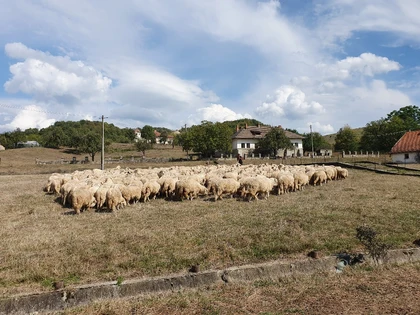
The objective of implementing this measure was, among other things, to demonstrate that reducing the carbon footprint of milk production can also be achieved without affecting the profitability of sheep farms, especially within less intensive sheep milk production systems. Within these systems, particularly where the livestock load per hectare is low, farmers often do not focus on ration optimization, especially in ensuring the dietary protein supply needed to support high milk yields or to reach the potential milk production of the animals.
Frequently, in such systems, milk production is less than 100 kg/head/lactation, although the genetic potential of sheep may exceed 120 kg (while the animals are still undergoing genetic improvement).
In this context, one of the implemented measures consists of aligning the protein intake of consumed diets with the nutritional requirements of the animals throughout the year, by providing complementary concentrated feeds. There are several such periods when the nutritional value of pastures is dramatically reduced or when sheep require higher nutritional intake (e.g., peak lactation or preparation for mating).
This measure can be implemented at several levels — from simply following basic nutritional recommendations (e.g., feeding a one-size-fits-all compound feed specific to sheep at certain times of the year), to checking the diets using ruminant feeding tables, and even up to applying precision feeding.
The advantage of the method lies in the fact that, for lactating animals, the effects are quickly noticeable, typically through increased daily milk production. On the other hand, the additional costs related to complementary feeding are offset by the increased income from the higher milk yields.
The main beneficiaries are farmers, but also nutrition consultants, feed producers, and others involved in livestock nutrition and management.
Summary for Practicioners in Native Language
Obiectivul implementării acestei măsuri a fost, printre altele, de a demonstra că reducerea amprentei de carbon a producției de lapte poate fi obținută și fără a afecta profitabilitatea fermelor de ovine, mai ales în cadrul unor sisteme de producție a laptelui de ovine mai puțin intensive. În cadrul acestor sisteme de producție, mai ales în cazurile în care încărcătura de animale / hectar este redusă, fermierii nu acordă atenție optimizării rațiilor, în particular atingerii necesarului de proteină care să susțină producții ridicate de lapte / atingerii potențialului productiv al animalelor. În mod frecvent, în astfel de sisteme, producția de lapte este mai mică de 100 kg / cap / lactație, deși potențialul productiv al animalelor poate depăși 120 kg (populațiile respective fiind încă în curs de ameliorare genetică).
În acest context, una dintre măsurile implementate constă în alinierea aportului de proteină al rațiilor consumate la cerințele nutriționale ale animalelor, pe toată perioada anului, prin asigurarea de nutrețuri concentrate complementare. Există câteva astfel de perioade, când valoarea nutritivă a pajiștilor scade foarte mult sau când animalele necesită aporturi nutriționale mai ridicate (ex. vârful de lactație / pregătirea pentru montă).
Această măsură poate avea mai multe niveluri de implementare – de la simpla urmare a unor recomandări nutriționale (de a administra, în anumite perioade din an, un nutreț combinat generic specific ovinelor), la verificarea rațiilor consultând tabelele de valori nutritive pentru rumeg[toare, mergând până la aplicarea nutriției de precizie. Avantajul constă în faptul că în cazul animalelor în lactație efectele se văd destul de rapid în creșterea producției zilnice de lapte. Pe de altă parte, costurile suplimentare (cu furajarea complementară) sunt acoperite de veniturile obținute de pe urma creșterii producției de lapte.
Principalii beneficiari sunt fermierii, dar și consultanții în nutriție, producătorii de furaje, etc.