



Contact/s:
Kelli Talving
kelli.talving@metk.agri.ee
Pastured Poultry: Portion Herding for Laying Hens

Estonia
Mixed Forest Sub-region of the Atlantic Continental region of the Temperate zone
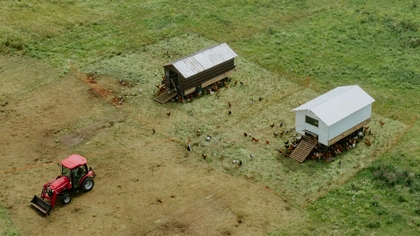
- Animal Welfare: Portion herding supports hens' ethological needs, enhancing well-being.
- Farmer Benefits: Low-cost entry into agriculture, no need for expensive aviary infrastructure or large arable land, improves grassland quality.
- Consumer Advantage: Pastured poultry eggs offer higher nutritional value than conventional eggs.
Thematic Areas
Production System/s
Summary for Practicioners on the Main Finding(s)/Innovative solution(s)
Pastured poultry is an alternative method of keeping chickens. In regenerative agriculture, this term refers to chicken portion grazing. Depending on the size of the chickens’ running area, they stay in one place for 2–3 days. During this time, they eat the youngest parts of plants, fertilize, and aerate the soil by scratching.
Chicken portion grazing mimics how animals move in nature. They eat the best and youngest parts of plants, contribute fertilizer through manure, and slightly mix and loosen the soil. This method is highly effective in improving grassland health. After just one or two grazing sessions, vegetation becomes noticeably lusher.
Since the chickens remain in one place for only a few days, they constantly have clean ground and fresh green feed. They can consume nutrient-rich plants, insects, and small stones necessary for digestion. Sunlight and daylight strengthen their immune system. Being naturally curious and sharp birds, they can live as natural a life as possible on the pasture.
In winter, the chickens stay in a large, unheated greenhouse. Chickens are more sensitive to wetness and wind than to low temperatures, and the greenhouse provides excellent protection. Deep bedding helps keep their feet warm.
A short digestive tract ensures that much of the chickens’ valuable food and good living conditions contribute to the quality of their eggs. Thanks to their diet of grass and insects, pasture-raised chickens’ eggs contain significantly more vitamins and minerals.
Summary for Practicioners in Native Language
Rohumaal kanade karjatamine on alternatiivne pidamisviis, taastavas põllumajanduses peetakse selle termini all silmas kanade portsjonkarjatamist. Olenevalt kanade jooksuala suurusest on nad ühe koha peal 2-3 päeva. Selle ajaga nad söövad ära taimede kõige nooremad otsad, väetavad natukene ning õhutavad siblimisega mulda. Tegemist on väga efektiivse rohumaid tervistava meetodiga. Juba ühe-kahe karjatamise järel on taimestik märgatavalt lopsakam kui enne.
Kuna kanad on ühe koha peal kõigest paar päeva, on neil pidevalt puhas jalgealune ja värske roheline ninaesine. Nad saavad süüa toitaineterohkeid taimi, putukaid ja kanadele seedimiseks vajalikke pisikesi kive. Päike ja päevavalgus annab oma panuse immuunsüsteemile. Oma olemuselt väga uudishimulikud ja terased linnud saavad rohumaal elada nii liigiomast elu kui vähegi võimalik.
Talvisel ajal on kanad suures kütteta kasvuhoones. Kanad ei karda niivõrd madalaid temperatuure kui niiskust ja tuult, mille eest kasvuhoone neid ideaalselt kaitseb. Sügavallapanu annab oma panuse sooja jalgealuse hoidmisel.
Lühike seedetrakt tagab selle, et palju kanade väärtuslikust söögist ja heast elust jõuab ka muna sisse. Tänu rohu ja putukate söömisele on rohumaakanade munades oluliselt rohkem vitamiine ja mineraale.
Additional Information
Pastured poultry has established itself in America and some parts of Europe.
Due to the nutrient-rich eggs, improvement of pasture health, and various other reasons, they could become much more common in Estonia as well.
At Ahisilla farm, pastured hens have been present for three seasons. In the first year, the farm tested the system with 150 laying hens. In 2023, they increased the number of chickens to 800, and by 2024, Ahisilla farm’s pastures were home to 1,400 chickens.
The chickens live in mobile coops during the grazing period. According to regulations, this is considered an alternative housing method, and in regenerative agriculture, this term refers to the rotational grazing of chickens.
Depending on the size of their run, they stay in one place for 2–3 days. During this time, they eat the youngest parts of the plants, fertilize a bit, and aerate the soil with their scratching. This is especially important for our farm’s natural pastures, as there is a thick layer of moss under the plants that the chickens effectively remove by scratching.
Rotational grazing of chickens mimics how animals move in nature.
Chickens eat the best parts of the plants in one spot, contribute fertilizer, and mix and loosen the soil. After just one or two grazing periods, the vegetation becomes noticeably lusher.
Since the chickens remain in one place for only a few days, they always have clean ground under their feet and fresh greens to peck at. They consume nutrient-rich plants, insects, and small stones necessary for digestion.
Sunlight and daylight strengthen their immune system. Being naturally curious and sharp-witted birds, they can live as species-appropriate a life as possible on the pasture.
During winter, the chickens are housed in a large, unheated greenhouse.
They are not as sensitive to low temperatures as they are to wetness and wind, which the greenhouse protects them from perfectly. Deep bedding helps keep their toes warm in winter.
Their short digestive tract ensures that much of their valuable food and good living conditions transfer into the eggs. Thanks to eating grass and insects, free-range chickens’ eggs contain significantly more vitamins and minerals.
According to a study by Pennsylvania State University (USA), compared to conventional farm birds’ eggs, free-range chickens’ eggs contain 39% more vitamin A and twice as much vitamin E. Additionally, they have nearly three times more Omega-3 fatty acids and nearly seven times more betacarotene.
Since the chickens spend all day in the sun, their eggs also contain a large amount of vitamin D. A study conducted by Martin Luther University of Halle-Wittenberg found that pasture-raised chickens’ eggs contain an average of 14.3 micrograms of vitamin D3 per 100g, whereas indoor chickens’ eggs contained only 3.8 micrograms per 100g.
There is also a significant difference in folic acid between free-range and conventional eggs. Mother Earth News magazine conducted a study
comparing conventional eggs in the USA with free-range eggs from 12 different producers, finding that free-range eggs contained 1,038 micrograms of folic acid—21 times more than conventional eggs.
The economic aspect of grazing chickens should not be overlooked.
Acquiring farmland in Estonia is challenging due to high prices and land consolidation by large producers. Additionally, land-use regulations impose strict limitations on how land can be utilized. Grazing chickens provide an affordable entry into the agricultural sector with low investments and fixed costs. A bonus is that permanent grasslands can be used, and large land areas are not required.
At Ahisilla farm, free-range chickens are part of the farm’s local circular economy. In addition to chickens, they grow vegetables and cut flowers, ensuring nothing goes to waste. Chickens act as excellent composters of plant residues—everything leftover from vegetables either goes into an egg or returns to the soil as chicken manure.