



Contact/s:
Zlatko Tomljanović
zlatko.tomljanovic@mps.hr
How to Reduce the Carbon Footprint in Arable Crop Production?

Croatia
Continental and Mediterranean
- Decrease GHG emission in arable production
- Cover crop sowing methods
- Positive effect of introducing legumes into the crop rotation
Thematic Areas
Production System/s
Summary for Practicioners on the Main Finding(s)/Innovative solution(s)
We have been witnessing climate change, and its impact on agriculture is enormous. Agriculture is one of the most vulnerable sectors affected by climate change. Therefore, several agricultural producers who are aware of this impact, as well as the need to adapt their production and implement climate-smart practices on their farms, have joined the Climate Farm Demo project.
It is important to present to farmers engaged in arable production the structure of sowing on farms, the method of tillage, and whether, and which, cover crops are sown (winter or spring). As integral stakeholders of the ecosystem, seed producers and distributors—with their offer of leguminous seeds and mixtures of seeds from different botanical species for various purposes—must be included in efforts to adapt agriculture to climate change.
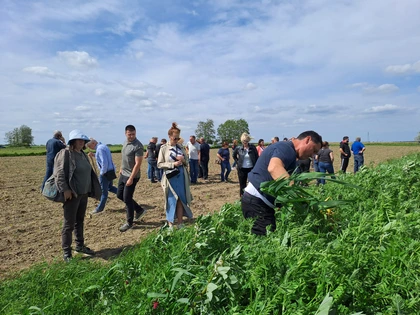
It is also very important to show farmers different types of winter cover crops, such as mixtures of winter vetch, winter broad beans, black beans, and broad bean crops intended for processing. Demonstrating the nodules on the roots of legumes and emphasizing the positive effects of introducing legumes into crop rotation is essential.
However, it is important to emphasize that sowing cover crops involves several soil maintenance measures that include the presence of vegetation on the land, with the aim of maintaining or increasing soil organic matter content, improving the physical properties of the soil (soil structure, water-air relations), accumulating nitrogen in the soil through legume cultivation, enhancing soil microbiological activity, and controlling weeds through biological methods—in general, increasing soil fertility.
Additionally, cover crops serve the important function of “soil cover” with the intention of preventing erosion (by water and/or wind) and nutrient leaching, primarily nitrates, thereby helping to prevent groundwater pollution.
Summary for Practicioners in Native Language
Svjedoci smo klimatskih promjena, a utjecaj klime na poljoprivredu je ogroman. Poljoprivreda je jedan od najranjivijih sektora na koje utječu klimatske promjene. Stoga su se poljoprivredni proizvođači koji su svjesni utjecaja klimatskih promjena na poljoprivrednu proizvodnju, ali i potrebe da svoju poljoprivrednu proizvodnju prilagode te implementiraju klimatski pametne prakse na svom gospodarstvu, uključili u CFD projekt. Stoga je bitno poljoprivrednicima koji se bave ratarskom proizvodnjom predstaviti strukturu sjetve na gospodarstvima, način obrade tla te siju li pokrovne usjeve i koje (ozime ili jare). Kao sastavni dionici AKIS-a, u prilagodbu na klimatske promjene u ratarstvu moraju se uključiti i proizvođači i distributeri sjemena sa svojom ponudom sjemena mahunarki, ali i smjesa sjemena različitih botaničkih vrsta za različite namjene. Također, vrlo je bitno ratarima tijekom obilaska parcela prikazati različite tipove ozimog pokrovnog usjeva poput smjese ozime grahorice, ozimog boba i inkarnatke te usjeva boba namijenjenog preradi. Svakako treba prikazati nodule na korijenu mahunarki i istaknuti pozitivan učinak uvođenja mahunarki u plodored. Međutim, bitno je naglasiti da sjetva pokrovnih usjeva podrazumijeva više različitih mjera održavanja tla uz prisutnost vegetacije na zemljištu, a s namjerom održanja ili povećanja sadržaja organske tvari tla, poboljšanja fizikalnih svojstava tla (struktura tla, vodozračni odnosi u tlu), akumulacije dušika u tlu uzgojem mahunarki (leguminoza), poboljšanja mikrobiološke aktivnosti tla, suzbijanja korova biološkim mjerama, odnosno, općenito – podizanja plodnosti tla. Pri tome pokrovni usjevi imaju dodatnu funkciju “pokrivača tla” s namjerom sprječavanja erozije (vodom i/ili vjetrom) i ispiranja hranjiva, prije svega nitrata, a time i sprječavanja onečišćenja podzemnih voda.
Additional Information
For the past ten or more years, we have witnessed climate change causing significant disruptions in everyday social activities. Unfortunately, alongside energy and transport as the main sources of greenhouse gas (GHG) emissions, agriculture and forestry are considered the third largest sources of GHGs in most countries.
The Republic of Croatia does not belong to the group of leading European GHG emitters, but we certainly cannot—and do not want to—remain isolated in the long-term effort to achieve zero emissions by 2050. The numerical indicators and forecast models related to climate change, which are circulating within the scientific and professional communities, are concerning in many respects. They call for serious and urgent changes in our way of thinking, living, eating, transporting, supplying energy, managing waste, and making interventions in agriculture and forestry.
The agricultural sector, in particular, will face major challenges in adapting to and mitigating climate change. In this effort to reduce carbon emissions, the agricultural knowledge and innovation ecosystem—embedded in the very foundations of the Common Agricultural Policy—must be inclusive and open to all actors.
It is encouraging to note that the Climate Farm Demo (CFD) project is a shining example of this ecosystem in action at both the national and EU levels. The exchange of knowledge at all levels and the application of innovative techniques in agriculture represent the starting point in the fight against climate change.
Agriculture is one of the most vulnerable sectors affected by climate change. Therefore, agricultural producers who recognize the impact of climate change on agricultural production—as well as the need to adapt their practices and implement climate-smart approaches—have joined the CFD project.
It is important to present to farmers engaged in arable production the structure of sowing on farms, the methods of tillage, and whether (and which) cover crops are sown (winter or spring). As integral stakeholders in the AKIS system, producers and distributors of seeds—particularly those offering leguminous seeds and seed mixtures of different botanical species for various purposes—must be involved in agricultural adaptation to climate change.
It is also important to demonstrate to farmers the variety of winter cover crops, such as mixtures of winter vetch, winter broad beans, and black beans, as well as broad bean crops intended for processing. It is essential to show the nodules on legume roots and to emphasize the benefits of incorporating legumes into crop rotation.
However, it must also be emphasized that sowing cover crops involves several different soil maintenance measures, supported by vegetation on the land. These measures aim to maintain or increase soil organic matter, improve the physical properties of the soil (including structure and water air balance), accumulate nitrogen in the soil through legume growth, enhance soil microbiological activity, and control weeds through biological means—in general, to increase soil fertility.
Additionally, cover crops serve the function of “soil cover,” intended to prevent erosion (by water and/or wind) and nutrient leaching, particularly nitrates, thus reducing the risk of groundwater pollution.