



Contact/s:
Michael Billensteiner
Michael.Billensteiner@lk-stmk.at
Saving Fuel in Agriculture - How much Savings Potential is in your Farm?

Austria
All zones
- Reducing emissions
- Saving costs
- Saving time
Thematic Areas
Production System/s
Summary for Practicioners on the Main Finding(s)/Innovative solution(s)
The measures for reducing diesel consumption are very diverse, some are very easy to implement, while others only need to be considered when purchasing the next machine. However, all measures have one thing in common: the comprehensive knowledge of the farm manager and active implementation in practice are the prerequisites for successful fuel savings.
Regardless of whether you implement just one measure in your business or several – the fact is that every litre of diesel consumed unnecessarily has a negative impact on the carbon footprint and the economic results of your business. It is therefore very important to include fuel-saving solutions in your daily decision-making.
The greatest potential savings are:
⦁ 70-80 % E-mobility
⦁ 10-20 % Controlled traffic farming
⦁ 10-15 % Electric drives
⦁ 25-30 % Working width and working depth
⦁ 10-15 % Tyre pressure
⦁ 15-20 % Transmission
⦁ 15-20 % Engine
⦁ 5-10 % Maintenance
⦁ 5-10 % Ballasting
⦁ Taking a soil sample – your start for more vitality and efficiency in the field
Summary for Practicioners in Native Language
Die Maßnahmen zur Reduktion des Dieselverbrauchs sind sehr vielfältig, manche sind sehr einfach umzusetzen, andere wiederum erst beim nächsten Maschinenkauf zu berücksichtigen. Eines haben jedoch alle Maßnahmen gemeinsam: Das umfassende Wissen des Betriebsleiters und die aktive Umsetzung im praktischen Einsatz sind die Voraussetzung für erfolgreiches Spritsparen.
Egal ob Sie nur eine Maßnahme in Ihrem Betrieb umsetzen, oder aber mehrere – Fakt ist, dass jeder unnötig verbrauchte Liter Diesel negative Auswirkungen auf die Klimabilanz und das betriebswirtschaftliche Ergebnis Ihres Betriebs hat. Es ist daher von großer Bedeutung, treibstoffsparende Lösungen in die täglichen Entscheidungen miteinzubeziehen.
Die größten Einsparungspotentiale sind dabei:
⦁ 70–80 % E-Mobilität
⦁ 10–20 % Controlled Traffic Farming
⦁ 10–15 % Elektrische Antriebe
⦁ 25–30 % Arbeitsbreite und Arbeitstiefe
⦁ 10–15 % Reifendruck
⦁ 15–20 % Getriebe
⦁ 15–20 % Motor
⦁ 5–10 % Wartung
⦁ 5–10 % Ballastierung
⦁ Entnahme einer Bodenprobe – Ihr Start für mehr Vitalität und Effizienz am Acker
Additional Information
The majority of diesel is reserved for use in agricultural tractors and harvesters. The measures for reducing diesel consumption are very diverse, some are very easy to implement, others only need to be considered when purchasing the next machine. This factsheet explains five potential savings in diesel consumption.
Engine
Modern diesel engines are highly efficient and yet have poor overall efficiency. For every 20 litres of diesel used in heavy tillage, only 4 litres of diesel reach the ground as pure tractive power. The remaining 16 litres are lost to the environment in the form of waste heat as well as friction and slip losses.
As the operator of the machine, we cannot change this fact – but we can become aware of how every litre of diesel used can be converted more efficiently into working energy. If you try to operate the engine at a speed of 70 % of the nominal speed, you will save a lot of fuel and, with modern diesel engines, there is little or no loss of power.
Transmission
Even with continuously variable transmissions, diesel can be saved by knowing the efficiency curve. Each transmission has specific efficiency curves depending on the driving range. For example, one transmission may have the highest efficiency ranges when changing to the next driving range, while another transmission has the highest efficiency in the middle of the respective driving ranges. The different efficiency curves have a direct effect on fuel consumption. (See Photo 2)
Equipment settings
Agricultural machines and equipment have very complex adjustment options. The correct setting of a machine not only influences the improvement of work, but also on diesel consumption. Particularly with equipment that is difficult to adjust, such as a plough, diesel consumption rises sharply if the draft point, side tilt or camber are set incorrectly.
E-Mobility
As in the automotive sector, electric motors will increasingly find their way into agricultural technology in the future. The major advantages of the electric motor are the immediately available torque, superior efficiency and, finally, the possibility of producing electricity for charging the battery with renewable energy, e.g. photovoltaics, on the farm itself.
Machines with low power requirements and approximately the same number of operating hours per day are particularly suitable for the use of electric motors. Electric forklifts and farmyard loaders have been available on the market as standard products from various companies for years. Other advantages of electric forklift trucks and yard loaders include lower noise levels and the absence of pollutant emissions in enclosed spaces.
Controlled Traffic Farming
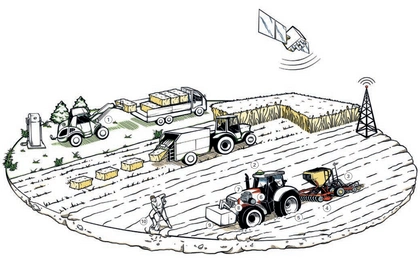
The use of digital technology can utilize or increase further savings potential.
The first step is to equip the tractor with a satellite-based guidance system.
This avoids overlaps of between 2 % and 7 % during tillage, depending on the field size, field shape and width of the implement. The faster turning times at the headland because of the bed cultivation made possible by the guidance system increase the overall cultivation speed of the field by up to5%. If the satellite technology is then also used for other applications – e.g. cultivation, fertilizer spreading or crop protection – the reduced use of operating resources can be seen not only as an ecological and economic measure, but also as an energy-efficient one.