



Contact/s:
Bieke Bockx
bieke.bockx@boerenbond.be
Jana Roels
Jana.Roels@boerenbond.be
Audrey Miserez
Audrey.Miserez@ilvo.vlaanderen.be
Soil Health as Capital: How Ongoing Experimentation Builds Sustainable and Productive Farming

Belgium
Temperate Maritime Climate
1. Improved soil health
2. Reduced chemical inputs
3. Visible improvements in crop resilience
Thematic Areas
Production System/s
Summary for Practicioners on the Main Finding(s)/Innovative solution(s)
By continuously experimenting and adapting, Stijn De Wulf, one of the Belgium Pilot Demo Farmers was able to manage sustainable farming with improved soil health and productivity.
Main Findings:
⦁ Transition to Sustainable Practices: Stijn De Wulf shifted from traditional plowing to non-inversion tillage, complex cover crops, and smart crop combinations. This transition was challenging but has shown positive effects in the field.
⦁ Reduction in Chemical Inputs: Stijn has significantly reduced the use of synthetic fertilizers and pesticides. He now grows his own animal feed autonomously and uses organic manure as a valuable resource.
⦁ Improved Soil Health: The changes in soil management have led to better soil structure and fertility, with visible improvements in crop yields and resilience.
Innovative Solutions:
⦁ Complex Cover Crops: These consist of at least 7-9 components, enhancing soil biology and plant resilience. They help break soil compaction, improve nutrient and water availability, and provide additional benefits like weed suppression and carbon storage.
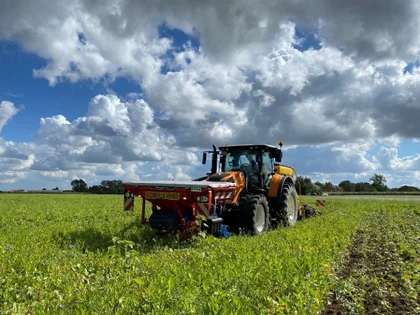
⦁ Direct Seeding Machine: Demonstrated by Bert Defruyt, this machine combines strip-till and direct seeding techniques, reducing soil disturbance and preserving soil moisture. It works on various soil types and allows for immediate seeding after crops like wheat, beets, and maize.
⦁ Carbon Farming: This involves adopting climate-friendly practices that enhance carbon sequestration in soils and reduce greenhouse gas emissions.
Farmers can receive compensation through eco-schemes and private markets for implementing these practices.
Conclusion: Stijn De Wulf’s approach highlights the importance of tailored soil management practices. By continuously experimenting and adapting, he has achieved sustainable farming with improved soil health and productivity.
Summary for Practicioners in Native Language
Belangrijkste Bevindingen:
⦁ Overgang naar duurzame praktijken: Stijn De Wulf schakelde over van traditioneel ploegen naar niet-kerende bodembewerking, complexe groenbemesters en slimme teeltcombinaties. Deze overgang was uitdagend, maar heeft positieve effecten in het veld laten zien.
⦁ Vermindering van chemische inputs: Stijn heeft het gebruik van kunstmest en pesticiden aanzienlijk verminderd. Hij teelt nu volledig autonoom zijn eigen veevoeder en ziet organische mest als een waardevolle bron.
⦁ Verbeterde bodemgezondheid: De veranderingen in bodembeheer hebben geleid tot een betere bodemstructuur en vruchtbaarheid, met zichtbare verbeteringen in gewasopbrengsten en veerkracht.
Aanpak:
⦁ Complexe groenbemesters: Deze bestaan uit minstens 7-9 componenten, die de bodembiologie en plantweerbaarheid verbeteren. Ze helpen bodemverdichting te doorbreken, verbeteren de beschikbaarheid van nutriënten en water, en bieden extra voordelen zoals onkruidonderdrukking en koolstofopslag.
⦁ Directzaaimachine: Deze machine combineert strip-till en directzaai, waardoor de bodemverstoring wordt verminderd en de bodemvochtigheid behouden blijft. Het werkt op verschillende grondsoorten en maakt directe inzaai na gewassen zoals tarwe, bieten en maïs mogelijk.
⦁ Carbon Farming: Dit omvat klimaatvriendelijke praktijken die de koolstofvastlegging in bodems verbeteren en de uitstoot van broeikasgassen verminderen. Boeren kunnen compensatie ontvangen via ecoregelingen en de private markt voor het implementeren van deze praktijken.
Conclusie: De aanpak van Stijn De Wulf benadrukt het belang van op maat gemaakte bodembeheerpraktijken. Door continu te experimenteren en aan te passen, heeft hij duurzame landbouw bereikt met verbeterde bodemgezondheid en productiviteit.
Additional Information
Stijn De Wulf welcomed the participants to his mixed farm in Ledegem, where he has 75 dairy cows and cultivates 100 hectares of arable land. About five years ago, he changed his approach to soil management. He stopped plowing and started using non-inversion tillage, cover crops, and smart crop combinations (such as herb-rich grassland). This transition was not without challenges, but the positive effects are now beginning to show in the field.
For Stijn, this is an extra incentive to continue experimenting with new measures and to make small adjustments every year.
Stijn now grows his own animal feed completely autonomously, uses fewer phytosanitary products, and sees organic manure as an asset. He has to make do with what he has. For example, 11 years ago, he built a new dairy barn with a manure cellar. He thus has slurry but would actually like to use more farmyard manure. He cannot change that situation now, but he can change how he handles his slurry. In short, every farm and every situation are different and requires an individual approach to focus on the soil.
The demonstration at Stijn’s farm was successful. Techniques were shown, experts were present, and the positive impact of several measures on soil health was visible
More specifically, Diederik Van Colen from Natural Grown emphasized the importance of good cooperation between soil biology and plants for good production and plant resistance to diseases and pests. The more complex the activity above ground, the greater the richness below ground. Complex cover crops consist of at least 7 to 9 components and stimulate soil biology through this diversity. The different components have different and often stronger and deeper rooting, which can also break through soil compaction, increasing nutrient and water availability. Additionally, they offer other benefits such as improved drainage capacity, weed suppression, and organic carbon storage. Stijn uses several complex mixtures that we could observe on-site. Legumes are an important part of the mixtures because they ‘capture free nitrogen from the air,’ reducing the need for fertilization.
Bert Defruyt (Loonwerken Defruyt) demonstrated the Claydon direct seeding machine, which offers a simplified seeding technique combining strip-till with direct seeding. One advantage is that limited soil tillage reduces soil drying. Other benefits include not disturbing soil life and ensuring a firm subsoil for better field accessibility in spring. It is possible to sow directly after wheat, beets, maize, and even in grass. The machine works on all soil types.
Throughout the demonstrations and presentations, it became clear that taking care of your soil leads to a more resilient and fertile soil in the long term. This sometimes requires learning and effort, without a doubt.
Therefore, it can help to look for ways to mitigate potential risks, such as subsidies and compensations through a private market. This is where carbon farming comes into play. A complicated term often mentioned now, but it simply means that as a farmer, you are compensated for climatefriendly practices that improve carbon sequestration and storage in soil and reduce greenhouse gas emissions from the soil. Today, several eco-schemes are available to provide support, including the farm-based eco-scheme ‘Increasing organic carbon content.’ Additionally, you can turn to the private market, such as the local compensation platform Claire, and the collaboration between Soil Capital and Arvesta. These initiatives sell your carbon storage within or outside the agri-food chain in the form of CO2 compensation to companies that cannot fully offset their own emissions.