



Contact/s:
Marion Hassenforder
marion.hassenforder@bretagne.chambagri.fr
Morgane Adamolle
Improving Soil Organic Content on Vegetable Farms in Brittany: Material, Technical and Cultural levers

France
Atlantic Zone
- Increased water retention
- Carbon storage
- Improved soil structure and fertility
Thematic Areas
Production System/s
Summary for Practicioners on the Main Finding(s)/Innovative solution(s)
An organic open-field vegetable farm in Nord Finistère (France, Brittany region) is addressing the challenges of climate change by implementing innovative solutions to improve soil health and enhance resilience.
1. Setting up a composting platform (under consideration)
In response to the increasing scarcity of manure, the farm aims to compost its own organic waste (particularly 55 tonnes of leek waste) instead of sending it to a nearby biogas plant. This solution would:
⦁ Increase self-sufficiency in organic matter, which is essential for soil fertility and water retention.
⦁ Reduce tractor trips, thereby lowering the environmental impact.
⦁ Produce a carbon-rich soil improver that enhances soil structure and biological activity.
2. Optimizing plant cover
The farmer systematically plants cover crops after harvests to enrich the soil. He is participating in an economic and environmental interest group to refine species selection and mixtures suited to vegetable rotations. An innovative seeding system has been developed to:
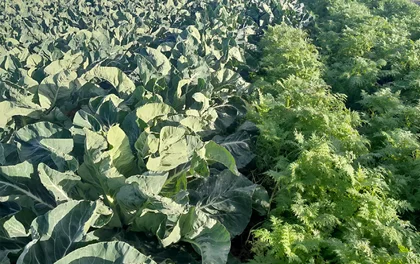
⦁ Sow cover crops in the uncultivated alleys of cauliflower fields, increasing carbon storage and soil structure.
⦁ Maximize biomass production to improve water retention and fertility.
To reduce soil compaction, the farmer has equipped a tractor with a remote tyre inflation system. Air pressure is reduced when working in the fields (harvesting winter vegetables, tilling the soil, and sowing cover crops). Mini-profiles have been created to observe the effect of this equipment during leek harvests in the winter of 2023–2024.
These practices enhance the farm’s resilience by limiting erosion, increasing carbon storage, and improving the soil’s ability to withstand drought and excess water.
Summary for Practicioners in Native Language
Une exploitation bio de légumes plein champ en Nord Finistère fait face aux défis du changement climatique en mettant en place des solutions innovantes pour améliorer la santé de ses sols et renforcer leur résilience.
1. Mise en place d’une plateforme de compostage (en réflexion)
Face à la raréfaction du fumier, l’exploitation souhaiterait composter ses propres déchets organiques (notamment 55 tonnes de déchets de poireaux) au lieu de les envoyer à un méthaniseur voisin. Cette solution permettrait :
⦁ D’être plus autonome en matière organique, essentielle pour la fertilité et la rétention en eau des sols.
⦁ De limiter les trajets et donc l’impact environnemental.
⦁ De produire un amendement riche en carbone, améliorant la structure et la vie biologique du sol.
2. Optimisation des couverts végétaux
L’exploitant utilise systématiquement des couverts végétaux après les cultures pour enrichir ses sols. Il participe à un GIEE (Groupe d’Intêret Economique et Environnemental) pour affiner ses choix d’espèces et de mélanges adaptés aux rotations légumières. Un semis innovant a été développé :
⦁ Semer des couverts dans les allées non cultivées des champs de chou-fleur, afin de stocker davantage de carbone et d’améliorer la structure du sol.
⦁ Maximiser la biomasse produite pour une meilleure rétention en eau et une fertilité accrue.
Afin de réduire le tassement des sols, l’exploitant a également équipé un tracteur d’un système de télégonflage des pneumatiques. La pression d’air est réduite lors des travaux des champs (récoltes de légumes d’hiver, travail du sol, semis de couverts). La réalisation de mini-profils a permis d’observer l’effet de ce matériel lors des récoltes de poireaux pendant l’hiver 2023-2024.
Ces pratiques renforcent la résilience de l’exploitation en limitant l’érosion, en augmentant le stockage du carbone et en améliorant la capacité des sols à faire face aux sécheresses et aux excès d’eau.
Additional Information
Improving soil health to cope with climate change: innovative solutions from an organic field- grown vegetable farm
Here we present the farm of Lionel, one of the ‘Pilot Demo Farmers’ involved in Climate Farm Demo. This organic open-field vegetable farm in Nord Finistère (in the Brittany region of France) is facing increasing challenges linked to climate change. Alternating droughts and excess rainfall, rising temperatures and changes to biological cycles are affecting soil fertility and crop productivity. To strengthen the resilience of its soils, the farmer is implementing two levers: a composting platform project and the optimisation of plant cover.
1. Composting platform project: Towards self-sufficiency in organic matter
The scarcity of manure, which has been replaced by slurry systems that are lower in carbon, presents a challenge for the farm. In addition, the farm produces 55 tons of organic waste from leek crops every year, which until now has been sent to the biogas plant with no return in terms of organic matter.
To remedy this, the farm is working on a composting platform to recycle this waste and produce a carbon-rich soil improver. This compost will improve soil fertility, optimise water retention and reduce dependence on external inputs.
Implementation and perspectives
The project includes:
• A dedicated area with humidity and temperature monitoring, • The incorporation of green waste to balance the compost, • Tests to assess its impact on soil structure and fertility.
2. Optimising plant cover: a lever for soil fertility
Benefits of plant cover crops
The farm systematically uses plant cover crops to:
• Limit erosion and improve soil structure,
• Optimise water retention and fertility,
• Reduce weeds and pests using adapted species.
Innovations introduced
An innovative technique has been introduced: sowing plant cover in the uncultivated alleys of cauliflower fields, reducing erosion and restoring nitrogen to subsequent crops.
The farm is part of a GIEE (Groupement d’Intérêt Économique et Environnemental – economic and environmental interest group), which enables it to experiment with new cover crop combinations and refine their integration into its rotations.
Diversifying species and reducing soil compaction
The farm tests different plant mixes depending on the season and rotation: • Legumes (clover, broad bean, vetch) for nitrogen fixation, • Grasses (rye, oats) for soil structure,
• Crucifers (daikon, mustard) for nutrient uptake.
To reduce soil compaction, the farmer has also fitted a tractor with a remote tyre inflation system. Air pressure is reduced when working in the fields (harvesting winter vegetables, cultivating the soil, sowing cover crops). Mini profiles have been produced to observe the effect of this equipment during leek harvests in the winter of 2023-2024.
Something to remember! By developing a composting platform and optimising plant cover crops, the farm is putting in place solutions adapted to climate change. These initiatives improve soil health, boost soil resilience and contribute to more sustainable agriculture, reconciling economic performance with environmental care.